A Modern Tractor Runs More Code Than Most People Realize
Park yourself next to a brand-new tractor at a dealership, and what catches your eye is steel, big tires, maybe that cushy-looking seat in the cab. What you’re not seeing is everything packed underneath dozens of processors, millions of lines of code, and a networking setup that wouldn’t be out of place in a small […]
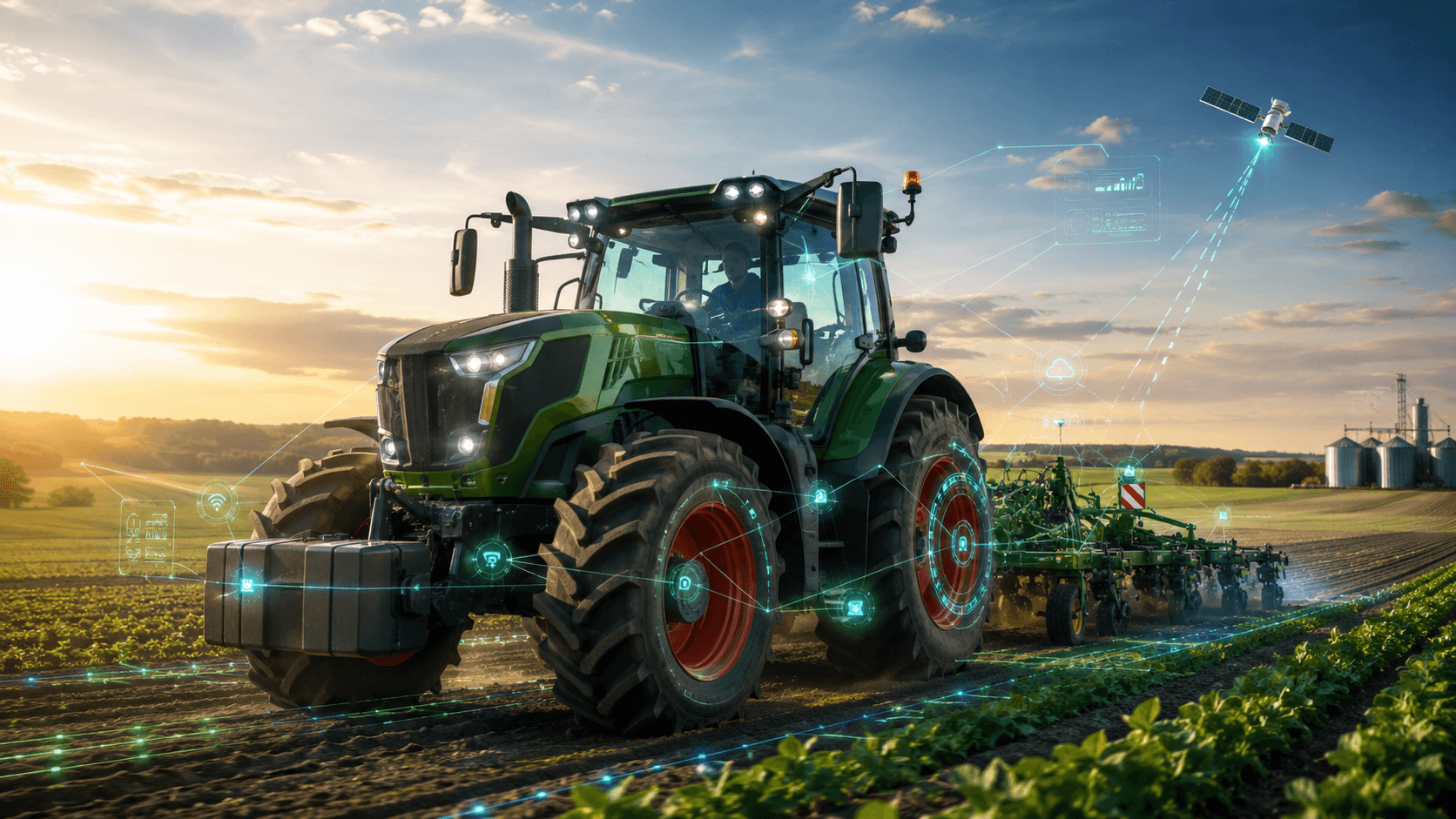
Park yourself next to a brand-new tractor at a dealership, and what catches your eye is steel, big tires, maybe that cushy-looking seat in the cab. What you’re not seeing is everything packed underneath dozens of processors, millions of lines of code, and a networking setup that wouldn’t be out of place in a small office building’s server closet. Agricultural machinery has, somewhat quietly, turned into one of the most computationally loaded products you can buy. Most people, including plenty of farmers who drive these things every day, have no clue how much software is actually doing the work. Most people don’t realize that a modern tractor machine runs more code than you can imagine. Explore the techs here.
Dozens of ECUs, All Talking at Once
There’s no single brain running a modern tractor. Instead, there are dozens of small embedded computers, called ECUs (Electronic Control Units), each one assigned to a narrow job: engine, transmission, hydraulics, steering, climate control, lighting, fuel injection, exhaust treatment, implement management, and so on.
Every ECU runs its own firmware and crunches sensor data in real time, but they can’t just do their own thing in isolation; they’re constantly checking in with each other. The engine controller needs visibility into what the transmission is doing. The hydraulics module has to sync up with whatever implement is hooked up back. What you end up with is a distributed system where:
- Each ECU specializes in one tight job with real-time constraints, leaving little margin for error.
- A gateway or central ECU usually steps in to arbitrate traffic and decide what gets priority.
- One firmware update can ripple outward, changing the calibration or behavior of several other modules.
- Diagnostics run continuously in the background, monitoring fault codes and performance drift across the entire fleet of ECUs.
That’s basically why a tractor dealership’s service bay now resembles an IT department as much as a mechanic’s shop. Technicians show up with laptops, run diagnostic software, and push firmware updates. Adjusting a carburetor is ancient history at this point.
Why this software architecture is currently a $99 million legal story
The proprietary, tightly controlled nature of this software isn’t just a technical detail, it’s the center of one of the more significant antitrust stories in American agriculture right now. John Deere, the dominant player in large agricultural equipment, has spent years restricting farmers’ and independent repair shops’ access to the diagnostic software needed to fix equipment they legally own, forcing reliance on Deere’s authorized dealer network for repairs that could otherwise be done locally, faster, and cheaper.
That restriction is now the subject of a $99 million class action settlement, which received preliminary court approval in May 2026 and requires Deere to make diagnostic and repair tools available to equipment owners and independent repair providers for at least ten years. According to reporting from The Register, a separate lawsuit from the Federal Trade Commission and the attorneys general of Illinois and Minnesota, alleging the same conduct violates federal antitrust law, remains active and is currently in discovery, independent of the settlement. A related complaint covering Deere’s construction and forestry equipment, filed by a landscaping contractor in May 2026, suggests this dynamic extends well beyond farm tractors specifically.
This context matters for understanding the ECU architecture described above. Every one of those specialized control units generates diagnostic data. Whoever controls the software to read and act on that data controls who can perform a repair, which is exactly why “the dealership’s service bay now resembles an IT department.” The legal fight isn’t really about software at all, it’s about who gets to use it once the hardware is sold.
CAN Bus: Think of It as the Nervous System – Modern Tractor Code
None of those ECUs would matter much if they couldn’t communicate, and that’s where the CAN bus (Controller Area Network) comes in. Originally built for the auto industry, it’s now the standard backbone for ag equipment too, letting multiple ECUs share a single set of wires while still firing off thousands of messages per second, with no collisions or dropped data.
It’s not a bad comparison to call CAN bus the tractor’s nervous system. Sensor readings, commands, status pings, and fault codes all travel over this shared network. And it has to hold up in conditions that would wreck a typical office network setup: constant vibration, dust everywhere, wild temperature swings, and electrical interference. CAN bus was built with exactly that kind of abuse in mind.
ISOBUS: One Language for a Mixed Fleet of Implements
Tractors rarely work solo. They’re out there pulling planters, sprayers, balers, and tillage equipment, often from manufacturers totally different from the tractor’s. ISOBUS (ISO 11783) is the standard that lets a tractor from Brand A talk to an implement from Brand B without anyone needing a translator.
ISOBUS basically takes the CAN bus concept and extends it beyond the tractor’s own boundaries, creating something close to a plug-and-play ecosystem. A sprayer, for instance, can automatically tweak its application rate based on the tractor’s speed and GPS position. The cab display can pull up implement-specific controls without any proprietary software involved. Section control and variable-rate application get coordinated across the entire equipment train, not just the tractor itself. Universal terminals (UTs) mean one screen in the cab can run multiple ISOBUS-compatible devices, no more stacking three different monitors on the dashboard.
Before ISOBUS came along, every implement maker had its own proprietary control box, which usually meant a separate screen for each one. Now most of that mess has been folded into shared digital standards, yet another example of software quietly swallowing problems that used to be purely mechanical or electrical.
The major manufacturers building this technology
The systems described throughout this article aren’t uniform across the industry, and naming who builds what gives a clearer picture of the competitive landscape.
John Deere remains the largest player in large tractors and combines in North America, and its Operations Center platform is the most widely deployed telematics and remote diagnostics system in the space. Case IH and New Holland, both under CNH Industrial, run comparable ECU and telematics architectures under their AFS (Advanced Farming Systems) and PLM (Precision Land Management) brands respectively. AGCO, which owns Fendt, Massey Ferguson, and Valtra, has built out its own precision agriculture stack under the AGCO Precision Ag umbrella, with Fendt in particular known for advanced continuously variable transmission control software. Kubota, historically stronger in compact and mid-size equipment, has been expanding its own connected and autonomous offerings as demand grows in that segment.
Trimble deserves a separate mention, since it isn’t a tractor manufacturer at all but supplies much of the GNSS correction and guidance hardware that multiple tractor brands integrate into their own autopilot systems, making it one of the more important, less visible names behind the “centimeter-level precision” this article describes.
Modern Tractor Code GNSS & Autopilot: Accuracy You Can Measure in Inches
The flashiest piece of all this tech, and probably the one people actually notice, is satellite-based guidance. GNSS (Global Navigation Satellite System) receivers. Often boosted with correction signals for centimeter-level precision. Let a tractor know its exact position in a field at any given moment.
That positioning feed goes straight into the autopilot system, which steers the tractor along a pre-mapped path with minimal operator input. The payoffs add up fast across a whole operation. Less overlap means less wasted fuel and fewer wasted inputs. Straighter rows make harvest go smoother. Consistent pass-to-pass patterns reduce uneven soil compaction over time. And operators can grind through longer days with less fatigue, since the system handles the repetitive steering grind during those long field passes.
Under the hood, though, this requires serious, nonstop computation. So, fusing GPS data with inertial sensors, calculating steering corrections dozens of times a second, then sending those corrections to the steering ECU over the CAN bus. It’s a real-time control loop that just keeps running, pass after pass, for as long as the tractors are in the field.
What actually delivers that centimeter-level accuracy
The “correction signals” mentioned above have a specific name worth knowing: RTK, or Real-Time Kinematic correction. Standard GPS alone is accurate to roughly a few meters, nowhere near precise enough for the pass-to-pass consistency this article describes. RTK works by comparing the tractor’s satellite signal against a fixed reference station with a precisely known location, either a base station the farm owns or a subscription-based regional correction network, and using the difference between the two to correct the tractor’s position down to a couple of centimeters in real time.
This is also where the security question this article doesn’t otherwise raise becomes relevant. A distributed network of dozens of ECUs, a shared CAN bus, cloud-connected telematics, and a GNSS-driven autopilot loop is, in security terms, a fairly large and largely unregulated attack surface for a piece of equipment increasingly treated as agricultural infrastructure. Researchers and industry security groups have flagged concerns ranging from GPS spoofing, which could feed a tractor false position data and throw off an entire field’s guidance pattern, to the broader risk of an unpatched ECU or telematics gateway being used as an entry point into a farm’s wider network. None of this is unique to agriculture; it’s the same OT (operational technology) security conversation happening across manufacturing, utilities, and other industries that have quietly become distributed computing platforms without necessarily building the security posture to match.
Telematics: Your Tractor, Now Online
And then there’s the internet connection. Telematics systems pull data from all over the machine, fuel use, engine hours, location history, fault codes, efficiency numbers, and beam it up to cloud platforms.
This is what lets manufacturers and dealers keep tabs on fleet health from afar, sometimes catching a failure before it actually happens. Farm managers, meanwhile, can check on multiple machines scattered across multiple fields right from their phone. Software updates can get pushed over the air instead of requiring a trip to the dealership. And all that operational data can flow straight into farm management software for record-keeping, compliance, and whatever else is needed. Basically, every tractor is now a node in a larger network, pumping out data nonstop, just like any connected sensor or IoT device.
Why this level of technical detail matters if you’re marketing to this industry
If you’re building or marketing a product aimed at agricultural equipment manufacturers, dealers, or ag-tech buyers, the depth in this article isn’t just interesting, it’s a template for the kind of credibility that actually converts a technical buyer.
A farm operations manager or equipment dealer evaluating a new telematics platform, a diagnostic tool, or an ag-tech integration can tell within a paragraph whether the person writing about their industry actually understands it or is paraphrasing a press release. Getting the specific terminology right, ECUs, CAN bus, ISOBUS, RTK, matters because these are the exact terms a technical buyer uses to evaluate whether a vendor’s content, and by extension their product, is worth their time.
This is the same principle behind turning genuine subject-matter expertise into content that actually moves a B2B buyer through a decision, rather than content that just fills a keyword gap. The depth has to be real, not performed. For a closer look at how to structure that kind of expert-grounded content specifically for B2B audiences, this site’s guide to turning expert industry insights into high-converting B2B content covers the framework directly, and pairs naturally with the site’s broader coverage of what makes an industrial website effective for modern B2B buyers, since technical credibility on the page is only half the equation if the site architecture around it doesn’t support a technical buyer’s research process.
For companies specifically in the logistics and equipment-adjacent space, the same principle of matching content depth to a technical buyer’s actual vocabulary applies well beyond agriculture, as covered in this site’s look at freight reloading operations near major ports, another example of industrial B2B content written for people who actually work in the field it describes.
So… a Data Center on Wheels?
Add it all up: dozens of ECUs, a CAN bus acting as the nervous system in a modern tractor code, ISOBUS handling implement communication, GNSS feeding autopilot steering, and telematics keeping everything connected to the cloud, and the picture gets pretty clear. A modern tractor isn’t farm equipment with some electronics tacked on as an afterthought. It’s a distributed computing platform that happens to have wheels and a diesel engine, running more code than plenty of consumer software products, with real-time networking and sensor fusion built in straight from the factory.
For an industry people still tend to picture as diesel engines and steel implements, agriculture has become quietly, almost without anyone noticing, one of the more software-heavy sectors out there. And the tractors rolling across fields right now are living proof of just how far that shift has gone.
Modern tractor technology FAQ
John Deere has restricted farmers’ and independent repair shops’ access to the diagnostic software needed to repair equipment those farmers legally own, forcing reliance on Deere’s authorized dealer network. This is the subject of a $99 million class action settlement that received preliminary court approval in May 2026, and a separate, ongoing Federal Trade Commission and multi-state antitrust lawsuit alleging the same conduct violates federal law.
There’s no single fixed number since it varies by model and manufacturer, but a modern large tractor commonly runs dozens of separate ECUs (Electronic Control Units), each managing a specific system such as the engine, transmission, hydraulics, steering, and implement communication, all networked together over a shared CAN bus.
RTK, or Real-Time Kinematic correction, compares a tractor’s satellite position signal against a fixed reference station with a precisely known location, using the difference to correct the tractor’s position to within a couple of centimeters in real time. This is what enables the pass-to-pass accuracy behind automated steering systems, well beyond what standard GPS alone can achieve.
Increasingly, yes, though this has historically been restricted by manufacturers controlling access to diagnostic software. The 2026 John Deere settlement specifically requires the company to make repair and diagnostic tools available to equipment owners and independent repair providers for at least ten years, part of a broader right-to-repair movement that has also produced new state-level legislation in several US states.
The same distributed, networked architecture that makes modern tractors capable of precision farming, dozens of connected ECUs, cloud telematics, GNSS-driven autopilot, also creates a meaningful attack surface. Security researchers have raised concerns ranging from GPS spoofing affecting autopilot accuracy to broader network security risks from unpatched connected components, concerns similar to those raised in other industries where operational technology has become increasingly networked.
CAN bus is the underlying communication network within a single tractor, connecting its own internal ECUs. ISOBUS (ISO 11783) extends that same concept across the boundary between a tractor and its implements, allowing a tractor from one manufacturer to communicate with a planter or sprayer from a different manufacturer without proprietary translation hardware.
