How to Rank Your Appliance Repair Business in the Google Map Pack
Every appliance repair business owner has had that conversation at least once. Someone calls and says they found you through Google. You ask them to describe how, and they say something like: “You were one of the top three results with the map. You had the most reviews, so I called you.” That call, that […]
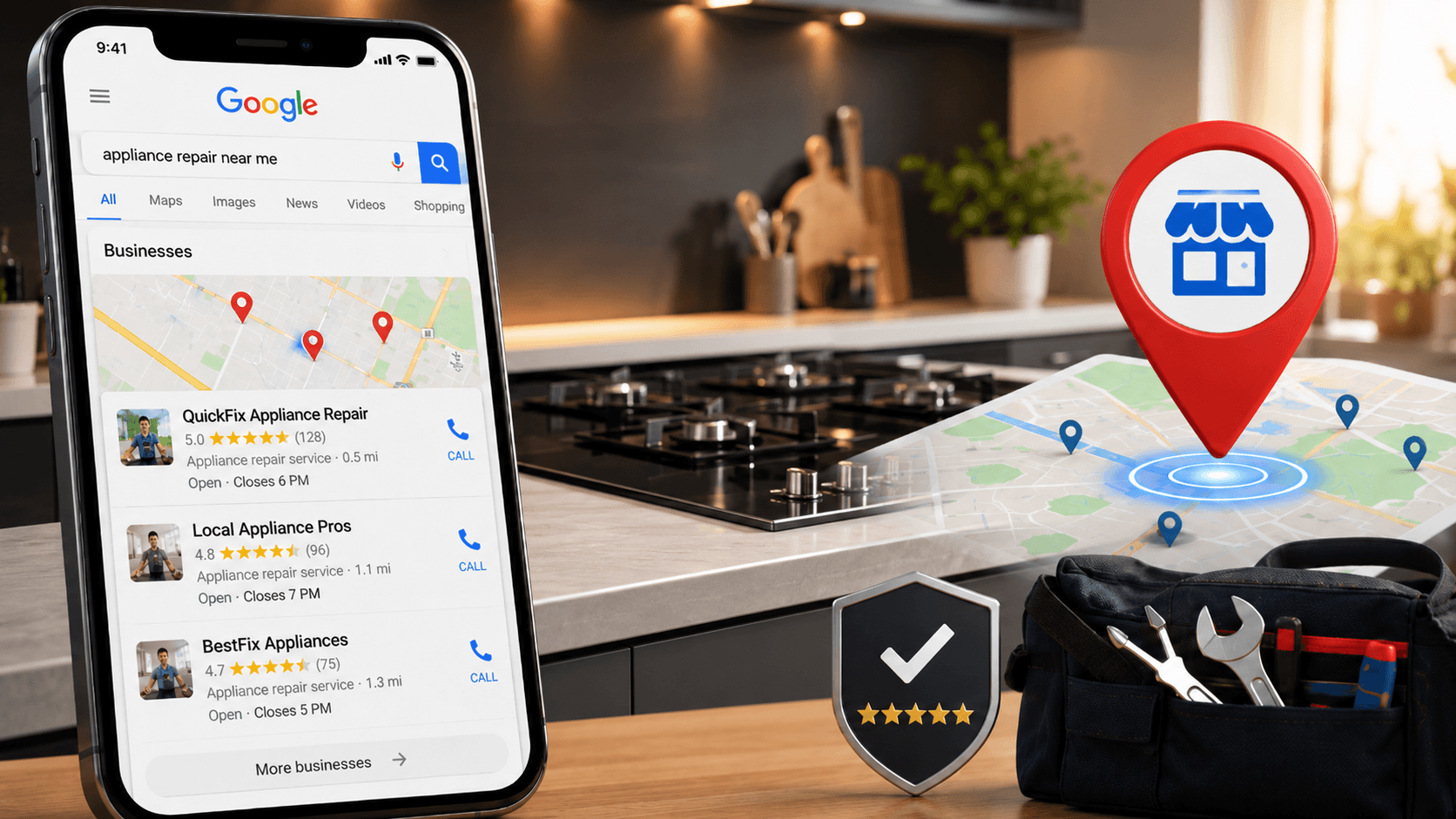
Every appliance repair business owner has had that conversation at least once. Someone calls and says they found you through Google. You ask them to describe how, and they say something like: “You were one of the top three results with the map. You had the most reviews, so I called you.” That call, that moment of a homeowner with a broken washing machine pulling out their phone and scrolling past your name, is exactly what the Google Map Pack delivers on a daily basis for the businesses that know how to earn their place in it. Learn how to rank your appliance repair business in the Google map pack with our expert tips.
The Map Pack, also called the local 3-pack, is the cluster of three business listings that appears at the top of Google’s results page whenever someone searches for a nearby service. On mobile, it often appears before any organic results at all, and for appliance repair, where the buyer’s intent is immediate and the purchase decision happens fast, those three positions generate a disproportionate share of all local search traffic. If your appliance repair business is not consistently visible there, you are effectively invisible to the people who need you most, right when they need you most.
The good news is that the factors Google uses to determine who appears in the Map Pack are knowable, actionable, and available to any business willing to put in systematic effort. This guide walks through every lever that matters, in order of impact.
What the Map Pack Actually Measures
Before getting into tactics, it helps to understand what Google is trying to accomplish with the Map Pack, because that context informs every decision you make. Google wants to show searchers the most relevant, geographically appropriate, and credible business for their specific search. It uses three primary signals to determine relevance: proximity to the searcher, relevance of the business to the search query, and prominence, which is essentially how well-known and trusted the business appears to be based on information available across the web.
Proximity is the one factor you cannot change directly. If someone is searching from a neighborhood three miles from your service area, you simply cannot be the geographically closest option to them. What you can influence is how Google understands your service area, which businesses you compete with, and how you measure up on the relevance and prominence dimensions. Those two pillars are where consistent, strategic effort pays off.
Understanding this three-factor framework matters because some business owners chase tactics that do not move any of these needles. Posting on Instagram every day does not directly affect Map Pack visibility. Having a beautiful website does not either, unless that website is built with the right local signals. The same proven strategies that help home service businesses like construction companies appear in local map results apply directly to appliance repair: a clean, complete Google Business Profile, genuine reviews, and consistent presence in the directories that reinforce your business’s legitimacy.
Step 1: Your Google Business Profile Is the Foundation to Rank Appliance Repair
The single highest-leverage action available to any appliance repair business is a fully optimized Google Business Profile. This is not a one-time setup task. It is an ongoing asset that requires regular attention and is directly reflected in your Map Pack visibility.
Start with the basics. Your business name should match exactly how it appears everywhere else online, including on your website, in invoices, and in directories. Your primary category must be specific: “Appliance Repair Service” beats “Home Services” by a substantial margin for appliance-related searches. Add every relevant secondary category you can claim: “Refrigerator Repair Service,” “Washer and Dryer Repair Service,” “Appliance Store” if applicable. Each secondary category expands the set of searches you can appear for.
Your service area settings directly tell Google which geographic regions you serve. Appliance repair businesses are typically service area businesses, meaning you travel to customers rather than having a storefront they visit. Set your service area to include every city, neighborhood, and ZIP code you realistically serve. Be honest here, over-claiming a service area that does not reflect your actual operations can suppress your rankings over time.
Your business description is 750 characters of SEO real estate that most businesses waste on generic language. Use it to name your specific appliance types, the brands you service, and the cities you cover, all naturally woven into sentences a real customer would appreciate. “We repair Whirlpool, LG, Samsung, and GE appliances throughout the Greater Dallas area, with same-day service available for refrigerators, dishwashers, and washing machines” does more work than “We are a trusted local appliance repair company.”
Photos matter more than most business owners realize. Google profiles with regular photo uploads, including before-and-after repair shots, your service van, and your technicians at work, show stronger signals of an active, legitimate business. Upload new images at least twice per month. Answer every question that appears in the Q&A section, because those responses influence how Google understands your services.
Step 2 to Rank Appliance Repair Business: Build a Review System, Not Just Reviews
Reviews are the highest-weighted prominence signal in local Map Pack ranking, and more importantly, they are the primary conversion factor once you appear. A business with 40 detailed, recent reviews will consistently outrank and outconvert a competitor with 7 reviews, even if the competitor’s technical profile is stronger.
The word “system” in this section heading is intentional. Businesses that accumulate reviews at a steady pace do so because they ask consistently, make it easy, and follow up. After every completed repair job, your technician or your scheduler should send the customer a direct link to your Google review page. A text message with a short sentence and the link outperforms an email that requires effort. Asking in the moment, while the customer is still delighted with their restored refrigerator or washing machine, captures reviews that might otherwise be forgotten.
The velocity of reviews matters as well as the volume. Twenty reviews received over three years is a very different signal than twenty reviews received over three months. Google interprets steady, recent review activity as evidence of an active, trusted business. Build this into your operations.
Responding to every review, positive and negative, signals to Google and to prospective customers that you are engaged and professional. For negative reviews specifically, a calm, solution-oriented response is often more convincing to a potential customer than the absence of any negative reviews at all. People understand that mistakes happen. How a business handles them tells the real story. Building expertise, authoritativeness, and trustworthiness signals that search engines use to evaluate local service providers is not purely a review exercise, but reviews are the most visible and impactful part of that trust equation.
The Google Map Pack Ranking Factors Compared
Understanding how each factor contributes to your Map Pack visibility helps you prioritize where to spend your effort each month. The table below maps the key ranking dimensions against their relative impact and how quickly improvements in each area typically show results.
| Ranking Factor | Impact Level | Time to See Results | Difficulty |
|---|---|---|---|
| Google Business Profile completeness | Very High | 2 to 4 weeks | Low |
| Review quantity and recency | Very High | Ongoing | Medium |
| Review quality and keyword relevance | High | 4 to 8 weeks | Low |
| Service area and proximity | High | Immediate upon setup | Low |
| Website authority and local signals | High | 2 to 6 months | Medium |
| NAP consistency across directories | High | 1 to 3 months | Low |
| Local backlinks | Medium-High | 3 to 6 months | High |
| Engagement signals (clicks, calls, directions) | Medium | Weeks to months | Medium |
| Photo activity and post frequency | Medium | Weeks | Low |
| Service-specific landing pages | Medium | 2 to 5 months | Medium |
This table reflects the general consensus from local SEO practitioners, though Google’s algorithm continues to evolve and individual market competition affects how each factor plays out in a specific geography.
Step 3: Your Appliance Repair Business Website Needs Local SEO Signals, Not Just a Nice Design to Rank
Many appliance repair businesses have websites that look professional but do nothing to support local search visibility. A website supports your Map Pack ranking by confirming Google’s understanding of who you are, where you operate, and what services you provide. That confirmation happens through specific technical and content signals.
Your name, address, and phone number must appear consistently on your website, in the exact same format you use on your Google Business Profile and every directory listing. Place this information in the footer on every page, not just the contact page. Embed a Google Map on your contact page. These details seem trivial but they provide the consistency signals that local ranking algorithms actively look for.
Schema markup is the structured data layer that helps search engines read your business details with precision. For a local service business, you should implement LocalBusiness schema on your homepage and service pages, specifying your business name, address, phone number, service area, and operating hours in a format that both search engines and AI systems can extract reliably. Many themes and plugins handle this automatically, but verifying that it is implemented correctly with Google’s Rich Results Test is worth doing. Understanding how mobile web design and local SEO work together for service businesses making this a technical and design consideration simultaneously is a principle that applies directly to appliance repair sites, where most searches happen on mobile and the website experience directly affects how long visitors stay and whether they call.
Page speed is a ranking factor, and the appliance repair customer searching on their phone in a moment of frustration will leave a slow site within seconds. Test your site with Google PageSpeed Insights and address any issues flagged in the mobile performance category first.
Step 4: NAP Consistency Across the Web
Every time your business’s name, address, and phone number appear correctly and consistently across the web, it is called a citation. Citations are one of the prominence signals Google uses to verify that your business is real, established, and legitimate. They are also a common source of ranking problems when they are inconsistent.
Here are the most impactful citation sources for an appliance repair business in the United States, in order of priority:
- Google Business Profile. Your primary source. Everything else should match this exactly.
- Yelp. High-authority, frequently indexed, and a significant local trust signal.
- Bing Places for Business. Smaller share than Google but meaningful for total citation footprint.
- Apple Maps. Increasingly important as voice search and Apple device usage grows.
- Better Business Bureau. Trust signal that influences both rankings and customer conversion.
- Angi, Thumbtack, HomeAdvisor. Service-specific directories that directly attract high-intent appliance repair searches.
- Facebook Business Page. Social signals from an active, populated page contribute to prominence.
- Local Chamber of Commerce. One of the most valuable local backlink and citation sources available.
Run an audit through a tool like Whitespark, BrightLocal, or Moz Local to identify every directory where your business is listed and flag any inconsistencies. An old phone number from before a number change, or an address in one format on some directories and a different format on others, creates conflicting signals that suppress your overall ranking.
Step 5: Build Hyperlocal Content That Closes the Distance Gap
Google’s Map Pack algorithm gives heavy weight to proximity, but relevance and prominence can compensate for being slightly further away from a searcher. One of the most effective ways to build both is through hyperlocal content: individual service pages or city-specific pages that mention specific appliance brands, specific neighborhoods, and specific services together.
If your business serves 12 cities within a metropolitan area, each city deserves its own dedicated page that speaks specifically to appliance repair needs in that location. Not thin, cookie-cutter pages that simply swap city names, but genuinely useful pages that might reference the common appliance brands in that area’s housing stock, typical appliance age given the neighborhood’s build era, and a clear call to action for that specific service zone.
This same logic applies at the brand and appliance level, not just the city level. A dedicated page for Wolf Cooktop Repair in Jacksonville, for instance, targets a very specific search intent: someone with a Wolf cooktop who wants a local specialist, not a generalist. That searcher has already narrowed their decision considerably, and a page built around that exact combination of brand, appliance type, and city signals deep relevance to Google for that precise query. Premium appliance brands like Wolf are also worth targeting specifically because their owners tend to prioritize expert repair over price, which means higher average job value from the same search traffic.
This approach mirrors what local SEO and reputation management are essential for in service businesses that rely on calls: you are building the web of evidence that confirms to Google you are the right, relevant result for searches happening in a specific place. Local digital marketing done well is about being genuinely present in the communities you serve, not just technically claiming to serve them.
Step 6: Earning Local Backlinks
Backlinks from locally relevant, authoritative websites are one of the hardest Map Pack signals to build and one of the most difficult for competitors to replicate. For an appliance repair business, the most realistic and effective sources include:
Partnerships with real estate agents and property management companies who refer clients to you and link to your site. Local news coverage of anything noteworthy your business does, whether that is a community initiative, a charitable partnership, or simply a business feature in a local newspaper. Sponsoring local events, sports teams, or community organizations, which often come with a website mention. Writing a genuinely useful article for a local home improvement blog or neighborhood website. These links do not need to be numerous. Five strong, genuinely local links are worth more for Map Pack ranking than fifty low-quality directory submissions.
Tracking Progress and Knowing What Is Working
Ranking in the Map Pack is not a one-time achievement. It fluctuates based on competitor activity, Google algorithm updates, your review velocity, and the location of the person searching. Tracking the right metrics tells you whether your effort is working and where to focus next.
Check your Map Pack position for your primary service terms in your primary cities at least monthly. Tools like BrightLocal’s Local Rank Tracker, Whitespark, and the rank-tracking features in Ahrefs and SEMrush all support local position tracking with geographic targeting. Monitor your Google Business Profile’s Insights section for call volume, direction requests, and profile views, because these engagement signals both reflect your visibility and contribute to it. Using tools like Ahrefs, SEMrush, and Google Analytics to track your local ranking progress creates a clear feedback loop between your effort and its results, which is the foundation of any sustainable local SEO strategy.
Frequently Asked Questions
For a business with little existing online presence, expect three to six months of consistent effort before you see sustained Map Pack visibility for competitive terms. Some signals, like Google Business Profile completeness and service area settings, can affect rankings within a few weeks. Others, like review velocity and local backlinks, build over months. Businesses in lower-competition markets often see results faster than those in large metropolitan areas with many established competitors.
Yes. Google specifically supports service-area businesses, including appliance repair companies that travel to customers. You can configure your service area by city, region, or ZIP code, or choose not to display a physical address. You can still appear in the Map Pack for searches across your service area, though Google’s proximity weighting means you will rank more easily for searches closest to your actual location.
There is no fixed number, because it depends entirely on your local competition. In smaller markets, twenty to thirty reviews may put you at the top. In major cities, leading businesses often have several hundred. The most important principle is that you should consistently have more recent, quality reviews than your direct competitors, not just a historically large total. A business with ten reviews from the past month will often outrank a business with a hundred reviews from two years ago.
Yes, but indirectly. Your website contributes to your prominence signals through the authority it has earned, the NAP consistency it demonstrates, the local signals in its content and schema markup, and the quality of the experience it provides to visitors who click through. A weak, slow, or thin website does not prevent you from ranking in the Map Pack entirely, but it reduces conversion from clicks and does suppress your overall prominence over time.
Setting up a Google Business Profile once and never returning to it. Businesses that treat their GBP as a static listing consistently underperform those that treat it as an active marketing channel. Regular photo uploads, prompt review responses, regular Google Posts about services or promotions, accurate holiday hours, and complete service listings all contribute to the engagement signals Google uses to determine which businesses deserve prominent placement.
Yes, meaningfully so. Traditional website SEO focuses on content quality, technical performance, and backlink acquisition, primarily influencing organic search results. Google Business Profile optimization focuses on your local entity’s signals: your profile’s completeness, your review ecosystem, your photo activity, and your consistency across the local citation landscape. The Map Pack primarily draws on GBP signals, while organic rankings draw on website signals. The most effective local strategy builds both in parallel.
