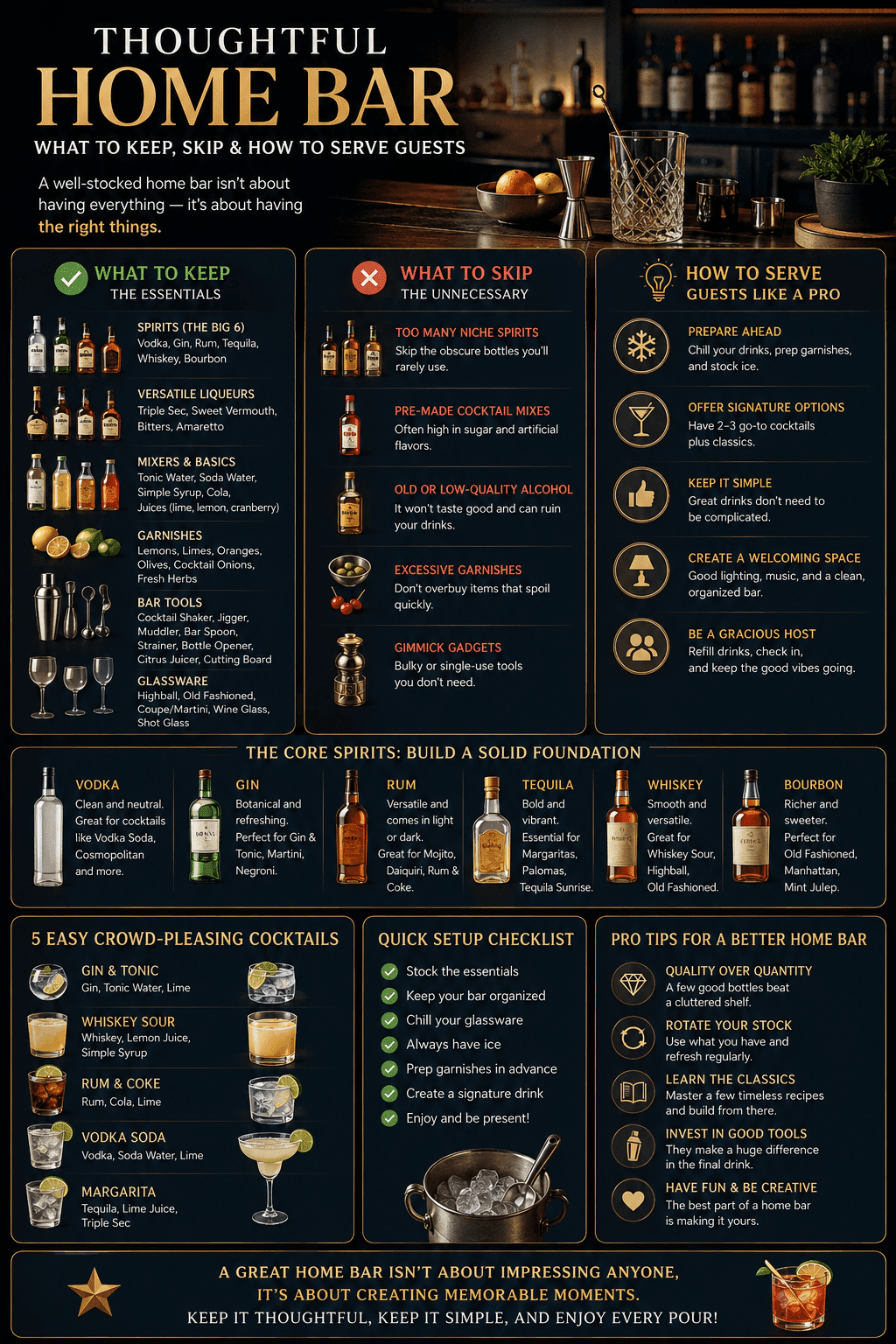
Thoughtful Home Bar: What to Keep, Skip & How to Serve Guests
Build a thoughtful home bar with smart bottle choices, better hosting habits and elegant ways to serve every guest.
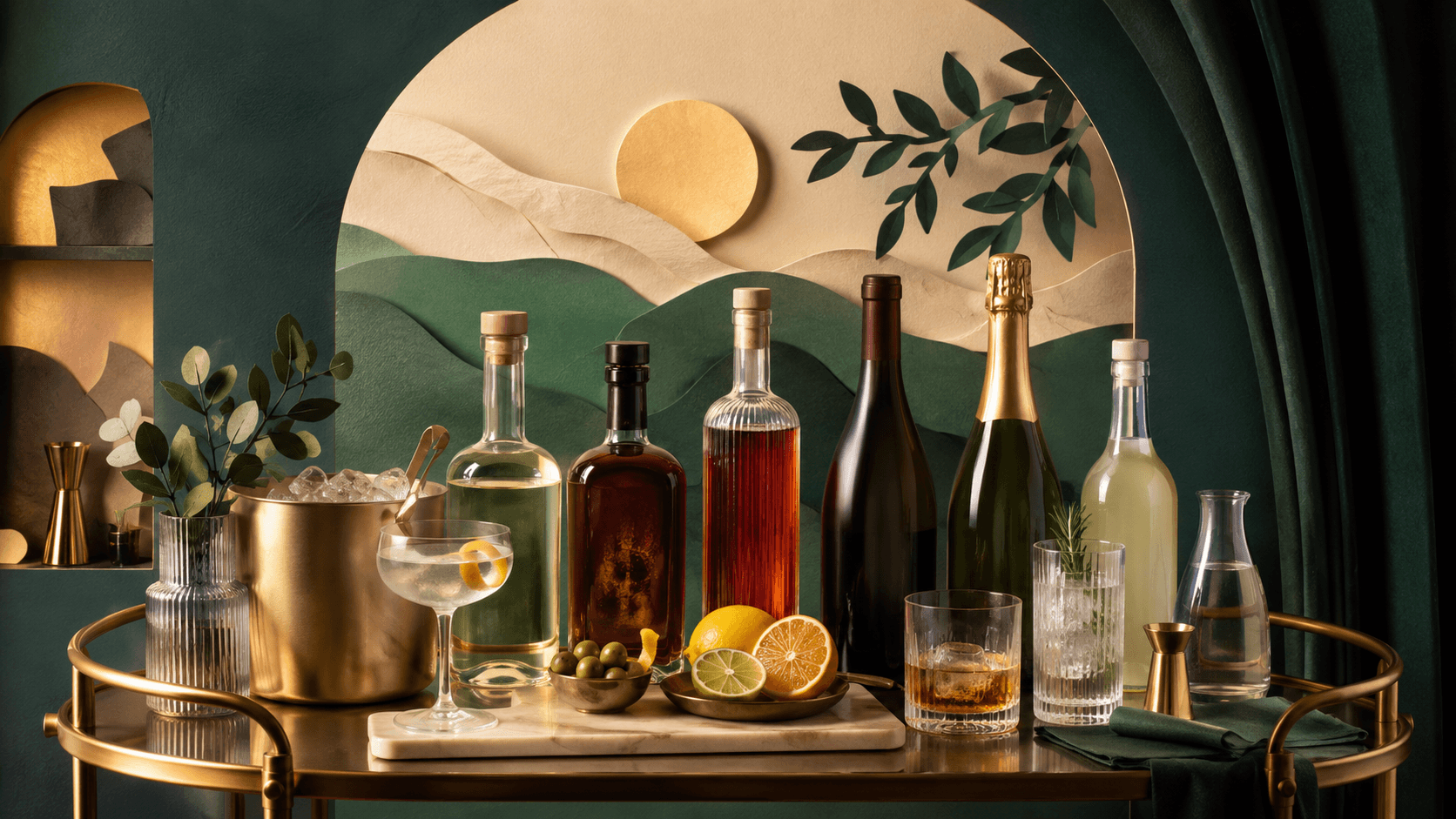
A thoughtful home bar is not a shelf full of random bottles. It is a small, useful system that helps you host different situations: a relaxed dinner, a cocktail night, a celebration, a gift moment or a non-alcoholic toast. This home bar guide covers the essentials worth keeping, what’s safe to skip, and how to serve it all with real portion sizes in mind. The goal is not to own everything, but to own the right things.
Short answer: What should a modern home bar include?
A balanced home bar should include at least one versatile cocktail spirit, one sipping spirit, one aperitif or liqueur, one wine direction, one sparkling option, and one alcohol-free alternative. This creates flexibility without clutter.
| Home bar role | Example category | Why it helps |
| Cocktail base | Gin, rum or vodka | Covers simple mixed drinks |
| Sipping moment | Whisky or aged rum | Works for slow, quiet enjoyment |
| Aperitif | Vermouth, bitter liqueur or sparkling wine | Starts dinner elegantly |
| Food pairing | Red, white or rosé wine | Supports meals |
| Celebration | Sparkling wine | Creates a festive ritual |
| Inclusive option | Alcohol-free distillate or sparkling alternative | Allows every guest to participate |
Why purpose beats quantity
The most common mistake is buying bottles without defining their job. A floral gin may be excellent in a tonic but less useful in a whisky-style sipping moment. A bold red wine can be perfect with food but too heavy for a casual aperitif. A home bar becomes better when every bottle earns its place.
- Choose by occasion before choosing by brand.
- Keep at least one easy crowd-pleaser for guests.
- Add one discovery bottle for personal interest.
- Include alcohol-free drinks as a planned category, not an afterthought.
- Stock tonic water and a ginger beer or ginger ale, the two mixers that do the most work: tonic makes a gin and tonic, ginger beer makes a Moscow Mule or Dark ‘N Stormy, and both keep the alcohol-free guest covered too, since either one is a complete drink on its own with a splash of citrus and bitters.
| Hosting goal | Useful drink direction | Practical serving idea |
| Small dinner | Wine, aperitif, digestif | Serve one welcome drink and one food-pairing bottle |
| Cocktail night | Gin, rum, liqueurs | Prepare two simple recipes instead of ten complex ones |
| Celebration | Sparkling wine | Chill early and serve in clean glasses |
| Gift-ready bar | Whisky, rum, elegant sparkling wine | Keep one bottle suitable for last-minute gifting |
| No-alcohol hosting | Alcohol-free sparkling or distillate | Serve with the same care as alcoholic drinks |
What a Starter Home Bar Actually Costs
The six-to-eight bottle starter range mentioned in the FAQ below has a real price attached to it, worth knowing before shopping.
A functional starter setup, one versatile spirit, one sipping spirit, one aperitif or liqueur, a couple of wine bottles, and one alcohol-free option, typically runs $150 to $300 total at mid-range retail pricing, before glassware or mixers. Adding proper tools (a jigger, shaker, strainer, and bar spoon) adds another $20 to $50 for a basic set, a modest one-time cost against how many gatherings a well-chosen shelf actually supports.
Shopping across categories in one place, rather than piecing a bar together from several stores, is worth considering at this stage. An online shop for spirits such as Red & Weiss covers multiple drink categories in one order, which can simplify the starter list above into a single purchase.
Frequently Asked Questions About Building a Home Bar
A starter home bar can work with six to eight well-chosen bottles. The key is that each bottle has a defined purpose.
Gin, rum and vodka are very versatile. Depending on the style, liqueurs, vermouth and bitters can expand the range.
Because modern hospitality is about choice. Alcohol-free options allow guests to enjoy a grown-up drink ritual without alcohol.
A functional starter setup typically runs $150 to $300 for bottles at mid-range pricing, plus another $20 to $50 for basic tools like a jigger, shaker, and strainer.
In the US, one standard drink contains 0.6 fluid ounces of pure alcohol, roughly 12 ounces of beer, 5 ounces of wine, or 1.5 ounces of spirits, according to the National Institute on Alcohol Abuse and Alcoholism. A generous home pour often runs bigger than that without looking any different.
A jigger, a shaker, a strainer, and a bar spoon cover almost everything a home bartender needs early on. A muddler and a citrus juicer are worth adding once cocktail night becomes a regular thing.
Opened wine generally holds its quality for three to five days refrigerated with the cork back in. Vermouth and other fortified wines last longer once opened but should still be refrigerated and used within a month or two, they’re wine-based and go flat over time, unlike spirits.
Not at first. A rocks glass, a wine glass, and a highball or collins glass cover most drinks in this guide. Specialized glassware is worth adding once you know which drinks you actually make often, not before.
How Much Is Actually in a Serving? A Real Pour Guide
The responsible-serving note below means more with actual numbers behind it.
According to the National Institute on Alcohol Abuse and Alcoholism (NIAAA), a single standard drink in the US contains 0.6 fluid ounces of pure alcohol, roughly 12 ounces of regular beer (5% ABV), 5 ounces of table wine (12% ABV), or 1.5 ounces of distilled spirits (40% ABV). A generous home pour routinely runs bigger than that: a casual glass of wine filled to the top of a large glass, or a heavy-handed spirit pour into a mixed drink, can easily add up to 1.5 to 2 standard drinks without looking any different from a normal serving.
This matters directly for hosting. A jigger (1.5 oz) keeps cocktails consistent and matches the standard spirits pour exactly, a simple, low-cost addition to any home bar and arguably more useful than another bottle. For wine, a standard 5-ounce pour looks smaller than most people expect in a large glass, worth knowing before guests start comparing who got poured more.
None of this is about limiting a good night. It’s about a host actually knowing what they’re serving, which is the difference between “always serve and consume responsibly” being a real practice and just being a line at the bottom of the page.
How Much to Buy for a Home Bar Party: A Quick Formula
None of the sections above answer the question most hosts actually type into Google: how much do I actually need to buy?
A workable rule of thumb: plan for one to two standard drinks per guest for the first hour, then about one drink per additional hour after that, so a typical three to four hour gathering lands most guests around three to four drinks total, adjusted down for a dinner-focused night and up for a longer cocktail-forward one. Using the standard drink sizes covered above, one 750ml bottle of spirits pours about 16 standard 1.5-ounce servings, and one 750ml bottle of wine pours about 5 standard 5-ounce glasses.
For a table of 8 guests with mixed preferences, a solid starting shelf looks like: one bottle of spirits (roughly 16 drinks, plenty even split across cocktails), two bottles of wine (10 glasses total), and enough alcohol-free option for about a third of the group, plus mixers with real headroom, running out of tonic water ends a cocktail faster than running out of gin does.
It’s worth over-buying slightly on what doesn’t spoil (spirits keep indefinitely once opened) and staying closer to exact on what does (opened wine and mixers), which turns leftover risk into a non-issue rather than a guess to get exactly right on the first try.
Your Home Bar Essentials, Summed Up
A strong home bar guide always comes back to the same idea: build on roles, not volume. When you plan for cocktails, dinner, celebration, sipping and alcohol-free moments, the selection becomes practical and elegant rather than random.
Knowing what to keep in a home bar, and just as importantly what to skip, is really a one-time decision that pays off at every gathering afterward. Six to eight well-chosen bottles, the right tools, and a clear sense of how you actually pour, covered above, do more for how you host than a crowded, unplanned shelf ever will.
Responsible note: Alcoholic drinks are for adults of legal drinking age only. Always serve and consume responsibly.
Infographic