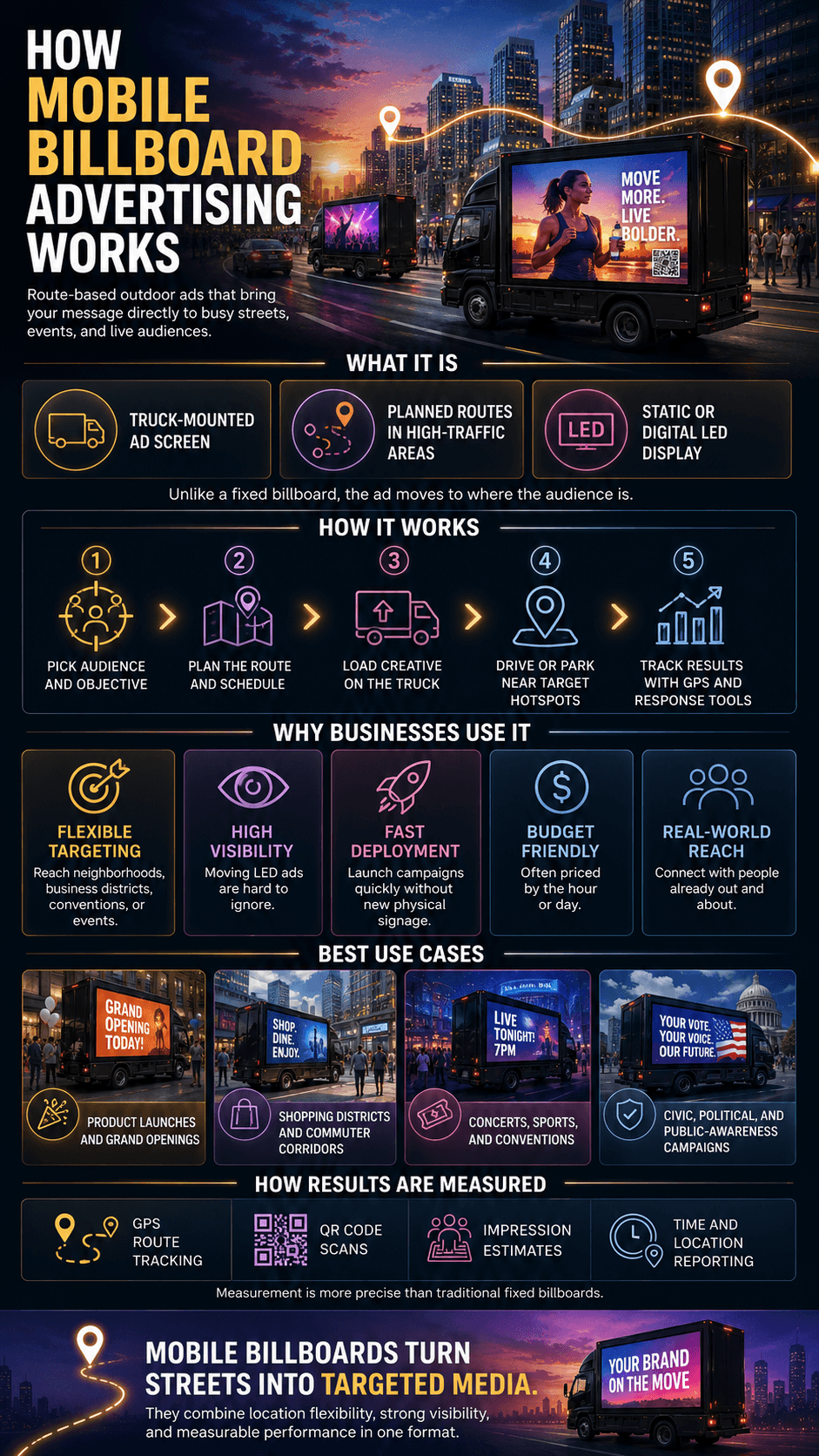
How Mobile Billboard Advertising Works?
See how mobile billboard trucks use planned routes, digital displays and GPS tracking to reach audiences across busy city locations.
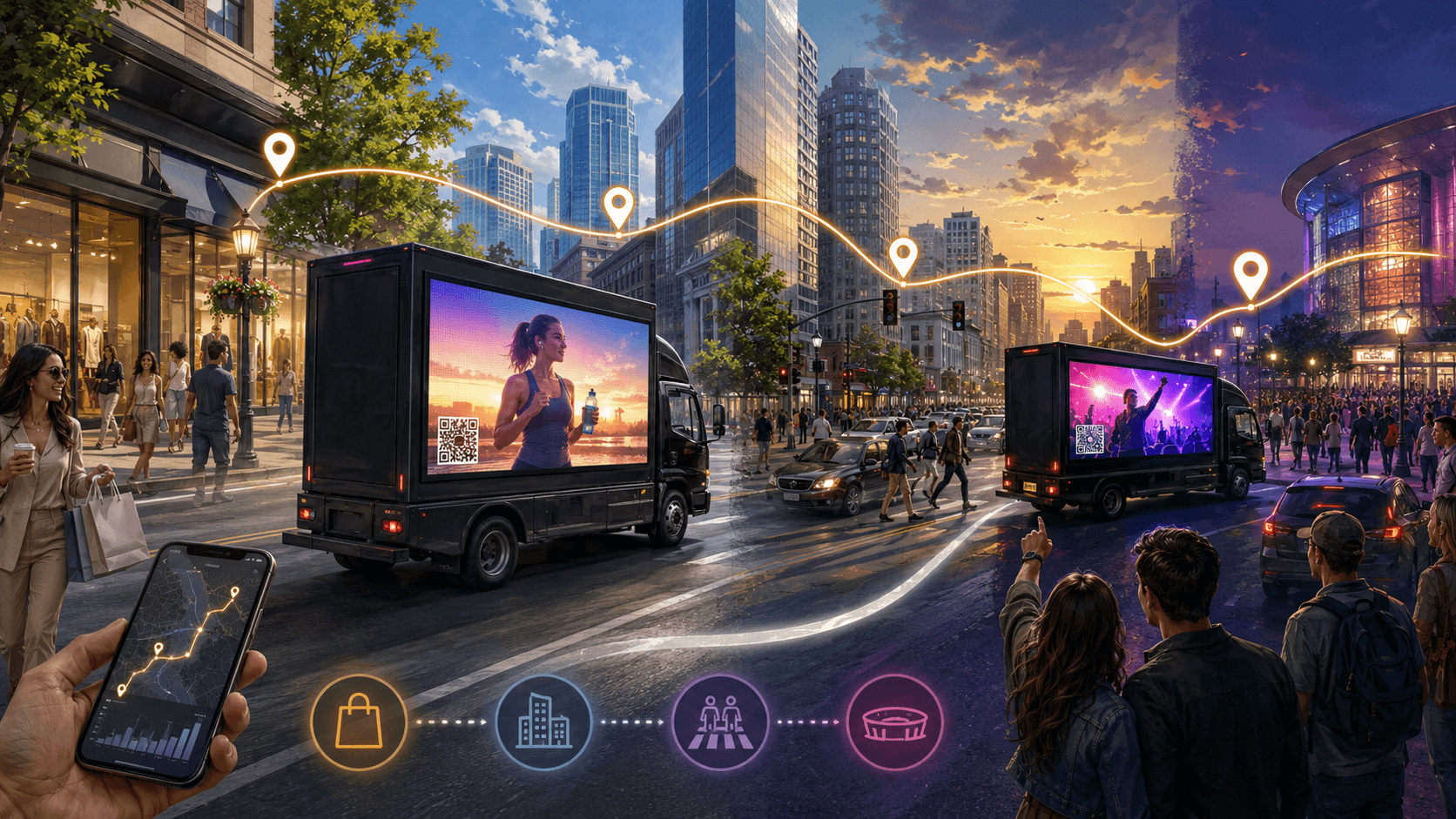
Mobile billboard advertising, a large screen mounted on a truck that follows a planned route through a city instead of sitting fixed in one place, has spread quickly across major US cities over the past several years. It gives businesses a way to reach an audience that’s already out on the street, in traffic, or at an event, rather than waiting for people to walk or drive past a fixed sign.
What Mobile Billboard Advertising Is?
At its core, the format is simple: a large screen, static or digital, is mounted on a truck, and the truck follows a planned route through areas with heavy foot or vehicle traffic. Unlike a billboard bolted to a single location, a mobile billboard can be moved to wherever the audience actually is on a given day, a shopping district in the morning, an event venue in the evening.
Flexible, Route-Based Targeting
That flexibility is one of the main reasons the format has spread so quickly. A campaign can be built around a neighborhood, a business district, a convention, or a one-off event, and the route can change from day to day without any extra cost for new physical signage. Digital LED trucks take this further, since the screen itself can rotate between several ads, run video, or switch content in real time.
Why It’s Hard to Ignore?
Visibility is another key advantage. A billboard that moves through traffic or holds position near a busy intersection tends to draw more attention than one people simply learn to stop noticing over time. Add audio, motion, or bright LED contrast, and the format becomes difficult to ignore even in a visually crowded city.
Civic and Public-Sector Use
Government and civic use of the format has also expanded in recent years. A mobile unit can be positioned near government buildings, rallies, or high-traffic commuter corridors on short notice, something a fixed billboard lease can’t easily match. This has made mobile billboards a recognizable part of both political campaign season and broader public-awareness efforts.
Cost Compared to Traditional Advertising
Cost is often the deciding factor for smaller businesses. Traditional outdoor advertising, especially a long-term billboard lease or a broadcast TV slot, usually requires a large upfront commitment. Mobile billboard campaigns are typically priced by the hour or by the day, which makes short, targeted bursts of advertising a product launch, a grand opening, or a single weekend event far more accessible.
Real 2026 rates: static vinyl trucks generally run $500 to $2,400 per day, while digital LED trucks run $1,200 to $3,600 per day, with most single-day bookings landing in the $800 to $2,000 range depending on market and screen type. Multi-week campaigns typically bring the per-day rate down 15 to 30 percent. For context against other formats, AdQuick’s 2026 out-of-home pricing data puts mobile billboard cost-per-thousand-impressions at roughly $1 to $5, well below the $20 to $40 CPM typical of local TV, one reason the format keeps gaining share among businesses running short-notice or short-run campaigns.
Deciding how much of a marketing budget belongs in a short burst like this versus longer-term channels is really a broader allocation question, the kind covered in How SMEs Build a Digital Marketing Strategy That Drives Revenue.
Measuring Results
Measurement has improved as well. Many operators now offer GPS tracking so advertisers can see exactly where their truck has been, along with QR codes or impression-counting technology that gives a rough sense of how many people actually saw the ad. That data-driven layer is a meaningful shift from traditional billboards, where impressions were largely estimated rather than measured.
The Outlook for Mobile Billboards
As more cities grow denser and screen technology keeps improving, mobile billboard advertising is likely to keep expanding beyond its current strongholds. For businesses weighing their outdoor advertising options, it offers something a fixed sign or an online ad can’t: a message that travels directly into the middle of a live, moving audience.
Permits and Regulations: What Actually Requires Approval
Cost and creative get most of the attention, but regulation is the part that can actually stop a campaign before it starts, and it varies more by city than most advertisers expect.
The legal foundation for how cities regulate this format goes back further than most people assume. In Railway Express Agency, Inc. v. New York, a 1949 Supreme Court case, the Court upheld a New York City ordinance allowing a vehicle to advertise its own owner’s business while prohibiting vehicles used mainly to sell advertising space to others. That distinction, a business truck advertising itself versus a vehicle operating as a rented, roving billboard, still shapes how many cities draw the line today.
In practice, a moving truck generally doesn’t require the same permit a fixed billboard would, since most billboard and zoning ordinances were written for stationary signage. Parking a truck for extended periods specifically to display ads is where cities get stricter: California passed a statewide law in 2010 restricting parked mobile billboard displays outside of parking lots and garages, and several major cities apply similar restrictions to vehicles that stop and idle mainly for advertising rather than genuine business activity. Established Mobile billboard advertising providers typically build that kind of city-by-city compliance into their route planning from the start, rather than leaving the research to the advertiser.
The practical takeaway: confirm with the operator, in writing, whether their standard route includes any extended parked or stationary segments, and in which cities those segments are actually permitted. Choosing a local marketing partner who already knows a specific city’s enforcement patterns is usually faster and cheaper than finding out mid-campaign.
Local, event-driven businesses, the kind already covered in how a home renovation business builds a local growth strategy, are often the best fit for this format precisely because a short, geographically targeted burst matters more than sustained national reach.
Frequently Asked Questions About Mobile Billboard Advertising
Static vinyl trucks generally run $500 to $2,400 per day, while digital LED trucks run $1,200 to $3,600 per day, depending on market and screen type. Multi-week bookings typically reduce the per-day rate by 15 to 30 percent.
Usually not for a truck that stays in motion on its planned route, since most billboard permitting rules were written for fixed signage. Parking a truck for extended periods specifically to display ads is where permit and zoning rules are more likely to apply, and it varies by city.
It depends on the goal. A fixed billboard reaches the same commuters repeatedly in one location; a mobile billboard trades that repetition for reach across multiple locations and the ability to target specific events on a given day.
Sometimes, but this is the part most likely to trigger local restrictions. Several states and cities specifically regulate parked advertising vehicles differently from moving ones, so confirm this with the operator first.
Single-day bookings work for events, launches, or grand openings. Multi-week campaigns cost less per day and suit sustained local awareness goals.
Static vinyl trucks display one fixed image and cost less. Digital LED trucks can rotate between multiple ads, run video, and update creative remotely mid-campaign, at a higher day rate reflecting that added flexibility.
Infographic