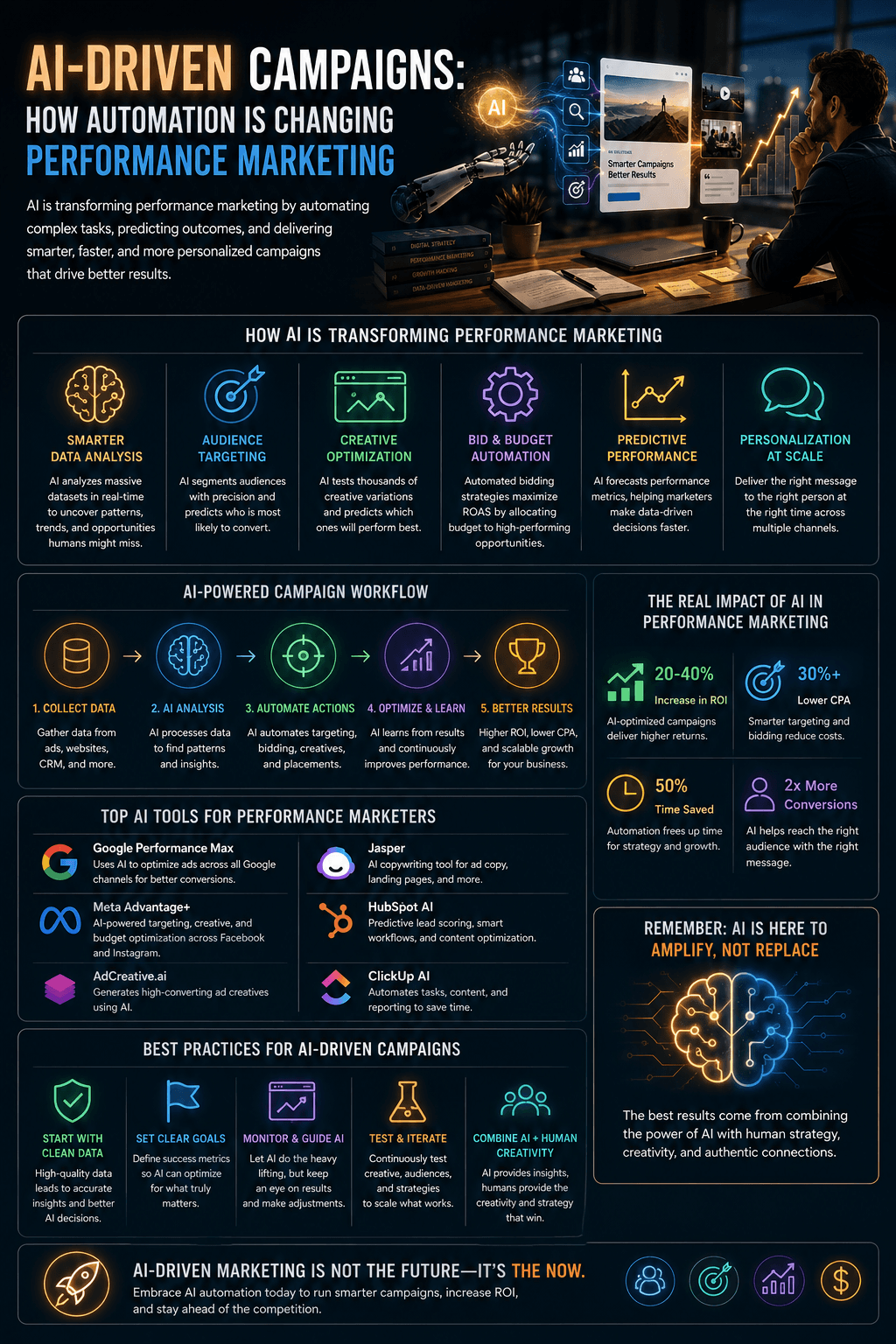
AI-driven Campaigns: How Automation Is Changing Performance Marketing
Modern digital marketing generates an enormous amount of operational data. Every advertising platform, affiliate network, landing page, traffic source, CRM, and analytics tool produces its own stream of performance signals. Media buyers and performance teams are expected to process conversion metrics, click quality indicators, attribution paths, lead scoring data, fraud patterns, and audience behavior simultaneously […]

Modern digital marketing generates an enormous amount of operational data. Every advertising platform, affiliate network, landing page, traffic source, CRM, and analytics tool produces its own stream of performance signals. Media buyers and performance teams are expected to process conversion metrics, click quality indicators, attribution paths, lead scoring data, fraud patterns, and audience behavior simultaneously across multiple channels. In this article, you’ll learn how automation and AI-driven campaigns are changing performance marketing for good.
Manual optimization methods are increasingly unable to keep pace with this level of complexity. Even experienced performance teams struggle to react quickly enough when traffic conditions change in real time. Conversion rates fluctuate by hour, fraud patterns evolve constantly, and campaign profitability can shift rapidly depending on audience quality, bidding competition, or routing logic.
This is one of the main reasons businesses are moving toward AI-driven campaigns. Instead of relying entirely on manual analysis and static optimization rules, companies are using automation systems capable of processing large amounts of data continuously and making operational decisions in real time.
In performance marketing, AI is becoming less about experimentation and more about infrastructure. Automated optimization systems now influence traffic distribution, bidding adjustments, lead qualification, fraud prevention, and campaign analytics. For many organizations, automation is no longer treated as a supplementary tool but as a core operational layer required to scale efficiently.
The growing adoption of AI-driven campaigns is also tied to return on investment. Faster optimization cycles help reduce wasted spend, improve lead quality, and allocate budgets more efficiently across traffic sources. As competition increases in affiliate marketing and paid acquisition, businesses that rely exclusively on manual optimization often face slower reaction times and higher operational overhead.
What AI-driven campaigns actually mean in performance marketing
The phrase “AI-driven campaigns” is often associated with AI-generated ads, automated copywriting, or content production. While these technologies are becoming more common, the operational role of AI in performance marketing is much broader and significantly more important.
In practice, AI-driven campaigns refer to systems that automate decision-making across the traffic lifecycle. These systems process behavioral data, campaign performance metrics, conversion probabilities, audience patterns, and attribution signals to optimize campaign execution dynamically.
One major component is predictive optimization. Instead of reacting only after performance declines, AI models attempt to forecast outcomes based on historical patterns and real-time data inputs. This allows performance teams to identify traffic sources, placements, or audiences that are likely to underperform before losses accumulate.
Automated traffic distribution is another critical element. In affiliate and lead generation ecosystems, incoming traffic often needs to be routed between multiple offers, buyers, or landing pages, depending on quality and expected conversion probability. AI systems help automate these routing decisions at scale.
AI-based segmentation also plays an important role. Rather than using static audience groups, machine learning systems continuously analyze user behavior and engagement patterns to identify high-intent segments more accurately. This improves targeting precision and allows campaigns to adapt more quickly to changing market conditions.
Smart bidding systems are another example of operational automation. AI models can evaluate auction environments, historical performance, and conversion probability to adjust bids dynamically across advertising channels.
Perhaps most importantly, AI-driven campaigns rely heavily on real-time decision-making. In modern performance marketing environments, delayed optimization often results in wasted budget. AI systems help shorten the gap between detection and response, allowing organizations to adapt faster than manual workflows typically allow.
How AI improves campaign optimization
Real-time traffic analysis
One of the biggest advantages of AI systems is their ability to process large volumes of campaign data continuously. Traditional manual reporting workflows often involve delayed analysis, fragmented dashboards, and reactive optimization cycles.
AI-powered analytics systems can evaluate incoming traffic streams in real time. They identify which sources generate high-quality users, which placements underperform, and which campaigns show abnormal behavioral patterns.
This becomes especially important in affiliate traffic management, where multiple traffic sources operate simultaneously across different geographies, devices, and acquisition models. Real-time analysis allows teams to react faster when conversion rates decline or suspicious activity emerges.
Anomaly detection is another important capability. AI systems can identify unexpected traffic spikes, unusual click-through behavior, or sudden conversion drops far more quickly than manual monitoring processes. Faster detection helps reduce operational losses and prevents inefficient spend from accumulating over time.
Predictive lead scoring and routing
Lead quality varies significantly across traffic sources. In industries such as finance, insurance, SaaS, healthcare, and education, not all leads generate the same downstream value.
AI-based lead scoring systems attempt to predict conversion probability before a lead enters the sales pipeline. These models analyze behavioral data, engagement patterns, demographic signals, and historical conversion outcomes to prioritize incoming traffic automatically.
Predictive lead scoring is often combined with automated routing logic. Instead of distributing leads manually, AI systems can redirect traffic dynamically toward the buyer, offer, or campaign most likely to convert successfully.
This improves operational efficiency while reducing delays between acquisition and monetization. Faster routing also helps prevent lead degradation, which is especially important in competitive verticals where response speed strongly influences conversion rates.
In large-scale affiliate ecosystems, automated redistribution logic helps organizations manage varying traffic quality without relying entirely on static rules or manual intervention.
Automated fraud detection
Fraud remains one of the biggest operational challenges in performance marketing. Invalid clicks, bot traffic, spoofed conversions, and low-quality traffic sources can significantly reduce campaign profitability.
Traditional fraud detection methods often rely on static filters or delayed manual reviews. AI systems improve this process by analyzing behavioral patterns continuously and identifying suspicious activity more dynamically.
Modern anti-fraud systems evaluate factors such as session behavior, click timing, navigation patterns, device fingerprints, and conversion anomalies. Instead of looking only for predefined fraud indicators, machine learning models attempt to identify abnormal behavior patterns that differ from legitimate user activity.
This helps companies reduce wasted advertising spend and improve traffic quality across acquisition channels.
Fraud prevention is particularly important in affiliate marketing, where traffic may originate from multiple independent publishers, networks, or arbitrage environments. AI-driven fraud detection provides additional visibility that manual reviews alone often cannot achieve efficiently at scale.
Smarter budget allocation
Budget allocation is one of the most difficult operational tasks in performance marketing. Traffic quality changes constantly, channel performance fluctuates, and customer acquisition costs vary across platforms.
AI systems help optimize spending dynamically by shifting budgets toward higher-performing campaigns, traffic sources, or audience segments.
Instead of relying exclusively on periodic reporting cycles, automated optimization systems evaluate performance continuously and adjust allocation logic in real time.
This becomes especially valuable in environments where campaigns operate across multiple channels simultaneously, including search, social, native advertising, influencer traffic, affiliate networks, and programmatic platforms.
Dynamic optimization also helps reduce inefficient acquisition spend. Campaigns that begin underperforming can be deprioritized automatically before losses escalate significantly.
The operational challenges behind AI-driven campaigns
Despite their advantages, AI-driven campaigns are not simple to implement successfully. Many organizations underestimate the operational infrastructure required to support automation systems effectively.
One major challenge is fragmented infrastructure. Performance teams often operate across disconnected tools for analytics, attribution, CRM management, affiliate tracking, bidding, and reporting. These systems may not synchronize data consistently, creating visibility gaps that reduce optimization accuracy.
Integration complexity is another major issue. AI systems depend heavily on accurate data pipelines. If campaign data arrives late, contains inconsistencies, or lacks proper attribution signals, optimization models become less reliable.
Data synchronization problems can also create operational confusion. Different platforms may report conflicting metrics due to attribution differences, delayed conversion tracking, or inconsistent event definitions.
Attribution itself remains a difficult problem in performance marketing. Multi-touch customer journeys make it increasingly difficult to determine which traffic source deserves credit for a conversion. AI systems can improve attribution analysis, but they still depend on structured and reliable data environments.
Managing multiple traffic sources manually also becomes increasingly inefficient as scale grows. Large affiliate programs often operate across numerous partners, campaigns, geographies, and verticals simultaneously. Without centralized infrastructure, optimization workflows become fragmented and difficult to manage effectively.
This is why AI systems are most effective when combined with structured campaign infrastructure rather than disconnected, standalone tools.
How traffic management platforms support AI-driven campaigns
The growth of campaign automation has also increased demand for centralized traffic management infrastructure.
Modern traffic management platforms help performance teams consolidate analytics, routing, fraud prevention, and campaign orchestration into unified operational environments.
Centralized analytics systems improve visibility across acquisition channels by reducing fragmentation between reporting tools. This allows teams to evaluate performance more consistently and identify optimization opportunities faster.
Automated lead routing systems also support campaign scalability. Instead of relying on static distribution rules, platforms can redirect traffic dynamically based on conversion probability, buyer demand, or campaign conditions.
Anti-fraud infrastructure is another important component. Many traffic management systems now integrate behavioral analysis, bot detection, and suspicious activity monitoring directly into campaign operations.
API integrations are equally important for AI-driven campaigns. Modern performance marketing environments depend heavily on data synchronization between advertising platforms, affiliate systems, CRMs, analytics tools, and lead distribution networks. Well-structured integrations improve operational consistency and reduce delays in optimization workflows.
Real-time monitoring capabilities also help teams respond faster to performance changes. Instead of waiting for delayed reporting cycles, marketers can evaluate campaign conditions continuously.
Platforms such as Hyperone are part of the broader ecosystem of traffic management and automation tools designed to help companies manage AI-driven campaigns more efficiently across increasingly complex acquisition environments.
The named tools behind each capability described above
Understanding these concepts in the abstract is useful only up to a point. Here’s where each capability this article describes actually shows up in real, widely used products.
For predictive optimization and smart bidding, Google’s Performance Max and Meta’s Advantage+ are the two most widely deployed systems in the market, both using machine learning to adjust targeting, creative, and bid strategy across a campaign in real time rather than requiring manual rule-setting.
For fraud detection specifically, CHEQ and DoubleVerify are among the most established independent verification platforms, both analyzing behavioral signals such as click timing, session patterns, and device fingerprints to flag invalid traffic before it consumes budget. Independent research from Juniper Research projects global ad fraud losses will exceed $100 billion in 2026, which is precisely the scale of problem these tools exist to address.
For predictive lead scoring, HubSpot and Salesforce both offer native AI-based scoring within their existing CRM platforms, while 6sense specializes specifically in account-based, intent-driven scoring for B2B pipelines, each analyzing engagement and firmographic signals to prioritize which leads a sales team should act on first.
Traffic management and orchestration platforms like Hyperone sit in a related but distinct category, focused specifically on routing and distributing traffic across offers and buyers in affiliate and lead-generation ecosystems, which is a narrower use case than the broader optimization and fraud detection tools above.
The right combination depends entirely on which specific operational problem is most acute, fraud, lead quality, or bid efficiency, rather than adopting one platform expecting it to solve all three simultaneously.
Common misconceptions about AI-driven campaigns
One common misconception is that AI replaces marketers completely. In reality, automation systems still depend heavily on human-defined goals, campaign structures, routing logic, and strategic oversight.
AI can optimize within operational frameworks, but it does not automatically create an effective business strategy.
Another misconception is that AI guarantees profitability. Automation can improve efficiency, but poorly structured campaigns, low-quality traffic, weak offers, or inaccurate attribution models can still produce unprofitable outcomes.
Some organizations also assume that AI removes the need for analytics. The opposite is often true. AI systems require reliable data infrastructure, accurate tracking, and continuous monitoring to function effectively.
There is also a belief that automated campaigns require little or no human oversight. In practice, successful implementation depends on continuous optimization, infrastructure maintenance, and operational supervision.
Campaign automation works best when supported by:
- High-quality data pipelines
- Reliable attribution systems
- Structured traffic routing logic
- Consistent anti-fraud monitoring
- Strategic human decision-making
Without these elements, even advanced automation systems can produce inaccurate or inefficient optimization outcomes.
A practical framework for evaluating any AI marketing automation platform
Whichever category of tool is being considered, a few consistent questions produce a more reliable evaluation than a vendor’s own feature list.
Ask what data the system actually needs to function well, and confirm the current data infrastructure can supply it reliably. AI optimization is only as good as the attribution and conversion data feeding it, a point this article’s own misconceptions section already raises but doesn’t translate into a concrete evaluation step.
Ask for a specific example of a decision the system made and the outcome that followed, not just a description of its general capability. A vendor unable to walk through one real, specific optimization decision and its measurable result is asking for trust without evidence.
Ask how the system fails, not just how it succeeds. Every automated optimization system makes mistakes under certain conditions, sudden traffic pattern changes, unusual seasonal effects, a new fraud technique it hasn’t seen. Understanding the failure modes in advance is more useful than a list of ideal-case benefits.
Ask what level of human oversight the vendor actually recommends. A platform that positions itself as requiring zero ongoing human involvement is either overstating its own reliability or underselling the strategic judgment this article correctly notes automation cannot replace, the same reason long-term client relationships in B2B marketing still depend on human oversight and judgment even as more of the execution layer becomes automated.
The future of AI-driven campaigns in affiliate and performance marketing
The future of performance marketing is moving toward increasingly automated operational ecosystems.
Predictive automation will likely become more advanced as machine learning models gain access to larger datasets and more sophisticated behavioral signals. Campaign systems will continue improving their ability to forecast conversion probability, customer value, and acquisition efficiency.
Autonomous optimization systems are also becoming more common. Instead of relying solely on predefined rules, future campaign infrastructure will likely adapt more dynamically to changing traffic conditions.
AI-assisted traffic allocation is expected to become increasingly important in affiliate marketing ecosystems where traffic quality varies constantly between sources and verticals.
Fraud prevention systems will also continue evolving. As invalid traffic methods become more sophisticated, anti-fraud infrastructure will rely more heavily on behavioral analysis and anomaly detection models.
Automated ROI forecasting may become another important operational layer. Instead of evaluating campaign profitability only after spend occurs, AI systems may increasingly predict expected performance outcomes before budget allocation decisions are finalized.
Integration between analytics systems and campaign execution infrastructure is also expected to deepen. Rather than operating as separate tools, reporting, optimization, routing, and fraud prevention systems will likely become more interconnected operational environments.
The long-term trend is not simply toward “more AI,” but toward tighter operational integration between data, automation, and campaign execution.
Final thoughts: AI-driven campaigns are becoming operational infrastructure
Performance marketing is becoming increasingly data-intensive, fragmented, and operationally complex. Manual optimization alone is no longer sufficient for many organizations managing large-scale acquisition environments.
AI-driven campaigns help businesses process data faster, optimize traffic allocation more efficiently, detect fraud earlier, and reduce operational bottlenecks across campaign workflows.
At the same time, automation is not a replacement for strategic thinking. Successful implementation still depends on reliable infrastructure, high-quality data, accurate attribution, and experienced operational oversight.
As affiliate marketing and performance acquisition continue evolving, businesses are increasingly shifting away from disconnected tools toward integrated operational ecosystems capable of supporting real-time optimization at scale.
In many ways, AI-driven campaigns are no longer just a competitive advantage. They are becoming foundational infrastructure for managing modern traffic acquisition efficiently in increasingly complex digital environments.
AI-driven performance marketing FAQ
Juniper Research projects global digital ad fraud losses will exceed $100 billion in 2026, up from an estimated $84 billion in 2023, with continued growth projected through 2028. Independent verification data from firms like Fraudlogix has separately found invalid traffic rates around 18 to 20 percent across programmatic advertising specifically.
No. AI systems optimize within a strategy, campaign structure, and set of goals that still require human judgment to define. Automated systems can adjust bids, route traffic, and flag fraud faster than manual processes, but they don’t set business strategy, evaluate whether an offer is actually good, or catch structural problems the data itself can’t reveal, which is also why genuine expertise, not just automation, is what actually differentiates content and campaigns that convert.
Fraud detection tools like CHEQ and DoubleVerify identify and filter invalid, bot-driven, or manipulated traffic before it consumes ad spend. Lead scoring tools like HubSpot’s or Salesforce’s predictive scoring, or 6sense for account-based marketing, evaluate genuine leads to predict which are most likely to convert, a different problem than filtering out fraud.
Platforms like Google’s Performance Max and Meta’s Advantage+ generally outperform manual bidding at scale, since they process real-time signals faster than manual adjustment allows. They perform less reliably with limited historical data, unusual campaign structures, or data quality issues, which is why the underlying data infrastructure matters as much as the tool itself.
Infographic