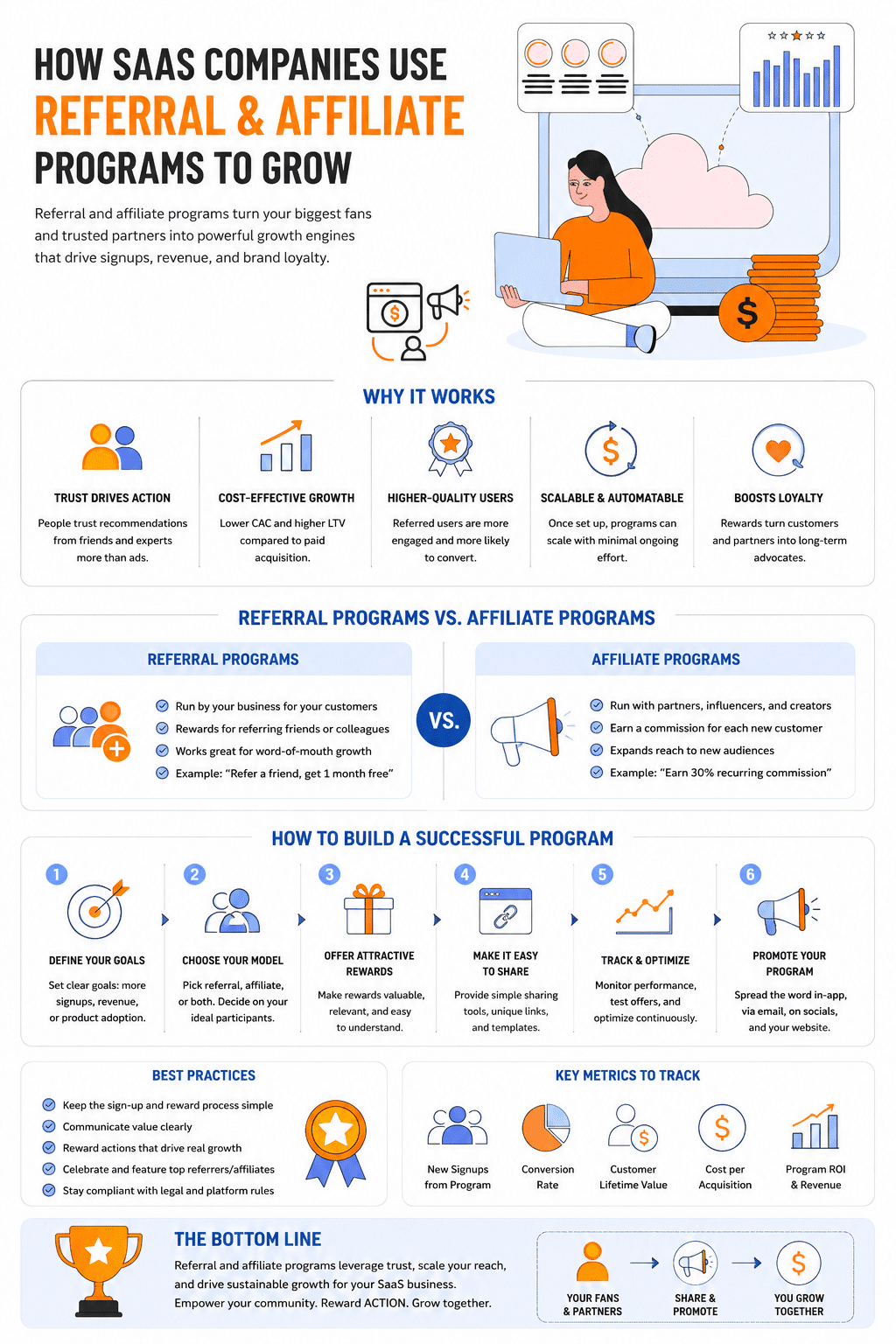
How SaaS Companies Use Referral And Affiliate Programs To Grow
Growth in SaaS rarely comes from one channel alone. A company can invest in SEO, paid ads, content, partnerships, outbound sales, webinars, social media, and product-led onboarding, and still find that customer acquisition gets more expensive over time. That is why so many SaaS brands look for growth engines that feel more efficient, more scalable, […]
Growth in SaaS rarely comes from one channel alone. A company can invest in SEO, paid ads, content, partnerships, outbound sales, webinars, social media, and product-led onboarding, and still find that customer acquisition gets more expensive over time. That is why so many SaaS brands look for growth engines that feel more efficient, more scalable, and more trust-driven. In this comprehensive guide, we’ll explore how SaaS companies use referral and affiliate programs to grow their client base and revenue.
Referral and affiliate programs fit that need surprisingly well.
They give SaaS companies a way to turn happy customers, creators, educators, niche publishers, consultants, and business partners into growth channels. Instead of relying only on internal marketing teams to generate demand, SaaS brands create systems that reward outside advocates for bringing in new users and paying customers.
Done well, this approach can lower acquisition costs, expand reach, improve trust, and create a more sustainable growth loop.
Done poorly, it can turn into a messy program full of weak incentives, low-quality traffic, and disappointing conversions.
That is why the question is not whether referral and affiliate programs can work for SaaS. They absolutely can. The real question is how smart SaaS companies structure them, promote them, and align them with the product experience.
This guide breaks that down clearly, so you can understand how SaaS referral and affiliate programs work, how Affiliate software for SaaS helps, and why they matter, and how companies use them to grow without making the process feel forced or spammy.
Why referral and affiliate programs work so well for SaaS
SaaS products are especially well suited to these programs because they are subscription-based, measurable, and often easy to recommend.
When a user loves a tool that saves time, automates a task, improves workflow, or helps generate revenue, they are naturally more likely to talk about it. That word of mouth can be turned into a more intentional channel through a referral program. On the affiliate side, creators and publishers often like promoting SaaS because recurring subscriptions can make the economics more attractive than one-time product sales.
That combination is powerful for SaaS affiliate to grow.
SaaS companies benefit because they can track signups, trials, upgrades, and recurring payments with precision. Partners benefit because they can earn rewards from products that often solve real business problems. Users benefit because they hear about software from people they already trust.
This is one reason affiliate marketing for SaaS continues to be such an appealing growth model for software brands.
Referral programs and affiliate programs are not the same thing for SaaS
A lot of people lump them together, but they serve different purposes.
A referral program usually targets existing users, customers, or close advocates. The idea is simple. Someone who already uses your product recommends it to another person and receives some form of reward if that recommendation leads to a sign up, purchase, or upgrade. In many SaaS businesses, the reward might be account credit, an extended plan, a discount, a cash bonus, or an added feature.
An affiliate program is broader and usually more structured. It is designed for partners, creators, bloggers, agencies, media publishers, educators, and specialists who promote the product to their audiences using tracked links and receive commissions based on conversions.
In short, referral programs are often trust-based and customer-led. Affiliate programs are usually partner-led and content-driven.
Both can be effective, but they should not be built as if they are identical.
Why SaaS companies like these channels
Referral and affiliate programs appeal to SaaS companies because they align with how software businesses scale.
SaaS companies care deeply about efficient customer acquisition, predictable revenue, and retention. A good referral or affiliate system can support all three. It can bring in users through trusted recommendations, expand top-of-funnel awareness, and sometimes attract customers who already understand the product before they even start a free trial.
That matters because educated users often convert better.
These programs can also create diversification. If a SaaS company relies too heavily on paid search or social ads, growth becomes vulnerable to rising costs and platform changes. Partnerships, referrals, and affiliate traffic can reduce that dependence and create a healthier marketing mix.
The smartest companies do not treat these programs as side experiments. They treat them as deliberate acquisition channels with clear incentives, tracking, onboarding, and partner support.
What the data actually shows about referral and affiliate growth in SaaS
It is easy to talk about these channels in the abstract. It is more useful to look at what they have done for real companies.
Dropbox ran what is still one of the most studied referral programs in SaaS history. The model was simple: refer a friend and both of you get extra storage. No cash. No discounts. Just more of the product. That double-sided incentive helped the company grow from 100,000 registered users to 4 million in 15 months. The referral program accounted for roughly 35 percent of new daily signups at its peak.
HubSpot has run a partner and affiliate ecosystem for years. Their Solutions Partner Program connects agencies, consultants, and software integrators who earn recurring commissions for customers they bring in. As of their last published data, partners generate a meaningful percentage of HubSpot’s new ARR, particularly in the mid-market and enterprise segments where agency relationships carry significant trust.
SEMrush, Ahrefs, and similar SEO tools have built entire creator and educator ecosystems around their affiliate programs. These companies benefit because their products already have an active community of practitioners who make tutorials, comparison content, and training courses. The affiliate program turns that existing community activity into a structured revenue-sharing arrangement.
Notion took a different angle with a referral credit model during its earlier growth phase. Users who invited teammates received additional time on paid features, keeping the incentive product-native rather than cash-based. This fit the product’s collaborative nature and drove organic team adoption.
What these examples share is not the incentive type. It is the alignment between the product’s natural sharing behavior and the structure of the program. Dropbox users were already talking about storage. SEO professionals were already teaching tools. HubSpot customers were already inside agencies. The program worked because it met an existing behavior and gave it a formal channel.
The general research backs this up. According to Nielsen’s Trust in Advertising report, 92 percent of consumers trust recommendations from people they know over any other form of advertising. Research from Wharton has found that referred customers are 18 percent less likely to churn than customers acquired through other channels. Whether those exact numbers translate to your SaaS depends on your category and product maturity, but the directional finding is consistent: trust-based acquisition tends to produce better long-term customers than cold acquisition.
For SaaS companies tracking customer acquisition through multiple channels, these programs are worth measuring carefully rather than treating as passive nice-to-haves.
How SaaS referral programs typically drive growth
Referral programs work best when the product already has a strong user experience and a clear reason to be shared.
People refer software when it makes them look helpful, informed, or efficient. They do not refer tools just because a company puts a button inside the dashboard that says “Invite a friend.”
That is why the best SaaS referral programs feel natural. They show up at the right moment in the user journey, often after someone has experienced value. A customer completes a key action, saves time, gets a win, or reaches a milestone, and that is when the invitation to refer someone feels relevant.
The incentive matters too, but it should not carry the entire program. A weak product cannot be rescued by a referral bonus.
In practice, referral programs often grow through simplicity. One clear message, one easy sharing path, one attractive reward, and one obvious reason the referred user should care.
How SaaS affiliate programs create scalable demand
Affiliate programs expand growth beyond your existing user base.
Instead of relying only on customer referrals, SaaS companies recruit people who already have relevant audiences. These might be content creators reviewing tools, consultants recommending software to clients, niche bloggers writing comparison posts, YouTubers making tutorials, agencies bundling services, or newsletter operators curating useful products.
This works especially well for software because software needs explanation.
A creator can demonstrate the product, compare it to alternatives, teach use cases, and help a potential customer understand why the tool matters. That content can rank in search, perform on YouTube, circulate on social media, or convert through email for months after it is published.
For many SaaS brands, this is where affiliate programs become more than a revenue share model. They become a content distribution engine.
Why agencies and consultants deserve a separate look in your affiliate strategy
Most SaaS companies think about affiliates primarily as bloggers, YouTubers, and newsletter operators. That audience is real and valuable. But for B2B SaaS in particular, the highest-converting affiliate category is often agencies and independent consultants.
An agency recommending your tool is not making a casual endorsement in a blog post. They are often directly implementing it for clients, training their team on it, and building their service offering around it. That depth of integration produces customers who stick around.
HubSpot’s partner program is structured almost entirely around this idea. Partners in their Solutions Partner tier are not just promoting HubSpot. They are building businesses on top of it. That alignment means the referrals they generate tend to be well-qualified and well-prepared.
If you are building a B2B SaaS affiliate program and ignoring the agency tier, you are probably leaving your most valuable partner segment unaddressed. The recruitment approach for this group is also different from content creators. Agencies care less about commission rates and more about co-marketing, training resources, co-branded collateral, and a dedicated partner contact they can actually reach.
For software tools with a steep learning curve or a complex setup, agencies can also handle onboarding on your behalf for their clients, which reduces your support burden while increasing partner stickiness.
This partner type also tends to produce strong backlinks, case studies, and guest content that benefits your overall search visibility, not just your conversion pipeline.
What the strongest SaaS affiliate programs usually get right
The difference between a weak program and a strong one is rarely just the commission rate.
The best programs are thoughtfully designed. They attract the right kind of partners, give them good materials, make the value proposition easy to communicate, and ensure that conversion tracking is reliable.
Here is a practical breakdown:
| Element | Strong SaaS approach | Weak SaaS approach |
|---|---|---|
| Incentive | Clear, attractive, sustainable reward | Confusing or low-value reward |
| Product fit | Easy to explain, useful, solves a real problem | Hard to describe or low perceived value |
| Tracking | Reliable attribution and transparent reporting | Broken links, unclear credit, poor dashboards |
| Partner support | Assets, onboarding, messaging help, communication | Little guidance after signup |
| Program positioning | Targets relevant audiences and use cases | Tries to recruit everyone |
| Conversion path | Smooth trial, demo, or signup experience | Friction-heavy landing pages and weak onboarding |
| Retention alignment | Rewards long-term quality customers | Focuses only on top-of-funnel volume |
This table highlights a simple truth. Referral and affiliate growth do not come from incentives alone. They come from systems.
How SaaS companies structure commissions and rewards
Commission structure is one of the most commonly mishandled elements of a SaaS affiliate program. Companies either set rates that are too low to attract serious partners, or they set rates that are unsustainable once you factor in churn and customer LTV.
Here are the most common models in use:
- Recurring commission The partner earns a percentage of the customer’s monthly or annual payment for as long as that customer stays subscribed. Rates typically range from 20 to 40 percent of MRR. This model is attractive to serious partners because it rewards quality over quantity. A partner who brings in ten customers who stay for two years earns far more than one who brings in thirty customers who churn in 90 days. Many SaaS companies cap the recurring period at 12 or 24 months to protect margins as customers age.
- One-time commission The partner earns a flat fee or percentage at first purchase. Rates tend to be higher in percentage terms to compensate for the one-time nature, often 50 to 100 percent of the first month’s subscription value. This model is simpler to track and easier to explain to new partners. The downside is it can attract partners focused on volume over quality.
- Tiered commission Partners who hit revenue or customer thresholds unlock higher percentages. This creates a loyalty structure that rewards top performers and gives growing partners something to work toward. HubSpot, ActiveCampaign, and several CRM companies use tiered models to keep their best partners engaged over time.
- Credit-based referral rewards For customer-facing referral programs, many SaaS companies avoid cash entirely and instead reward advocates with account credits, plan upgrades, or feature unlocks. Dropbox’s storage credit model is the most famous example. This approach keeps the reward in-product, which reinforces usage while reducing cash outflow. It also means the company only pays when the referred user actually sticks around long enough to trigger the credit.
The right structure depends on your product’s price point, retention rate, and the audience you are trying to recruit. A $30/month SMB tool probably needs a different model than a $500/month enterprise platform.
One number worth understanding before setting any rate: customer lifetime value. If a typical customer pays $100/month and stays for 18 months, their LTV is roughly $1,800. A 30 percent recurring commission for 12 months would cost you $360 to acquire that customer through an affiliate, assuming they convert. If your CAC through paid search is $700, that affiliate deal looks very attractive. If your CAC through content is $80, the math is tighter and you would need to evaluate the quality of affiliate-sourced customers carefully.
For partners thinking about how to evaluate which programs are worth joining, the traffic monetization platforms guide on this site covers how to assess revenue share models across different content types.
Why trust is the real engine behind both channels
Trust is what makes these programs work.
A referral from a friend lands differently than an ad. An affiliate review from a creator who actually understands a tool feels more persuasive than generic copy on a landing page. That is the hidden advantage of these channels. They borrow credibility from a relationship that already exists.
This is also why the best SaaS companies avoid pushing these channels in a cheap way. They do not want empty traffic. They want aligned recommendations.
That means choosing partners carefully, encouraging honest promotion, and making sure the product can support the expectations being created. If a partner promises easy automation but the onboarding is confusing, the traffic may come, but the conversions and retention will suffer.
Growth without trust is fragile. Growth built on trusted recommendations tends to hold up better.
Common mistakes SaaS companies make
A lot of SaaS companies launch a referral or affiliate program because it sounds like a growth shortcut. Then they are disappointed when nothing really happens.
Usually the problem is not the model. It is the execution.
Some programs fail because the reward is weak or unclear. Others fail because the product has not reached a point where users want to recommend it. Some recruit affiliates without giving them any real reason to care or any resources to succeed. Others track conversions badly, which destroys partner confidence fast.
Another common mistake is ignoring the website experience. Traffic can be valuable, but if the landing page is unclear, slow, or generic, even good partners will struggle to convert visitors. A referral or affiliate strategy is not separate from product, UX, or positioning. It depends on them.
How SaaS companies can build better programs
The best path is to keep the program simple, specific, and aligned with the actual product journey.
Start with the product. Is it genuinely useful? Do users hit a moment of value worth sharing? Is there a clear audience that benefits quickly? Once those answers are solid, build the program around real behavior, not wishful thinking.
A practical approach often looks like this:
- Identify who is most likely to refer or promote the product well
- Offer an incentive that feels meaningful without hurting margins
- Make sharing easy with clean links, simple messaging, and relevant assets
- Support partners with content angles, tutorials, and landing pages
- Track quality, not just quantity, so you reward customers who actually stick
That final point matters a lot. Not all signups are equally valuable. SaaS companies should care about retention, upgrade rate, and customer quality, not only first-click attribution.
When is the right time to launch a referral or affiliate program?
This is a question the article would be incomplete without answering. Most SaaS companies ask it early and get a range of contradictory opinions.
The honest answer is that both programs have a minimum readiness threshold, and launching before you hit it typically produces disappointing results rather than a flaw in the model.
For a referral program to work, you need users who are genuinely satisfied. That means you need product-market fit, or at minimum a user segment that consistently reaches a clear moment of value. If your activation rate is below 30 percent or your 30-day retention is still being figured out, a referral program is not going to save your acquisition funnel. It may actually expose the problem by sending your best users into a sharing flow that leads to a poor new user experience.
A rough benchmark: if you can point to a cohort of active users with a Net Promoter Score above 40, you probably have enough satisfied users to generate organic referrals. The program formalizes what some of them are already doing.
For an affiliate program, the threshold is different. You need a product that is explainable in content form, a price point that makes commissions meaningful, and a conversion funnel that works. If your landing page converts poorly or your trial-to-paid rate is under 5 percent, you are going to struggle to recruit and retain serious affiliates. They will test your offer, see low earnings, and move on.
A useful rule: a SaaS company should be able to say “our best customers see clear value within 14 days and they tend to stick around for at least 12 months” before they invest heavily in either program. If that sentence is not yet true, fixing the product and onboarding experience will do more for growth than any partner program.
Why referral and affiliate growth can support SEO and broader visibility
These programs can also create indirect SEO and brand benefits.
Affiliate partners often publish product tutorials, reviews, comparisons, integrations, and use-case content. That kind of content can rank for high-intent searches, especially when the partner already has authority in a niche. Referral and affiliate ecosystems can also increase branded search, visibility across channels, and awareness in communities your internal team may not reach easily.
This does not replace SEO, but it can reinforce it.
For SaaS companies trying to grow through keyword-led content and organic discovery, referral and affiliate channels can become useful complements rather than isolated tactics. They help the brand appear in more places, through more voices, with more context.
The metrics that separate a program that works from one that looks good
A common failure pattern is tracking volume metrics and missing the quality picture entirely. Clicks, signups, and trial starts are easy to measure and easy to celebrate. They are also easy to game, and they do not tell you whether your referral or affiliate channel is actually building a sustainable customer base.
These are the metrics worth building into your reporting from the start:
For referral programs:
- Referral share rate: what percentage of your active users have referred at least one other person in the last 90 days. Most programs see this in the 5 to 15 percent range. Lower than 5 percent usually signals weak incentives or poor trigger placement.
- Referred user conversion rate: of the users who sign up via referral, what percentage become paying customers. This should be notably higher than your organic conversion rate, because referred users arrive with more context and social credibility.
- Referred user retention at 90 days and 12 months: referred customers often churn less than cold-acquired users, but this varies significantly by product and referral source.
- Referral cycle time: how long from a referral link being shared to a conversion. Longer cycles mean the incentive or the onboarding path is creating friction somewhere.
For affiliate programs:
- Earnings per click (EPC): the average revenue your program generates per tracked click from partner content. This is the number affiliates use to evaluate whether your program is worth promoting. A low EPC tells you your landing page, trial experience, or pricing is leaking conversions before they reach you.
- Partner activation rate: of the affiliates who sign up for your program, what percentage actually promote it and generate at least one conversion. Programs with low activation rates usually suffer from poor onboarding, confusing dashboards, or weak creative assets.
- Commission to LTV ratio: for every dollar you pay out in commissions, how many dollars do you earn over the lifetime of that customer. This is the number that determines whether your program is sustainable. If you are paying $200 in commissions to acquire customers who generate $400 in LTV over their lifetime, your margin is too thin to scale.
- Top partner concentration: if 80 percent of your affiliate revenue comes from two or three partners, your program has a fragility problem. Diversifying your partner base protects revenue.
If you are running landing pages for your affiliate and referral traffic, conversion rate testing on those pages often returns the fastest improvement in EPC and referred conversion rate. The partner brings the traffic; your page has to close it.
Email sequences for newly referred users also deserve attention. Users who arrive via a trusted recommendation often have higher expectations than cold traffic, and a poorly timed or generic onboarding email sequence can quickly erode the trust the referral created.
Final thoughts
How do SaaS companies use referral and affiliate programs to grow?
They use them to turn trust into distribution.
Referral programs help satisfied users bring in new users. Affiliate programs help external partners, creators, and publishers introduce the product to qualified audiences at scale. Together, these channels can lower acquisition costs, improve credibility, diversify traffic sources, and support long-term revenue growth.
But the best results do not come from throwing up a signup page and hoping people promote your software.
They come from building a product worth recommending, creating a program worth joining, and making the journey from click to customer feel clear, credible, and useful.
That is where sustainable SaaS growth starts.
Saas affiliate programs FAQ
A SaaS referral program rewards existing users or customers for recommending the software to other people who sign up, start a trial, or become paying customers.
A SaaS affiliate program lets creators, publishers, agencies, consultants, or other partners promote a software product using tracked links and earn commissions when their referrals convert.
Yes. Referral programs usually focus on current users sharing the product with people they know. Affiliate programs are typically designed for external partners who promote the product to larger audiences.
They work because software is often easy to recommend when it solves a real problem. Satisfied users can become strong advocates, especially when the referral process feels natural and the reward is meaningful.
Affiliate programs work well for SaaS because partners can create tutorials, reviews, comparisons, and educational content that helps potential customers understand the product and convert with more confidence.
A strong SaaS affiliate program usually has reliable tracking, clear incentives, good partner support, a useful product, and landing pages that convert well.
Yes. When structured well, both channels can bring in qualified traffic through trusted recommendations, which can improve efficiency compared to relying only on paid acquisition.
SaaS affiliate commission rates vary based on price point, business model, and partner tier. Recurring commission programs typically offer 20 to 40 percent of monthly subscription revenue for a set period, often 12 months. One-time commission programs tend to pay 50 to 100 percent of the first month’s payment. Higher-ticket SaaS products with long sales cycles sometimes use flat per-conversion fees instead of percentages. The key is setting a rate that is attractive enough to motivate serious partners while sustainable enough to protect your margins as the program scales.
Not necessarily. A referral or affiliate program works best when the product already delivers consistent value to users and the conversion funnel is reasonably tight. Launching a program before reaching product-market fit tends to produce low partner engagement and disappointing results, which can lead teams to abandon the model prematurely. A better approach is to identify your most satisfied user cohort, confirm that referred users convert and retain at a reasonable rate, and then formalize the program. Many SaaS companies start with a simple referral system for existing customers and add a structured affiliate program once the product and economics are proven.
Start with people who already engage with your product or your category. Existing power users, community members, bloggers who have mentioned your tool, YouTubers who cover your niche, and agencies who work in your target market are all natural starting points. Outreach to these groups tends to convert better than a passive “join our affiliate program” page alone. Listing your program on affiliate directories, engaging in communities where your target affiliates spend time, and building visible marketing assets around the program also accelerates discovery. Quality matters more than volume here. Ten engaged partners with relevant audiences will outperform a hundred signups who never promote the product.
A one-time commission pays the affiliate a fixed amount or percentage when a customer converts, regardless of how long that customer stays. A recurring commission pays a percentage of the customer’s ongoing subscription payments for a defined period. Recurring commissions are more attractive to serious content creators and partners who think long-term, because they build compounding income over time. One-time commissions are simpler to manage and can be more affordable for early-stage products. The choice often comes down to your product’s price point and retention rate. If customers tend to stay for years, a recurring model is worth considering because it aligns partner incentives with the retention outcomes you care about most.
Infographic