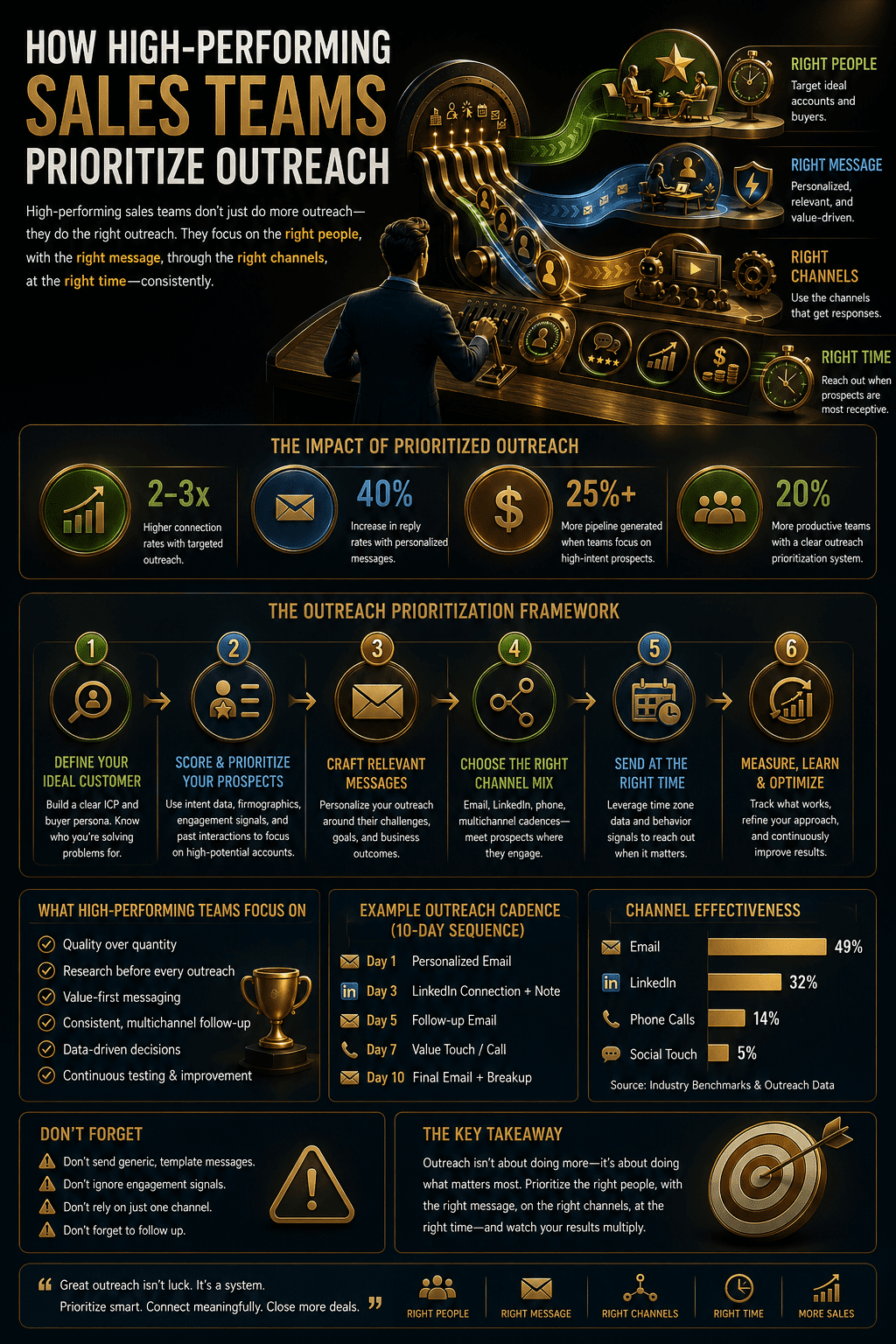
How High-Performing Sales Teams Prioritize Outreach
How to score leads by fit, authority and intent, why most B2B companies never answer a demo request, and what to measure instead of dials.

When sales teams struggle to hit revenue targets, the immediate diagnostic assumption is often a lack of activity. Sales managers push for higher daily dials, expanded prospect lists, and more automated email sequences. Yet, ramping up raw volume without an underlying strategy often produces diminishing returns and burns out sales representatives in the process.
Top-tier sales organizations do not succeed simply by out-working their competitors; they succeed by out-prioritizing them. They recognize that an hour spent engaging a deeply qualified, high-intent account yields significantly more revenue than three hours spent reaching out to cold, ill-fitting leads.
Shifting a sales development team from a high-volume, reactive posture to a disciplined, high-intent framework requires changing how prospects are evaluated, queued, and contacted.
The Flaw of the Unfiltered Calling List
In traditional outbound operations, reps are assigned large, static lists organised alphabetically or by geography. They work through sequentially, calling whoever sits on line 42, then line 43.
This ignores buyer readiness. On any given day only a small fraction of your addressable market is actively experiencing the problem you solve. When reps spend equal energy on every contact regardless of context, they burn prime calling hours on unresponsive leads while time-sensitive opportunities cool.
The evidence on that last point is worse than most teams assume, and it points somewhere unexpected.
Harvard Business Review’s 2011 study The Short Life of Online Sales Leads established the pattern: firms contacting an online lead within an hour were roughly seven times more likely to qualify it than those contacting an hour later, and sixty times more likely than those waiting a day. That research is now fifteen years old and it is still the foundation everyone cites.
More recent testing suggests the problem has not improved. RevenueHero submitted demo requests to 1,000 B2B SaaS companies and found 635 never responded at all. Among the 365 that did, the average response time was over 29 hours. Workato ran the same experiment at 114 companies and recorded zero phone calls inside five minutes and exactly one personalised email. Optifai’s benchmark across 939 B2B SaaS companies through Q1 2026 put average response at 47 hours, with 23% inside five minutes and 42% beyond a day.
Read those together and the diagnosis shifts. The dominant failure in B2B outbound is not that teams prioritise badly. It is that the single highest-intent signal available, someone explicitly asking for a demo, goes unanswered at a majority of companies. Any prioritisation framework is downstream of that. Before optimising the queue, confirm that inbound requests are entering it at all.
Every unanswered demo request is a paid acquisition that produced nothing, which puts response discipline squarely inside the cost-per-acquisition conversation rather than beside it. The wider version of that calculation is covered in this look at performance marketing approaches that lower B2B acquisition costs.
One caveat on this literature: nearly all of the recent research is published by vendors selling speed-to-lead software. The methodology in these studies is transparent and the findings are consistent across independent samples, but the ecosystem producing them has an interest in the answer. Treat the direction as reliable and the precise figures as directional.
Establishing Multi-Dimensional Prioritization Signals
To build a dynamic outreach queue, revenue operations leaders must establish clear prioritization rules based on three core layers of data:
1. Account-Fit Criteria (Firmographics)
Before evaluating activity, verify that the prospect matches your ideal customer profile (ICP). Factor in company size, industry, technology stack, and geographic location. A lead that perfectly matches your historical high-value customer profile should automatically jump ahead of a lower-tier match, even if their recent activity levels are identical.
2. Contact Role Authority (Persona)
Focus effort on decision-makers and key influencers. A director or VP facing an operational crisis should be prioritized over an entry-level coordinator who downloaded a whitepaper for personal education.
3. Behavioral and Intent Signals
Track real-time digital body language. High-priority triggers include visiting pricing pages, requesting product documentation, opening multiple nurture emails within 24 hours, or public corporate shifts such as recent funding announcements or leadership changes.
Turning Three Signals Into One Number
Naming the layers is the easy part. Combining them into a queue position is where most prioritisation projects stall, because a lead that is high fit and low intent has to be ranked against one that is low fit and high intent.
A workable structure that most teams can build in a weekend:
| Layer | Weight | Scoring |
|---|---|---|
| Account fit | 40% | Score against your closed-won profile, not your aspirational ICP. Company size, industry, tech stack, geography |
| Contact authority | 20% | Economic buyer, influencer, end user, unknown |
| Intent recency | 40% | Weighted by signal strength and decayed by time since the event |
Two design decisions matter more than the weights.
Score fit against closed-won, not against the ICP slide. Most ICP definitions are aspirational, built from who the company wants to sell to. Pull the last fifty closed-won deals and score fit against what those accounts actually looked like. The two lists usually differ, and the difference is where your model gains or loses accuracy.
Decay intent aggressively. A pricing page visit is worth substantially more today than it was last Tuesday. Halving the intent score every 48 to 72 hours approximates the real decay curve reasonably well and prevents stale signals from clogging the top of the queue. Without decay, a model surfaces leads that were hot a fortnight ago and produces exactly the cold-outreach experience it was built to eliminate.
Where the tier boundaries sit. Rather than fixed score thresholds, define tiers by capacity. If your team can run twenty genuinely personalised sequences a week, Tier 1 is the top twenty leads by score, whatever the score happens to be. Fixed thresholds either starve reps in a slow week or produce a Tier 1 nobody can service in a busy one.
Validate quarterly, or the model rots. Take the leads that converted last quarter and check where the model ranked them at the point of first contact. If a meaningful share sat outside your Tier 1, the weights are wrong. This is a one-hour exercise and almost nobody does it, which is why so many scoring models quietly stop working within a year of launch.
Transitioning from Static Lists to Queue-Based Management
Most teams can implement usable prioritisation with routing rules and dynamic views inside the sales engagement platform they already run, and should confirm that before buying anything new. A scoring model without a system is a spreadsheet nobody opens, but a system without a scoring model is the same list problem in a nicer interface.
Where volume makes the cost of a rep choosing their own next call material, a purpose-built queue system earns its place. Utilizing a queue-based sales engagement system like Vanillasoft allows managers to build multi-variable prioritisation logic directly into the daily workflow. Rather than scrolling through spreadsheets, reps are presented with the single highest-priority lead in real time. The moment a high-intent web submission lands or a target account triggers a buying signal, the platform adjusts the queue dynamically, pushing that contact to the next available rep’s screen.
Protecting Rep Energy with Tiered Outreach Cadences
Prioritization is not just about who gets contacted first; it also dictates how a contact should be engaged. High-performing teams match the intensity and personalization of their outreach cadence to the priority tier of the prospect.
- Tier 1 (High Fit + High Intent): Treat these prospects with high-touch, hyper-personalized outreach. Combine custom video messaging, tailored LinkedIn engagement, and direct phone calls with tailored research on their specific company pain points.
- Tier 2 (High Fit + Low Intent): Place these accounts into a structured, semi-automated multi-channel cadence. Focus initial touchpoints on education and industry benchmarking before pushing for a discovery call, which means the content itself carries the sequence. Approaches for producing that material are covered in turning expert industry insights into high-converting B2B content.
- Tier 3 (Low Fit / Top-of-Funnel): Rely primarily on automated marketing nurture sequences. Sales reps should only engage these leads if the prospect takes a direct, high-intent action such as booking a demo or requesting custom pricing.
This tiered structure ensures that reps reserve their creative energy and personal research time for the accounts that hold the highest potential deal value.
Where Prioritization Models Go Wrong
Four failure modes account for most of the projects that get built and then quietly abandoned.
- Intent data with a false-positive problem. Third-party intent signals identify accounts researching a category. A meaningful share of that activity is competitors, analysts, consultants, and employees doing unrelated research from a corporate IP range. Treating third-party intent with the same weight as a first-party pricing page visit puts noise at the top of the queue and teaches reps not to trust it. Weight first-party signals considerably higher.
- Speed-to-lead becomes a gamed metric. The moment response time enters compensation, reps optimise for the timestamp. A ten-second unqualified dial hits the SLA and burns the lead. If you measure speed, measure it alongside connect-to-meeting rate so that fast and useless is visible as a failure rather than a win.
- Score inflation. Every stakeholder wants their signal added to the model. Twelve months in, the score includes eleven variables, nobody can explain why a lead ranked where it did, and reps override it. Fewer inputs, understood by the team, outperform a comprehensive model nobody trusts.
- No recycling rules. A prioritisation system needs an exit as much as an entry. Define how many attempts before a lead returns to nurture, how long before it becomes eligible again, and who owns it in the interim. Without this, high-scoring leads get worked indefinitely by whoever claimed them first and the queue silently fills with dead accounts.
The pattern connecting all four: a scoring model is an operating system rather than a project. The version that works in month eighteen is one that someone has been maintaining, not the one that launched.
Measuring Prioritization Effectiveness
To determine whether your prioritization model is working, shift your team’s key performance indicators (KPIs) away from vanity activity metrics and focus on operational yield metrics:
Connect-to-Meeting Rate
Track the percentage of live conversations that turn into scheduled discovery meetings. A rising connect-to-meeting rate indicates that your reps are speaking with higher-intent, better-qualified prospects.
Time-to-First-Touch on High-Intent Signals
Monitor how quickly your team contacts a lead after a trigger event occurs (such as a demo request or pricing page visit). High-performing teams measure this response window in minutes, not hours.
Pipeline Value Generated per Calling Hour
Compare the total qualified pipeline value created against the actual hours spent on outbound calling blocks. This metric reveals whether your workflow improvements are driving actual revenue efficiency.
Outreach Prioritization: Common Questions
Under five minutes for inbound demo requests and pricing enquiries. Recent benchmarks across B2B SaaS put average response somewhere between 29 and 47 hours depending on the study, with roughly a quarter of companies hitting the five-minute window. The more useful internal target is a documented SLA by lead type, since a demo request and a whitepaper download do not warrant the same urgency.
Only alongside a quality metric. Comping on speed alone reliably produces fast, unqualified contact that satisfies the timestamp and wastes the lead. Pair it with connect-to-meeting rate so that the combination of fast and effective is what gets rewarded.
Fewer than you want. Three to five inputs the sales team can explain outperform a twelve-variable model nobody trusts, because reps override scores they cannot reason about. Add variables only when you can show the addition improved ranking accuracy against actual conversions.
It has value at the account level for timing and territory planning, and it carries a meaningful false-positive rate at the contact level. Competitors, analysts and employees generate category research indistinguishable from buyer research. Weight first-party behavioural signals substantially higher, and treat third-party intent as a tiebreaker rather than a trigger.
Most teams can implement usable prioritisation with routing rules and dynamic views inside the sales engagement platform they already run. Dedicated queue systems earn their place at higher volume, where the cost of a rep choosing the next call themselves becomes material. Configure what you have and measure before buying, because the most common outcome of a tooling purchase without a scoring model is the same list problem in a nicer interface.
Connect-to-meeting rate, time to first touch on high-intent signals, and qualified pipeline generated per calling hour. Dials remain useful as a diagnostic when something looks wrong, and misleading as a target, because they are the one metric a rep can hit without producing anything.
Transforming Activity into Revenue
Increasing outbound sales velocity isn’t about pushing your sales development team to make twice as many calls; it’s about making sure every call counts.
By defining strict prioritization criteria, automating lead routing through queue-based workflows, and aligning outreach intensity with buyer intent, revenue leaders build scalable, predictable engines for growth. When representatives log in each morning knowing that the next lead on their screen represents their best opportunity for a productive conversation, team morale rises alongside pipeline performance.
Infographic