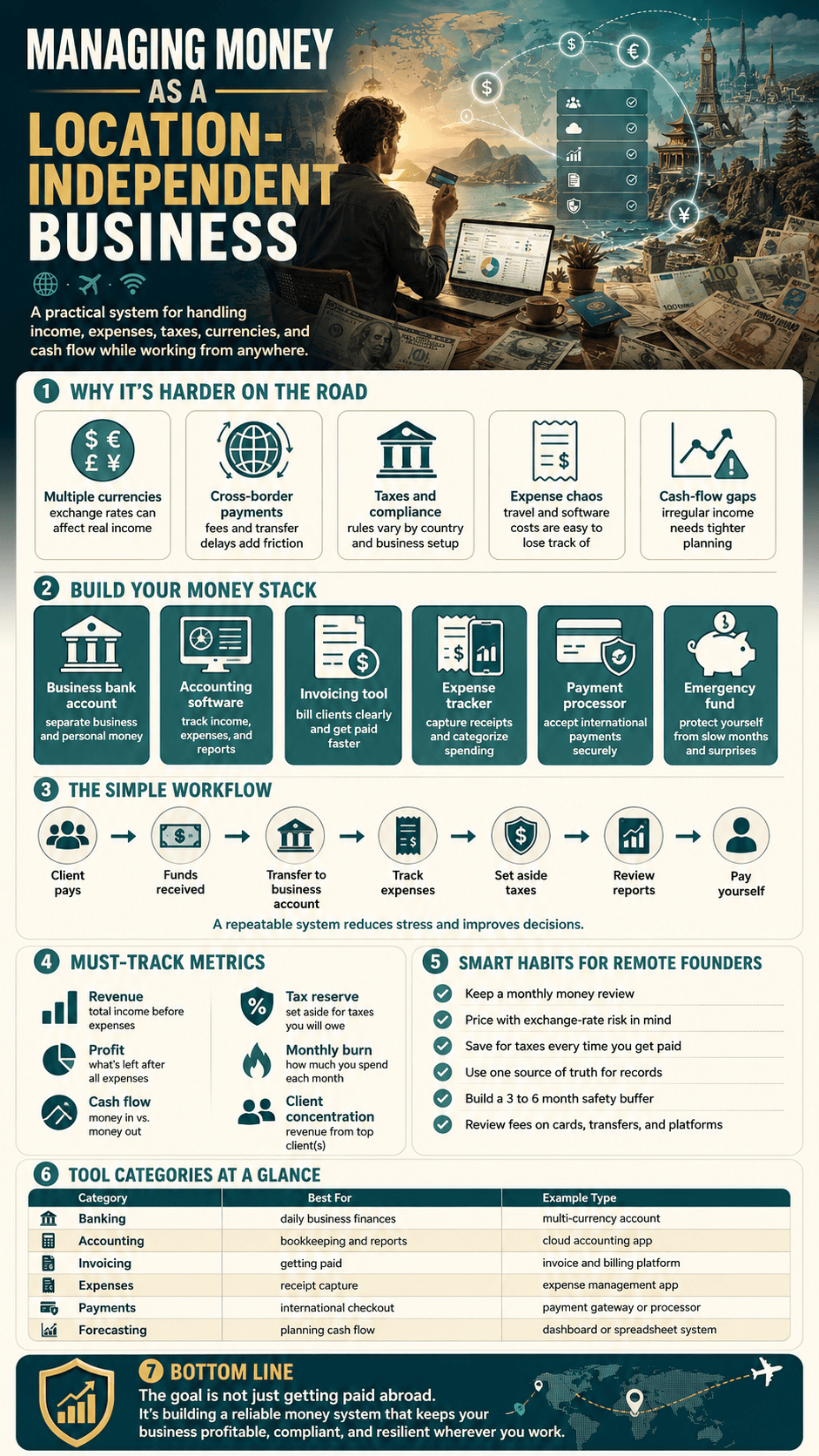
Managing Money as a Location-Independent Business
Manage global payments, currencies, fees and records with a simpler financial setup built for location independent businesses.

Location-independent businesses face a money problem that office-bound companies rarely think about: revenue and expenses arrive in different currencies, across different countries, often faster than traditional banking can comfortably handle. Solving it well is part of what makes remote-first operations sustainable. One tool that has become genuinely useful here is the crypto card.
Banking That Actually Moves With You
Crypto cards solve spending. They don’t solve the more basic problem of receiving client payments and holding operating capital in a way that survives a change of address every few months.
Wise Business and Payoneer both handle this differently than a traditional bank: neither requires a fixed local address to open, both issue local account details in major currencies so clients can pay like a local, and both give a founder the same access whether they’re in Lisbon or Bangkok. The difference that matters for a genuinely location-independent operation, rather than one just serving international clients from a fixed office, is app-based access and support that doesn’t assume a home-country phone number or an in-person branch visit.
The mirror image of this, converting crypto payments received from clients into usable fiat rather than crypto spent through a card, runs on the same kind of infrastructure: on-ramps and off-ramps designed for business use rather than personal trading.
If a client asks to pay you in stablecoins, settle three things before you send the invoice: the token, the network and how you will cash out. Our guide to getting paid in stablecoins walks through each step, from the invoice wording to the records the IRS expects.
All of this assumes money can move freely. In markets with capital controls it cannot, and the regulator’s limits decide the route before any provider does. Ukraine is the clearest current example, and our guide to Ukraine’s currency rules for foreign businesses explains how those limits work in 2026.
Tax Residency: The Question Location-Independent Businesses Skip
Managing currencies and payment fees is the visible problem. The bigger, quieter risk is figuring out where the business and its founder actually owe taxes, easy to get wrong simply by not addressing it.
Most countries use some version of the 183-day rule: spend 183 days or more there in a tax year, and that country generally considers you a resident. The rule is more commonly misunderstood than followed correctly. Germany can establish residency through a “habitual abode,” a home available to you, regardless of day count. The UK’s Statutory Residence Test weighs multiple tie-breaker factors beyond days present. And two countries can each independently conclude you’re their resident at the same time, which is how double taxation happens.
For US citizens specifically, moving the business or founder abroad doesn’t end US filing obligations, the US taxes based on citizenship, not residency. The Foreign Earned Income Exclusion lets qualifying individuals exclude up to $132,900 of foreign earned income for tax year 2026, but qualifying requires meeting a bona fide residence test or being physically present abroad for at least 330 full days in a 12-month period, and the exclusion has to be actively claimed, it isn’t automatic.
A residence permit does not settle the question on its own, either. An American who holds a Portugal Golden Visa and spends a few weeks a year there usually stays non-resident for Portuguese tax purposes, while one who moves on a D7 or D8 visa usually becomes a Portuguese tax resident, with very different results for local tax and even for the transfer tax on a home purchase. We break down how that plays out in our guide to Portugal residency for Americans.
This is genuinely a “consult an accountant familiar with cross-border tax situations” area, not a DIY spreadsheet problem, the residency question gets answered whether or not a founder deliberately addresses it.
How Crypto Cards Simplify Cross-Border Spending
The core friction is conversion and speed. When clients pay in stablecoins or crypto, the old routine was to move funds to an exchange, sell to fiat, withdraw to a bank, and wait. A crypto card collapses that cycle by letting you spend the balance directly, converting to local currency at the point of sale. For a business paying for software, ads, and travel across several countries, that can be both faster and simpler than juggling multiple fiat accounts and international transfer fees.
Understanding how crypto cards for spending actually work, and comparing providers directly, is worth the time once it’s clear the category fits how your business earns and spends.
Key Risks and Costs to Consider
The trade-offs are real and worth planning around. The conversion spread charged when crypto becomes fiat is the biggest hidden cost, and it compounds across a month of business spending, so it deserves close attention before anything else. Foreign-exchange fees on non-base-currency purchases matter especially for cross-border operators, and ATM terms come into play more on the road than at a desk. Clean transaction records are essential too, since spending crypto is often a taxable disposal and the reporting obligation sits with you.
Reliability and provider stability are the quiet dealbreakers. A declined payment to a supplier because of a slow conversion is a genuine operational cost, and a provider that suspends service or winds down can strand a working balance. Given how many card programs have closed over the years, favoring providers with a solid banking partner and a track record is simply prudent risk management for a business that depends on the tool.
For a location-independent business, the goal is a money setup that keeps pace with how you actually work: revenue turned into spending power with minimal friction, cost, and delay. A crypto card is not the whole answer, but for founders earning in digital assets across borders it can be a practical piece of the puzzle, provided it is chosen on fees, reliability, and issuer strength rather than on marketing. Compared deliberately, it quietly removes friction; chosen carelessly, it adds cost you will only notice later.
Frequently Asked Questions About Managing Money as a Location-Independent Business
It’s the common, though oversimplified, threshold many countries use: spend 183 days or more there in a tax year, and that country generally treats you as a resident. It’s a starting point, not a guarantee, since Germany and the UK can establish residency with fewer days based on having a home available or other ties.
It happens more often than people expect, since each country applies its own rules independently rather than checking with each other first. When it does, tax treaties usually include tie-breaker rules, permanent home, center of vital interests, habitual abode, to determine which country actually gets to tax you. This is exactly the situation where a professional familiar with the specific two countries involved earns their fee.
Yes. The US taxes based on citizenship, not residency, so filing continues regardless of where you live. The Foreign Earned Income Exclusion can reduce the bill, up to $132,900 for tax year 2026, but it must be actively claimed and requires meeting specific residency or physical presence tests.
Multi-currency business accounts like Wise Business or Payoneer are usually better suited than a traditional bank, since neither requires a fixed local address and both provide local account details clients can pay into directly.
Check three things specifically: whether they disclose their banking partner by name, not just “a licensed partner,” whether the card runs on Visa or Mastercard rails rather than a closed-loop system, and how long they’ve operated without a service disruption. A provider that won’t name its bank is the clearest single red flag.
It depends on where clients, founders, and revenue actually sit, and it’s worth deciding deliberately with a professional rather than defaulting to wherever is convenient. Malta is one concrete example worth understanding, an EU jurisdiction with transparent, published costs and explicit support for the same fintech tools already covered in this guide, but the right jurisdiction depends entirely on the specific business.
Infographic