Doing Business in Ukraine: Rules, Risks and Local Partners
The August 2026 currency easing, profit repatriation limits, Diia.City tax and war risk cover: what to plan before entering Ukraine.

Foreign companies looking at doing business in Ukraine usually arrive with one of two wrong pictures. Either a market too disrupted to consider, or a reconstruction boom already underway. Neither is accurate, and the gap between them is where most Ukraine market entry plans go wrong.
The accurate version is narrower and more useful. Martial law has been in force since 24 February 2022 and was extended for the twentieth time in July 2026, to 31 October 2026. Currency controls still apply, but the National Bank of Ukraine (NBU) eased them in January, April and again in August 2026, when it adopted its largest liberalisation package since the full-scale invasion. Formal EU accession talks moved into their substantive phase in June 2026. And Ukrainian firms have kept exporting software, engineering, design and agritech services throughout the war, which is why the talent and delivery capability are genuinely there.
What has not changed is the pace. The rules that govern how you move money into and out of Ukraine shift several times a year, which is the strongest argument for working with someone local instead of researching the market once and filing the notes.
This guide covers the operating conditions foreign companies have to plan around in 2026, how to set up an entity and how it will be taxed, what local consultants actually deliver, a three-phase entry roadmap, and the questions that separate a partner who knows the current position from one working off a summary written eighteen months ago.
Last verified: 5 October 2026. Ukraine’s wartime rules change often, so check every date and limit against the sources linked in this guide before acting on it.
Table of contents
- Ukraine at a Glance for Foreign Companies in 2026
- Why Ukraine’s Consulting Market Is Different Right Now
- The Operating Conditions Foreign Companies Have to Plan Around
- How to Set Up a Business in Ukraine: Entity, Banking and Tax
- What Local Consultants Actually Deliver
- Business Development Strategies That Work in Ukraine
- The Digital Growth Layer
- Where AI Fits Into the Picture
- What EU Accession Talks Change, and What They Don’t
- Practical Roadmap for Foreign Companies
- What to Ask When Choosing a Consultant
- Sample Budget and Timeline
- Risks to Watch and How to Reduce Them
- The Payoff for Working With Local Experts
- What Foreign Companies Ask About Martial Law, Profits and Partners in Ukraine
- Five Conditions to Price In Before Entering Ukraine
Ukraine at a Glance for Foreign Companies in 2026
If you only read one part of this guide, read this table. It summarises the position as of October 2026, and every row is explained further down.
| Topic | Position as of October 2026 | What it means for you |
|---|---|---|
| Martial law | In force since 24 February 2022; the twentieth 90-day extension runs to 31 October 2026 | Plan staffing, travel and insurance on the assumption it continues |
| Currency controls | NBU Resolution No. 18 still governs; eased in January, April and August 2026 | Confirm the current version before you structure any cross-border flow |
| Dividend repatriation | Allowed within a monthly cap plus incentive limits (investment, donation, loan and additional) | Model the extraction route, not just the profit |
| Settlement deadlines | 180 days for most goods; 270 days for some machinery, pipe and rail exports; most services exempt | Match payment terms and Incoterms to the deadline |
| Corporate tax | 18% standard; Diia.City residents can opt for 9% on distributed profit | Tech companies should compare regimes before incorporating |
| EU accession | Formal talks opened on Cluster 1 (June 2026) and Cluster 6 (July 2026) | Build compliance to EU standards now |
| War risk insurance | Available from Ukraine’s Export Credit Agency, MIGA, DFC and a few private insurers | Price cover before signing anything with a physical footprint |
| Website language | Ukrainian version must load by default for companies registered and selling in Ukraine | Build the Ukrainian site first and add other languages alongside it |
Why Ukraine’s Consulting Market Is Different Right Now
Ukraine combines a highly educated workforce, a maturing tech ecosystem and an export habit that survived the full-scale war. Diia.City, the special legal and tax regime for technology companies, had more than 4,500 resident companies by mid-2026, including hundreds of defence-tech firms. Local consultants operate in that environment daily. They bring a direct approach, clear KPIs and a bias for measurable outcomes, largely because anything else stopped being affordable in 2022.
One distinction worth stating plainly. Reconstruction planning is under way, and reconstruction is not the same as recovery. Any consultant, article or pitch deck describing Ukraine as a post-war market is describing a future state rather than current operating conditions, and for anyone investing in Ukraine that distinction changes budgeting, insurance, staffing and timelines.
Within those conditions, three forces define the current moment. Rebuilding and defence-adjacent demand create real need for operational excellence, compliance and financing strategy. Global buyers want resilient supply options, which makes nearshoring a live conversation rather than a slide. And digital adoption has accelerated sharply, with many Ukrainian small and mid-sized businesses now asking for data-informed marketing and channel analytics before they ask for a logo. That shift favours consultants who blend management skills with growth and product thinking.
Reconstruction, energy, logistics and defence-linked manufacturing are where most new foreign interest is concentrated. Each carries different regulatory exposure, so treat sector selection as a compliance question as much as a commercial one.
The Operating Conditions Foreign Companies Have to Plan Around
Four constraints shape every Ukraine market entry decision, and most consulting overviews skip all of them.
Currency restrictions are being eased, not removed. NBU Resolution No. 18 of 24 February 2022 established the wartime foreign exchange regime and remains the governing instrument. The NBU has amended it repeatedly, and 2026 has been the busiest year yet:
| Effective date | What changed | Who it matters to |
|---|---|---|
| 14 January 2026 | New loan limit for funds borrowed abroad; exports of insurance services freed from settlement deadlines | Companies with foreign lenders or shareholders |
| 1 March 2026 | Settlement deadline raised from 180 to 270 days for certain agricultural and specialised machinery exports | Machinery exporters |
| 25 April 2026 | Companies may pay non-resident board members into foreign accounts, for remuneration due from 1 May 2026 | Groups with foreign directors |
| 15 June 2026 | 270-day deadline extended to some pipe and railway component exports | Industrial exporters |
| 11 August 2026 | Resolution No. 90: the largest package since 2022 by number of measures, with higher corporate limits, a new additional limit and limits transferable within a business group | Almost every foreign-owned business |
| 1 September 2026 | Banks begin phasing reserves into their open currency position calculations | Banks, and indirectly their corporate clients |
The direction is consistently toward opening. The regime is still a restricted one, and it now changes more often than most companies review their structures.
Dividend repatriation is the constraint foreign investors raise first. Getting profit out of Ukraine is possible, but it runs through defined channels rather than freely. The base channel is a monthly cap on dividend payments. On top of that sit incentive limits that let a company send more abroad in proportion to new money it brings in, each with its own conditions, as the NBU’s own announcement of the loan limit shows. In practice, the route out depends on where the money came from:
| Where the money comes from | Route out | What to check |
|---|---|---|
| Ordinary operating profit | Dividends within the monthly cap | The cap stood at EUR 1 million per month after the August 2025 changes; confirm the current figure with your bank |
| Equity injected by foreign investors since 12 May 2025 | Investment limit | Equal to the new capital; allows transfers above the standard limits within that amount |
| Cross-border loans received after 1 January 2026 | Loan limit | Transactions must go through the bank that received the loan |
| Direct charitable contributions to military units of the Armed Forces or National Guard made from 10 August 2026 | Additional limit | Usable for dividends, older import settlements, external loans and funding foreign representative offices |
| An unused investment or additional limit held by another company in your group | Transfer within the business group | Written consent from the limit holder, and both companies must use the same bank |
| None of the above | Individual NBU permit | You must show the transaction’s importance to state interests during martial law |
A separate donation limit also exists, and banks apply each limit with their own documentation requirements, so confirm with your bank which route fits before you plan a payment. Anyone modelling returns on a Ukraine operation needs to model the extraction path, not just the profit.
Settlement deadlines are compressed for goods, not services. Most export and import transactions in goods must settle within 180 days, half the pre-war 365. In 2026 the NBU extended that to 270 days for certain agricultural and specialised machinery exported from 1 March and for some pipe and railway component exports from 15 June, in both cases at the government’s request. Services other than transport sit outside the deadline regime entirely, which is good news for software and design exporters. For goods traders, the deadline interacts directly with the Incoterms and payment terms in your contracts and with whoever handles the shipment, so it is worth knowing what freight forwarder duties actually cover before you agree terms with a Ukrainian counterparty.
Individual permits are a route, not a loophole. Where a transaction falls outside the permitted categories, an individual NBU permit can be sought, but the applicant must demonstrate the transaction’s importance to state interests during martial law. That is a real bar and a real timeline.
What to do with this. Verify the current position before committing to anything, because it moves. The authoritative summaries are maintained by the major firms, and PwC’s Worldwide Tax Summaries page for Ukraine tracks the currency control provisions and their amendment history. Ask any consultant you shortlist which resolution version they are working from and when they last checked. A consultant who cannot name Resolution No. 18, or who has not read Resolution No. 90 of 10 August 2026, is not operating at the level this market requires.
The reason to work with a local partner is precisely this. Not because the rules are impossible, but because they are specific, they change, and the gap between the general position and your particular transaction is where the money and the delay live.
How to Set Up a Business in Ukraine: Entity, Banking and Tax
Most foreign companies choose between three structures. A limited liability company, known locally as a TOV, is the standard trading vehicle and can be wholly foreign-owned. A representative office is cheaper to run but is generally limited to non-commercial work such as liaison and market research. And companies that only need people, not a legal presence, can hire through an employer of record or contract individual specialists, which avoids an entity at the cost of some control.
The decision framework is the same one you would use anywhere. The four questions in this guide to market entry, hiring and EOR arrangements in France apply here too, with different answers once currency controls and martial law are factored in.
Registration itself is rarely the bottleneck. Opening a bank account for a foreign-owned company is, because banks run full checks on ultimate beneficial owners and the source of funds, and sanctions screening adds time for any ownership chain that touches higher-risk jurisdictions. Budget weeks rather than days for banking, and have notarised and apostilled corporate documents ready before you start.
| Tax | Standard rate in 2026 | Notes |
|---|---|---|
| Corporate income tax | 18% | Banks pay 50% in 2026 and some non-bank financial institutions 25% |
| Diia.City option | 9% on distributed profit | Alternative to 18% for qualifying tech residents; tax is due when profit leaves the company |
| Defence City | Corporate income tax exemption | For defence technology companies earning at least 75% of income from qualifying activity, subject to conditions |
| Withholding tax on payments to non-residents | 15% | Reduced under double tax treaties when beneficial ownership is confirmed |
| VAT | 20% | A reduced 7% rate applies to some medical goods |
| Personal income tax | 18% plus a 5% military levy | Applies to employee salaries |
These rates follow the Chambers Corporate Tax 2026 guide to Ukraine and other 2026 practitioner summaries. They can change with each budget, so confirm them with a Ukrainian tax adviser before you model anything. The Diia.City choice deserves particular attention. Residents on the 9% regime pay when profit is distributed, and Ukrainian practitioners point out that a wide range of payments can be treated as distributions, which is one reason a majority of residents still choose the standard 18%.
What Local Consultants Actually Deliver
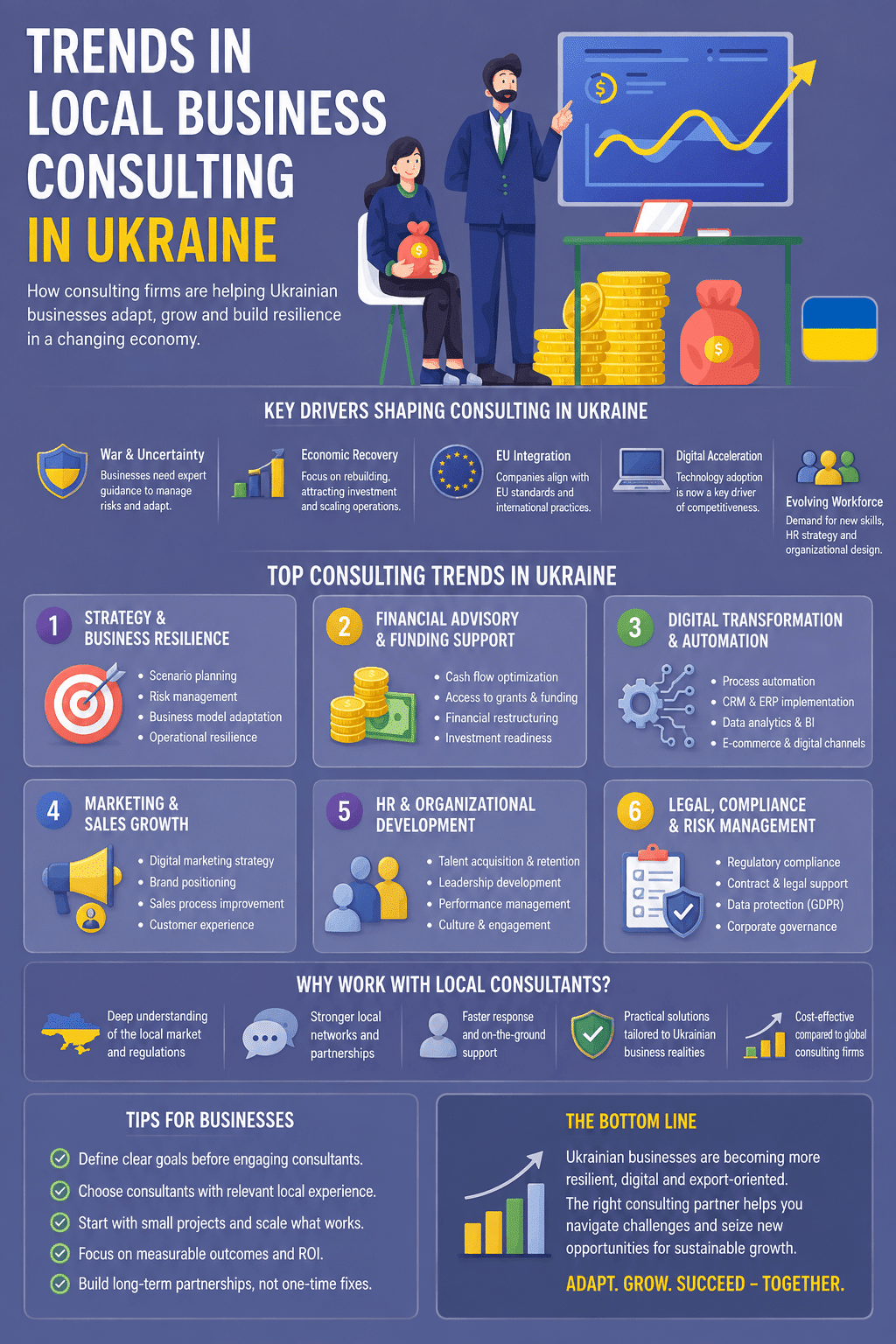
Local business consultants in Ukraine tend to focus on a practical bundle of services. Market entry mapping, legal and tax coordination, vendor and site selection, hiring plans and performance marketing are the common starting points. From there, the conversation usually moves to pricing strategy, partnerships and localisation, since the Ukrainian buyer journey differs from the US or EU in small but important ways.
The best firms also act like integrators. They will help you connect your finance stack to local banks, align VAT and export rules with your ERP, and stand up a simple analytics suite so you can see what is working. This is not busy work. It is the plumbing that keeps a new country operation from stalling.
Which Type of Local Partner You Actually Need
“Local consultant” covers very different businesses, and many entry problems start with hiring the wrong type for the job.
| Partner type | Best for | Watch for |
|---|---|---|
| International advisory or law firm with a Kyiv office | Structuring, tax opinions, currency control analysis, large transactions | Fees, and how much senior attention a smaller mandate really gets |
| Ukrainian law and tax firm | Entity setup, contracts, employment, NBU permit applications | Depth varies by practice area, so ask who leads your matter |
| Independent on-the-ground advisor | Coordinating paperwork, banking introductions, logistics and property for a client who is not in the country | Which licensed professionals sign off the regulated parts |
| Employer of record or payroll provider | Hiring without an entity | Mobilisation rules and IP assignment clauses |
| Growth or sector consultancy | Market research, partner search, demand generation | Claims about access that cannot be verified |
The independent advisor model is the least understood from abroad. These are individuals or small teams who handle what a foreign client cannot do remotely, such as obtaining a tax ID, coordinating notaries and banks, arranging logistics or managing a property purchase, and who bring in licensed lawyers and accountants where the law requires them. Advisors who offer this kind of accompanying support for business in Ukraine can save weeks for a company with nobody on the ground. The same test applies to them as to a large firm: they should be able to tell you which parts of your plan they handle directly, which parts go to a licensed professional, and how they keep up with NBU changes.
Business Development Strategies That Work in Ukraine
You can win quickly if you focus on five plays that local consultants keep using with good results.
- Start with real customer interviews. Ukrainian B2B buyers are direct. They will tell you what they need if you ask. A local consultant gets you in the room, runs interviews in Ukrainian, and translates feedback into a short set of non-negotiables for product and service delivery.
- Build a channel partner mesh. Distributors and regional resellers remain powerful. Consultants can identify trusted partners in industrial regions, then negotiate tiered discounts and service level expectations. The outcome is faster coverage with controlled risk.
- Treat compliance as a growth lever. Certifications, safety standards and export paperwork are not only checkboxes. When your materials show clean compliance, procurement moves faster. Local advisors know which auditor to call and which document actually matters.
- Localise pricing and payment flows. Card rails, currency options, invoicing cadence and tax receipts affect conversion rates. Consultants tune these flows so your first month feels normal for a Ukrainian customer. That small drop in friction often pushes you past competitors who did a quick translation and nothing else.
- Invest in reputation early. Case studies, Ukrainian-language pages, office hours on Telegram and Viber, plus participation in local chambers and tech clusters raise trust. For industrial and B2B offers, the Ukrainian site needs the same things procurement teams look for anywhere, including specs, certifications and named projects, which is what makes an industrial website effective for modern B2B buyers. A consultant can seed that presence within a few weeks because they already know the communities.
The Digital Growth Layer
Even in traditional sectors, digital growth is not optional. Local consultants increasingly bundle SEO, paid search, analytics and basic CRO, and they do it for feedback speed rather than convenience. Owning both the go-to-market plan and the first wave of demand generation means propositions get tested in weeks rather than quarters, which is the same logic behind performance marketing approaches that lower B2B acquisition costs.
Three Ukraine-specific details shape that plan. The first is language. Since 16 July 2022, businesses registered in Ukraine that sell goods or services there must load the Ukrainian version of their website by default for Ukrainian users, with at least as much content as any other language version, as Ukraine’s language ombudsman explains. The second is channels. Russian platforms such as Yandex and VKontakte have been blocked since 2017, so search effectively means Google, while Telegram channels and Viber communities work as news feeds and sales channels in a way they rarely do in EU markets. The third is marketplaces. For consumer goods, Rozetka and Prom.ua are often where buyers compare prices before they ever reach a brand site, so listing quality there can matter as much as your own SEO.
Expect a strong push on page speed, structured data, Ukrainian-language content and Google Business Profiles. Expect a clear handoff between paid channels that collect initial signal and organic content that compounds. And expect dashboards that compare a regional landing page against a national offer in a single view.
Where AI Fits Into the Picture
Ukrainian teams are pragmatic about AI, partly because the alternative to efficiency has not been available since 2022. It gets used to accelerate research, summarise regulation, produce first-pass drafts and score leads. That is unremarkable, and it is not where the interesting question sits.
The interesting question is governance, and it is sharper here than elsewhere. A consultant summarising NBU currency rules with a language model is summarising a document that has been amended dozens of times, including a major package in August 2026, where the model’s training data may predate the version that applies to your transaction. The same applies to sanctions screening, export classifications and anything touching defence-adjacent goods, where the cost of a confidently wrong answer is not a bad draft but a blocked payment or a compliance breach.
What a good consultant does with this is set explicit boundaries: which tasks AI handles, which require a named human with current source documents, and how outputs get verified and documented. Ask directly. A consultant who says they use AI extensively and cannot describe the verification step is describing a speed advantage you will pay for later.
The useful framing is that AI compresses the research phase and changes nothing about the accountability phase. In a regulatory environment that moves several times a year, that distinction is the whole thing.
What EU Accession Talks Change, and What They Don’t
Ukraine applied for EU membership in February 2022, and formal talks moved into their substantive phase on 15 June 2026, when the EU opened Cluster 1, the fundamentals. Cluster 6, external relations, followed on 14 July 2026, and as the Ukrainian government’s announcement of Cluster 6 sets out, its trade chapter covers the EU’s common commercial policy, export controls and investment protection. The remaining four clusters, including the internal market, come next, and the Ukrainian government has said it aims to provisionally close negotiations by the end of 2028. Some integration is already happening ahead of membership: Ukraine joined the EU’s roaming area on 1 January 2026.
For a foreign company, three things follow. First, standards alignment is already a sales argument, because Ukrainian buyers in procurement-heavy sectors increasingly ask whether a supplier’s products and documentation meet EU requirements. Second, the direction of regulation is predictable even when the timing is not, since each cluster comes with written benchmarks. Third, and this is the part pitch decks skip, accession talks change nothing about martial law, currency controls or war risk today. Treat EU integration as a reason to build compliance properly from day one, not as a reason to assume the operating conditions above will disappear on a set date.
Practical Roadmap for Foreign Companies
If you want to work with a local consultant and move quickly, use this three-phase roadmap. Most of the mistakes it guards against are the same ones that explain why companies fail when entering new markets anywhere; Ukraine simply punishes them faster.
Phase one: discovery and feasibility. Define the goal, constraints and non-negotiables. Commission a short feasibility study that covers target regions, buyer personas, regulatory exposure, the dividend extraction route and early budget. Ask for two or three entry hypotheses, not one.
Phase two: pilot and proof. Pick one region and one channel. Launch a narrow offer with very clear acceptance criteria, such as distributor readiness, the first ten B2B meetings, or one signed contract within ninety days. Keep the loop tight between field feedback and messaging.
Phase three: scale and systematise. Lock in partner agreements, standardise onboarding and replace manual processes with simple automations. Expand to the next region only after the first one hits pre-agreed thresholds for margin and retention.
What to Ask When Choosing a Consultant
Good consultants in Ukraine will invite tough questions. These seven separate a partner who knows the current position from one who is improvising:
- How do you measure success, and how often will we see the data?
- Which of your assumptions failed recently, and what did you change?
- Which version of NBU Resolution No. 18 are you working from, and when did you last check?
- How will our dividends or service fees get out of Ukraine, and under which limit?
- What are your business continuity arrangements, and when did you last use them?
- How do you handle mobilisation risk in staffing plans?
- Who exactly does the work in the first sixty days, and can we speak to two named clients?
Those questions are the filter. A partner who knows the market answers them without preparation, whether it is a large firm or a one-person advisory. The ones who cannot are usually reselling access they source elsewhere. Ask early, because the answers are cheap to give and expensive to fake.
Sample Budget and Timeline
Use this table as a starting point. The numbers are illustrative 2026 ranges in US dollars and should be tuned to your sector and scope. They exclude government fees and insurance premiums.
| Workstream | Typical deliverables | Suggested timeline | Ballpark cost range |
|---|---|---|---|
| Market entry discovery | Feasibility study, risk matrix, partner shortlist | Weeks 1 to 3 | 4,000 to 9,000 USD |
| Legal and tax setup | Entity guidance, banking, VAT, compliance checklist | Weeks 2 to 6 | 3,000 to 8,000 USD plus fees |
| War risk and continuity | Insurance review and applications, backup power and staffing plan | Weeks 2 to 12 | Quoted per policy and project |
| Go-to-market pilot | Localised offer, landing pages, paid test, CRM setup | Weeks 4 to 10 | 6,000 to 18,000 USD plus media |
| Channel build | Distributor contracts, enablement kits, SLAs | Weeks 8 to 16 | 5,000 to 12,000 USD |
| Growth and analytics | SEO foundations, reporting, conversion fixes | Weeks 6 to 20 | 3,000 to 10,000 USD monthly retainer |
Risks to Watch and How to Reduce Them
The commercial risks in any market entry are timeline slippage, regulatory surprises and partner misalignment. Reduce slippage with weekly standups, shared task trackers and a clear change control rule. Reduce regulatory surprises by using a local legal partner who reviews each major step. Reduce partner issues with short initial contracts, transparent targets and playbooks that spell out responsibilities.
Ukraine adds five more, and they should be planned for explicitly rather than discovered.
Physical and operational security. Energy infrastructure and logistics have been targeted throughout the war. Business continuity planning here means backup power, distributed teams and delivery schedules with genuine buffer, not the nominal kind. Ask any partner what their continuity arrangements actually are and when they last used them.
Workforce availability. Mobilisation affects staffing in ways that differ by sector and by role, and under rules in force since August 2025, men aged 22 to 60 generally cannot leave Ukraine without an exemption, which matters for client visits and trade fairs. Build succession into any plan that depends on named individuals, and discuss it directly with your partner rather than treating it as a sensitive topic to avoid. Many foreign companies end up running a distributed team with people inside and outside Ukraine, so set overlap hours and handoff rules early. Our guide to managing time zones in business covers the mechanics, including why Kyiv and New York share only about one hour of a standard working day.
Insurance and war risk cover. Standard commercial policies typically exclude war risk, but cover does exist. According to UkraineInvest’s overview of war risk insurance, Ukraine’s Export Credit Agency has accepted war risk applications since 2024 from Ukrainian and foreign investors holding at least 10% of a project. The World Bank’s Multilateral Investment Guarantee Agency (MIGA) and the US International Development Finance Corporation (DFC) both offer political and war risk cover, and in June 2026, at the Ukraine Recovery Conference in Gdańsk, they signed a framework to insure projects backed by the US-Ukraine Reconstruction Investment Fund. A few private insurers have launched their own products. All of it is priced accordingly and easier to obtain for larger, well-documented projects. Establish what is covered, what is excluded and at what cost before signing anything with a physical footprint.
Currency and repatriation. Beyond ordinary volatility, the capital controls above determine how and when funds move. Invoicing in a stable currency helps with the first problem and does nothing for the second. Model the extraction path as carefully as the revenue, and have your consultant run sensitivity scenarios before you commit.
The practical mechanics of moving money across borders under restriction are covered further in this look at managing money as a location-independent business.
Sanctions and counterparty screening. Ownership chains in the region can be opaque. Screen distributors, suppliers and co-investors, including their ultimate beneficial owners, against EU, UK, US and Ukrainian sanctions lists before signing, and repeat the check when the lists change. Ukrainian banks will run their own checks on you, and a counterparty flagged after the fact can freeze payments for weeks.
None of this argues against Ukraine as a market. It argues for entering it with the constraints modelled rather than assumed, which is the difference between a plan and a hope.
The Payoff for Working With Local Experts
The case for a local partner is not cultural fluency, though that helps. It is that the specific things determining whether your Ukraine operation works are all local, current and changing.
Which NBU resolution version applies to your transaction this quarter. Which limit your dividend can leave under. Which auditor is actually accepted by the counterparty you are trying to sell to. What a distributor in a particular oblast can genuinely deliver given current logistics. Whether the personnel your plan depends on are subject to mobilisation. None of that is knowable from outside, and none of it stays true long enough to research once.
What you are buying is a shorter distance between a decision and accurate information about it. In a stable market that is worth some money. In a market where the currency rules changed at least five times between January and August of this year, it is the difference between a plan that survives contact and one that gets rewritten after the first blocked payment.
The honest limit is worth naming too. A good consultant compresses your learning curve and does not remove the risk. Martial law, currency controls, mobilisation and physical security are conditions of the market rather than problems a partner solves. What a partner does is make sure you priced them in before you committed rather than discovering them in month four.
What Foreign Companies Ask About Martial Law, Profits and Partners in Ukraine
Yes. Martial law was introduced on 24 February 2022 and has been extended in 90-day blocks ever since. The twentieth extension, approved in July 2026, keeps it in force until 31 October 2026, and parliament normally votes on the next one in the weeks before it expires. It shapes banking, currency movement, travel and staffing, so plan on the assumption that it continues.
Yes, within defined channels rather than freely. Dividends can be paid abroad within a monthly cap, and incentive limits let a company send more in proportion to new money it brings in: an investment limit for foreign equity injected since 12 May 2025, a loan limit for cross-border loans received after 1 January 2026, and an additional limit created in August 2026. Since August 2026, investment and additional limits can also be shared within a business group. Model the extraction route alongside the revenue projection.
Several times a year. In 2026 the NBU eased restrictions in January, April and August, and lengthened export settlement deadlines for specific goods in March and June. The August package, adopted as Resolution No. 90, was the largest since 2022 by number of measures. Verify the current position before any commitment rather than relying on a summary, including this one.
For most export and import transactions in goods, 180 days. Exports of certain agricultural and specialised machinery (from 1 March 2026) and some pipes and railway components (from 15 June 2026) have 270 days. Services other than transport are not subject to settlement deadlines. Build these limits into payment terms and Incoterms before you sign.
If your company is registered in Ukraine and sells goods or services there, yes. Since 16 July 2022, the state language law has required those businesses to load the Ukrainian version of their website by default for Ukrainian users, with at least as much content as any other language version. Other languages can sit alongside it. Even where the rule does not strictly apply, a Ukrainian-first site is what local buyers expect.
Most register a limited liability company, known locally as a TOV, which can be wholly foreign-owned, or open a representative office for non-commercial liaison work. Companies that only need staff often use an employer of record instead. Registration is usually quick; opening a bank account takes longer because banks verify ultimate beneficial owners and the source of funds, so prepare notarised and apostilled corporate documents before you start.
The standard corporate income tax rate is 18%, VAT is 20%, and most payments to non-residents carry 15% withholding tax unless a tax treaty reduces it. Diia.City is a special legal and tax regime for tech companies that lets residents choose a 9% tax on distributed profit instead of 18% on all profit. Defence City offers qualifying defence technology companies a corporate tax exemption. Rates change with each budget, so confirm them with a Ukrainian tax adviser.
Yes, though it is priced accordingly and easier to obtain for larger, well-documented projects. Options include Ukraine’s Export Credit Agency, which has accepted war risk applications since 2024 from investors holding at least 10% of a project, the World Bank’s MIGA, the US DFC and a few private insurers. Standard commercial policies typically exclude war risk, so check the exclusions before signing anything with a physical footprint.
Which NBU resolution version they are working from and when they last checked, which limit your dividends or fees would leave under, what their business continuity arrangements are and when they last used them, how they handle mobilisation risk in staffing plans, and who does the work in the first sixty days. Ask for named references and for an assumption that failed recently and what they changed as a result.
Not yet in the ways that matter most. Formal talks opened on Cluster 1 in June 2026 and Cluster 6 in July 2026, and each cluster comes with written benchmarks that make the direction of regulation predictable. Accession talks do not lift martial law, currency controls or war risk, though. The practical step is to build products and compliance to EU standards now, because Ukrainian buyers increasingly ask for it.
Five Conditions to Price In Before Entering Ukraine
Ukraine is a real market with real constraints, and the constraints are specific rather than vague. Price in these five before you commit:
- Martial law remains in force. Plan staffing, travel and insurance as if it continues.
- Capital controls change several times a year. Check the current NBU position before every structural decision.
- Dividend repatriation runs through defined limits. Know which limit your money will leave under before you invest.
- Settlement deadlines are compressed for goods. Match payment terms and Incoterms to 180 or 270 days.
- War risk sits outside standard insurance. Price specialist cover before signing anything with a physical footprint.
None of that argues against doing business in Ukraine. It argues for entering with those five conditions priced in, and for choosing a partner who can tell you which NBU resolution applies to your transaction this quarter. The consultants worth hiring will answer that without preparation. The rest will change the subject.
Written by Claudio Pires, Editor at Growwwth. Last verified 5 October 2026 against announcements from the National Bank of Ukraine, Verkhovna Rada records, EU and Ukrainian government statements and published 2026 tax guides. This article is general information, not legal, tax or investment advice. Ukraine’s wartime rules change often, so confirm the current position with a licensed adviser before acting. Growwwth has no commercial arrangement with any firm, advisor, insurer or provider mentioned in this article; the independent advisor linked in the partner section is included as an example of that partner model, not as an endorsement.
