Expanding Your Business to France: Hiring & EOR Guide: Hiring & EOR Guide
What hiring in France really costs, the contract rules foreign employers miss, and when an EOR makes more sense than a French entity.

France is one of Europe’s largest economies and an attractive destination for international companies looking to reach new customers, access highly skilled professionals and establish a stronger presence within the European Union.
Yet entering the French market involves more than identifying commercial opportunities. Companies planning to build a local team need to understand employment regulations, payroll obligations, employee protections and the practical implications of becoming an employer in France.
For businesses that want to move quickly, choosing the right employment model can be as important as choosing the right market strategy.
Why Companies Expand to France
France offers international businesses access to a large domestic market, sophisticated infrastructure and a highly educated workforce across technology, engineering, finance, manufacturing, life sciences, professional services and many other sectors.
Paris remains an important European business hub, while cities such as Lyon, Toulouse, Lille, Bordeaux, Nantes and Marseille offer their own specialised talent pools and industry ecosystems.
For foreign companies, expansion into France may involve several different objectives:
- establishing a commercial or sales presence;
- recruiting technical specialists;
- building a local customer support team;
- hiring senior executives;
- testing demand before opening a permanent entity;
- supporting existing customers in the French market;
- creating a wider European operational base.
The commercial opportunity can be significant. The challenge is building the local organisation in a way that supports growth without introducing unnecessary employment and compliance risks.
What French Employment Law Actually Requires
The list of things to get right is short. The details inside each item are where foreign employers get caught.
Contracts
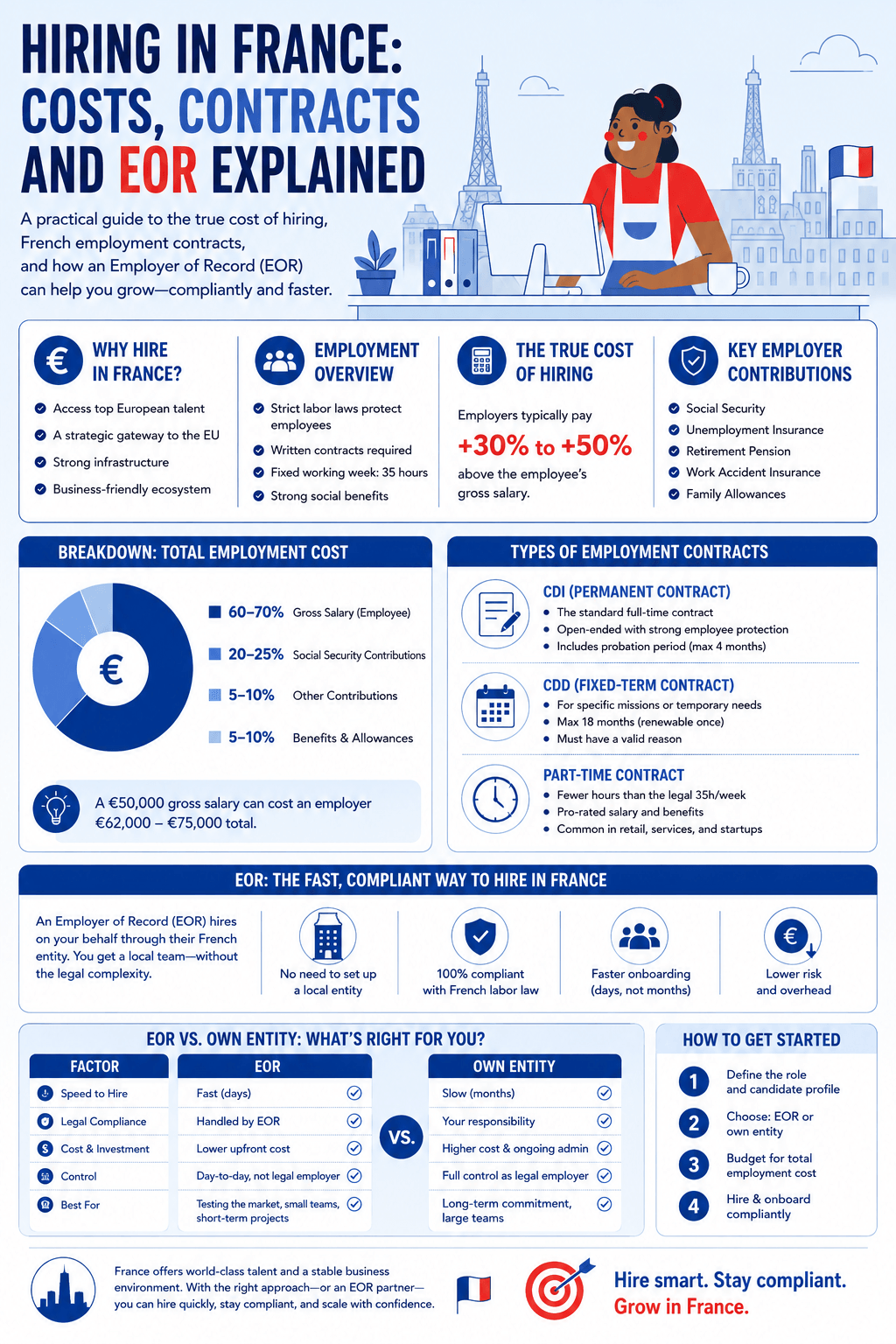
The CDI, an open-ended contract, is the legal default. French law presumes it, and a fixed-term CDD requires a specific statutory justification such as replacing an absent employee or covering a temporary workload surge. You cannot simply prefer a fixed term.
Two details that surprise people:
- The contract must be drafted in French. If it isn’t, the company cannot rely on its terms against the employee, though the employee can still rely on them against the company. This asymmetry catches out companies that issue their standard English contract with a translation attached as a courtesy.
- CDD caps at 18 months including renewals, and the employee receives a 10% end-of-contract premium, the prime de précarité, as compensation for insecurity.
Trial periods
Shorter than most non-European employers expect, and tiered by category: up to 2 months for workers, 3 for supervisors, 4 for cadres, renewable once where the collective agreement permits.
Working time
The legal week is 35 hours. Many French companies run 39-hour contracts, with the additional four hours paid at a 25% overtime premium. A 39-hour contract priced as though it were 35 is a compliance problem, not a negotiation.
Pay floors
| As of 1 June 2026 | |
|---|---|
| SMIC, hourly gross | €12.31 |
| SMIC, monthly gross (35h) | €1,867.02 |
| Employee contributions | roughly 20% to 23% of gross |
| Employer contributions | roughly 40% to 45% on top of gross |
Two things about that table matter more than the figures.
SMIC moved twice in 2026, on 1 January and again on 1 June via the automatic inflation adjustment that triggers when prices rise more than 2% since the last revision. Any budget built on a single annual figure will drift.
Sector collective agreements routinely set minimums above SMIC. The national figure is a floor, not the applicable floor. Metallurgy, chemicals and construction all have negotiated minimums, and the relevant one depends on your activity code rather than your preference.
The number foreign employers underestimate
Employer social contributions add roughly 40% to 45% to gross salary, covering health, pensions, unemployment, family allowances and workplace accident cover. A €50,000 salary is a €70,000 to €72,500 cost before benefits.
On top of that, complementary health insurance (mutuelle) is mandatory for all private-sector employees, with the employer covering at least half the premium.
Anyone modelling a French hire against a US or UK cost base and forgetting this line will be out by roughly a third.
For the authoritative position on any of the above, the French government’s Code du travail is published in full on Légifrance, and contribution rates and ceilings are published by CLEISS. Figures change, sometimes mid-year, so verify against those rather than any secondary summary including this one.
Should You Open a Legal Entity in France?
Establishing a French company can make sense for organisations planning substantial and permanent operations in the country.
A local entity gives a business a direct corporate presence and may be appropriate when the company intends to develop significant commercial activity, hire a large workforce or make France a long-term operational centre.
However, incorporation also creates additional responsibilities.
Businesses must consider company registration, accounting, tax administration, payroll infrastructure, HR processes, employment compliance and ongoing corporate governance.
For organisations entering the market with only a few employees, the investment may be disproportionate to the initial size of the operation.
This is why many companies first explore whether they can hire employees in France without establishing their own legal entity.
One increasingly common solution is an Employer of Record.
How an Employer of Record in France Works
An Employer of Record, often referred to as an EOR in France, allows an international company to employ professionals locally without immediately establishing its own French entity.
Under the arrangement, the Employer of Record becomes the legal employer of the worker in France.
The client company continues to manage the employee’s practical work, including responsibilities, objectives, projects and performance, while the EOR handles the formal employment infrastructure.
Depending on the service model, this can include:
- compliant employment contracts;
- employee onboarding;
- payroll administration;
- salary payments;
- statutory deductions and employer contributions;
- employment documentation;
- HR administration;
- local compliance support;
- employee offboarding.
For foreign businesses, the main advantage is not simply administrative convenience. An EOR can reduce the amount of infrastructure that must be created before the company makes its first hire.
This can be particularly valuable when speed matters.
When an EOR Makes Sense for Expansion to France
An EOR service in France is not necessarily the right structure for every organisation, but it can be highly effective in specific expansion scenarios.
Testing the French Market
A company may want a business development manager, sales executive or country representative in France before committing to a permanent subsidiary.
Using an EOR allows the organisation to establish a local team while evaluating whether the market justifies a larger investment.
Hiring a Candidate Quickly
International recruitment does not always follow corporate expansion schedules.
A company may identify an exceptional candidate in France before it has established a local entity.
Waiting several months to build the required corporate and payroll infrastructure can mean losing that candidate.
An EOR provides an alternative route to compliant employment.
Building a Small Remote Team
Companies increasingly recruit based on talent availability rather than office location.
If several strategically important employees are based in France, opening a separate company solely to employ them may be unnecessarily complex.
Supporting a Temporary Project
An organisation entering France for a specific client project or business initiative may require local employees without needing a permanent French corporate structure.
Preparing for Future Incorporation
An EOR can also act as a transitional model.
A company can begin hiring through the EOR and later migrate employees to its own French entity when local headcount and revenue justify incorporation.
Recruitment and Employment Infrastructure Should Be Planned Together
One common international expansion mistake is separating recruitment from employment planning.
A company begins searching for candidates first and only asks how they can legally employ the selected person after an offer is ready.
This creates unnecessary delays.
Before beginning recruitment in France, employers should understand:
- what roles they need;
- where the employees will be located;
- what compensation structure is competitive;
- whether a French entity already exists;
- whether direct employment, an EOR or another structure is appropriate;
- how payroll and HR administration will operate.
Recruitment strategy and employment infrastructure should therefore develop in parallel.
This becomes especially important when recruiting senior or highly specialised professionals who may have several competing opportunities.
Recruiting the Right Talent in France
Compliance solves only one part of international expansion.
The company must still find people capable of building the business locally.
Recruitment in a new country often requires a different approach from domestic hiring. Employers need to understand local salary expectations, candidate availability, recruitment channels and industry competition.
Senior hiring can be particularly challenging.
A Country Manager, Sales Director or Business Development Director is not simply filling a vacancy. That individual may shape the organisation’s market entry strategy, build customer relationships and represent the company locally.
For these roles, professional recruitment in France or executive search can reduce the risk of making a costly early-stage hiring decision.
The strongest expansion strategy therefore combines three elements: market knowledge, recruitment capability and compliant employment infrastructure.
For senior roles especially, the positioning work matters as much as the search, since the candidates worth hiring are usually evaluating you in parallel. Building that credibility is covered in turning expert industry insights into high-converting B2B content.
Employer of Record or French Entity: How to Decide
The choice is usually framed as permanence versus speed. That’s true and it isn’t decidable, because every company thinks it plans to be permanent.
Four questions that are actually decidable:
How many people, over what period? EOR pricing is typically per employee per month, so cost scales linearly with headcount. Entity costs are largely fixed: incorporation, accounting, payroll infrastructure, statutory filings. There is a crossover point, and for most companies it arrives somewhere between five and fifteen French employees depending on salary levels. Model it with your own numbers rather than accepting either party’s rule of thumb.
Do you need to invoice French customers locally? An EOR employs people. It does not give you a French commercial presence. If French clients require a local entity to contract with, or if VAT registration is needed for how you sell, the employment question is secondary to the commercial one.
If the French operation will also move physical goods rather than services alone, the import side is a separate project with its own requirements. VAT registration for imports, customs declarations and an EU-registered importer of record sit outside anything an EOR covers, and the cost of getting them wrong lands on the buyer rather than the seller. What that work actually involves is broken down in our guide to freight forwarder duties and who is liable for what.
Are you creating permanent establishment risk anyway? If your French employees conclude contracts on your behalf or operate as a fixed place of business, French tax authorities may find your company has a taxable presence regardless of who employs them. EOR reduces this exposure; it does not eliminate it, and the answer depends on what the employees actually do. A developer and a salesperson closing deals are different profiles.
The wider version of that question, including what contractor of record arrangements do and do not cover, is worked through in this look at global payroll services versus contractor management.
What happens at the exit? Migrating employees from an EOR to your own entity is a real project involving new contracts, transferred seniority, and continuity of employment rights. Ask the provider how they handle it and what it costs, before you sign rather than when you need it. Providers vary considerably here, and the answer is rarely on the pricing page: some treat migration as a standard service, others as a termination followed by a fresh hire, which resets seniority and creates severance exposure. Worth putting to any Employer of Record in France you shortlist, alongside the four questions above.
The honest summary: EOR is faster and simpler at low headcount and more expensive at scale. Entity is slower and heavier upfront and cheaper once you have a team. Neither is a strategy on its own, and choosing one because a provider recommended it is how companies end up paying per-employee fees on a thirty-person operation. Those four questions travel well beyond France. In markets with capital controls they need a fifth, how profit gets back out, which is the central planning issue in our guide to entering the Ukrainian market.
Hiring in France: Common Questions
Gross salary plus employer social contributions of roughly 40% to 45%, plus at least half the premium for the mandatory complementary health insurance. A €50,000 salary lands around €70,000 to €72,500 before benefits or equipment. The contributions cover health, pension, unemployment, family allowances and workplace accident insurance, and some are capped at a monthly ceiling that is revised annually.
Yes for practical purposes. A contract not drafted in French cannot be relied upon by the company against the employee, though the employee can still invoke it. Bilingual contracts are common, with the French version governing. This trips up companies that treat translation as an administrative courtesy rather than a legal requirement.
Up to two months for workers, three for supervisors and four for cadres, renewable once where the applicable collective agreement allows it. These are shorter than the probation periods common in the US or UK, and the renewal has to be agreed properly rather than assumed.
Yes, through an Employer of Record, which becomes the legal employer while you direct the work. It is a genuine route rather than a workaround, and it is most useful when headcount is low, timing is tight, or you are testing the market. It does not give you a French commercial presence, and it does not by itself resolve permanent establishment risk.
A fixed-term contract, permitted only with specific statutory justification such as replacing an absent employee or covering a temporary surge. It caps at 18 months including renewals and carries a 10% end-of-contract premium. Using a CDD without valid grounds risks it being reclassified as a CDI, which changes the termination position entirely.
It is the legal reference point rather than a universal practice. Many French companies contract for 39 hours, with the additional four paid at a 25% overtime premium. What matters for compliance is that the contracted hours and the pay are consistent with each other, and that overtime above the legal threshold is compensated correctly.
When per-employee fees exceed the fixed cost of running your own entity, which for most companies arrives somewhere between five and fifteen French employees. Two earlier triggers override the arithmetic: needing to invoice French customers locally, and any activity that creates permanent establishment exposure regardless of employment structure.
A Practical Approach to Expanding Your Business to France
Successful expansion rarely begins with incorporation paperwork.
It begins with understanding what the business actually needs in the market.
Companies should first define their commercial objective, determine the positions required to achieve it and identify the most appropriate employment structure.
For some organisations, establishing a French subsidiary immediately will be the logical choice.
For others, working with an Employer of Record in France provides a faster and more flexible route to building the first local team.
The important point is to make the employment decision deliberately rather than allowing it to become an obstacle after recruitment has already started.
France offers substantial opportunities for international companies, but a successful market entry requires more than finding customers. Businesses also need the right people, the right employment structure and the local expertise required to manage both effectively.
Whichever route you take, run the numbers before the conversation. Knowing your fully loaded cost per hire, your expected headcount over eighteen months, and whether you need a local commercial presence turns a vendor pitch into a comparison you can actually evaluate.
Infographic