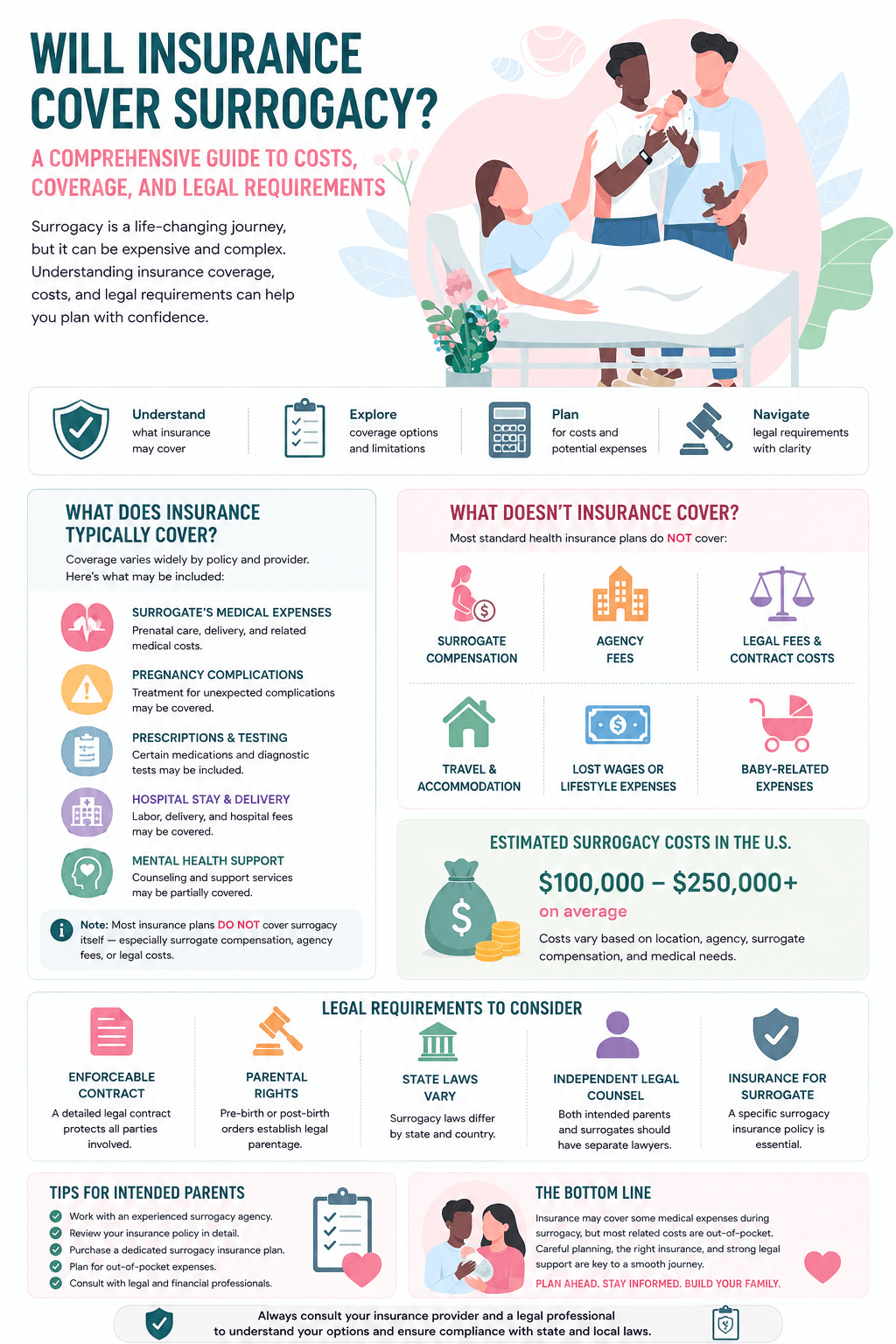
Will Insurance Cover Surrogacy? A Comprehensive Guide to Costs, Coverage, and Legal Requirements
Surrogacy is one of the most meaningful paths to parenthood, but it is also one of the most financially and legally complex. That is why one of the first questions intended parents usually ask is also one of the hardest to answer clearly: will insurance cover surrogacy? In this guide, you’ll see the costs, coverage, […]

Surrogacy is one of the most meaningful paths to parenthood, but it is also one of the most financially and legally complex. That is why one of the first questions intended parents usually ask is also one of the hardest to answer clearly: will insurance cover surrogacy? In this guide, you’ll see the costs, coverage, and legal requirements.
The honest answer is, sometimes, but not in the simple way most people hope.
Insurance may cover certain medical services connected to a surrogacy journey, especially pregnancy-related care for the gestational carrier, but that does not mean the entire process is covered. In many cases, some costs are covered, some are excluded, and some depend entirely on the specific policy, the state, the employer plan, and the legal structure of the arrangement. That is why families who assume “we have health insurance, so we should be fine” often get surprised later.
The good news is that surrogacy is not impossible to plan for. It just requires a more careful approach.
This guide explains how surrogacy insurance coverage usually works, what costs are commonly involved, what legal requirements matter most, and how intended parents can avoid expensive mistakes before the process begins.
Important notice: This article is for general informational purposes only and does not constitute legal, medical, or financial advice. Surrogacy laws, insurance policies, and cost structures vary significantly by state, employer plan, and individual circumstances. Consult a licensed reproductive attorney, certified surrogacy professional, and qualified insurance specialist before making any decisions.
Why surrogacy insurance is so confusing
Insurance and surrogacy do not fit neatly together, and this is why we recommend that you talk to an experienced Surrogacy Agency.
A traditional health insurance plan is built to cover medical care for the person enrolled in the plan. Surrogacy, on the other hand, involves multiple people, intended parents, a gestational carrier, fertility clinics, attorneys, screening professionals, and often an agency or escrow arrangement. That creates a coverage puzzle rather than one clean benefit.
Even when a plan covers pregnancy and maternity care, the details still matter. Some plans may cover ordinary prenatal care and delivery for an enrolled gestational carrier. Others may contain exclusions tied to surrogate pregnancy, gestational carrier arrangements, or fertility-related treatment. Some plans cover the carrier’s medical care but do not cover embryo transfer, IVF medications, legal fees, agency fees, or reimbursement obligations owed by intended parents.
That is why the right question is not simply “Does insurance cover surrogacy?”
The better question is “Which parts of the surrogacy journey might be up, by whose policy, under what limitations, and with what exclusions?”
That is where real planning begins.
What insurance may cover in a surrogacy journey
In many U.S. surrogacy arrangements, insurance is relevant in two separate areas.
First, there is fertility treatment coverage, which may involve IVF, embryo creation, medications, testing, and embryo transfer. Second, there is maternity and pregnancy coverage for the gestational carrier.
These are not the same thing.
A policy that helps cover fertility treatment for intended parents does not automatically cover a surrogate pregnancy. A gestational carrier’s health plan may cover prenatal visits, labs, delivery, and postpartum care, but still contain wording that creates complications if the pregnancy is part of a surrogacy arrangement.
That distinction matters a lot because many intended parents budget based on the wrong assumption. They hear “pregnancy is covered” and think the insurance issue is up. In reality, the policy language needs to be reviewed carefully before any medical steps begin.
What insurance usually does not cover
This is where expectations need to stay realistic.
Insurance rarely covers the full cost of a surrogacy journey. Even when there is some medical coverage, intended parents often remain responsible for many non-covered expenses. These can include agency fees, matching fees, legal contracts, independent legal counsel for both sides, psychological screening, background checks, escrow management, travel, lost wages, maternity clothing allowances, and other compensation or reimbursements required under the agreement.
In many journeys, insurance helps with pieces of the medical side, not the whole financial picture.
That does not make surrogacy unmanageable. It simply means budgeting needs to be built around reality rather than hope.
A practical look at common surrogacy cost categories
Here is a simple way to think about the financial side:
This table shows why families need both an insurance review and a full financial plan. One without the other is not enough.
| Cost category | Often covered by insurance? | Typical cost range (2026 US) |
|---|---|---|
| IVF and fertility medications | Sometimes | $15,000 to $30,000 per cycle (RESOLVE, 2026) |
| Embryo transfer procedures | Sometimes | Included in IVF cost or $3,000 to $5,000 separately |
| Prenatal care for gestational carrier | Sometimes | $5,000 to $10,000 if not covered |
| Labor and delivery | Sometimes | $10,000 to $20,000 if self-pay |
| Postpartum medical care | Sometimes | $1,000 to $3,000 typically |
| Agency fees | Usually no | $25,000 to $50,000 |
| Legal contracts and parentage work | Usually no | $10,000 to $20,000 (both parties) |
| Escrow and case management | Usually no | $2,500 to $5,000 |
| Surrogate compensation and reimbursements | No | $35,000 to $65,000 depending on state and experience |
| Travel, lodging, and incidentals | Usually no | $3,000 to $10,000 |
| Total typical journey (US) | Partial | $140,000 to $220,000+ |
Source: RESOLVE: The National Infertility Association cost data (2026); Physician’s Surrogacy cost guide (2026).
Why the gestational carrier’s policy matters so much
In most U.S. surrogacy journeys, the gestational carrier’s health insurance becomes a major issue because pregnancy care is delivered to her body, through her providers, under her plan. That means her policy language has to be reviewed carefully before proceeding.
Some plans may work reasonably well for a surrogacy arrangement. Others may include exclusions or restrictions that make them a poor fit. In certain situations, intended parents may need to purchase a separate surrogacy-friendly policy or budget for self-pay exposure if coverage is limited.
This is one reason experienced teams often review the insurance situation early, before transfer, before contracts are finalized, and ideally before everyone is too emotionally invested in a match.
A missed insurance issue late in the process can become expensive very quickly.
State law can change the insurance picture
Surrogacy is not regulated the same way everywhere in the United States. Keep reading this guide to explore Surrogacy costs and legal requirements.
Some states are more supportive and offer clearer legal structures for gestational carrier arrangements. Others remain more restrictive, less predictable, or simply more complicated. That affects contracts, parentage, and sometimes insurance handling as well.
New York is one example of a state where surrogacy law and insurance protections have become more clearly structured. But that does not mean every state follows the same model. The legal environment around surrogacy still varies significantly, and that is why intended parents should never assume a process that worked in one state will work the same way in another.
This is also why legal planning is not an optional extra. It is part of the foundation.
Why your state’s insurance mandate may not protect you: The ERISA exemption
Even intended parents in states with strong fertility coverage laws often discover that those protections do not apply to their specific plan. Understanding why requires knowing about a federal law called ERISA.
ERISA stands for the Employee Retirement Income Security Act. It governs most employer-sponsored health plans in the United States, particularly plans that large employers self-fund rather than purchasing coverage from an insurance carrier. These self-funded plans are subject to federal oversight, not state insurance regulation. That distinction matters because state mandates requiring fertility or surrogacy-related coverage only apply to state-regulated plans, which are typically fully insured plans purchased by small to mid-sized employers.
Here is the practical consequence: if you work for a large company, a multinational corporation, a government contractor, or a university, there is a reasonable chance your health plan is self-funded and therefore exempt from your state’s fertility insurance law. A person in New York, which has one of the more supportive fertility coverage frameworks in the country, may still have no mandate protection if their employer’s plan operates under ERISA.
How do you find out which type of plan you have? Ask your HR or benefits team directly whether your plan is self-funded or fully insured. You can also look at your Summary Plan Description, which is a document you are entitled to receive from your plan administrator. If the plan is described as self-funded or if it lists a plan administrator rather than an insurance carrier as the primary point of contact, ERISA likely applies.
This does not mean self-funded employers never cover fertility or surrogacy-related care. Many large employers have voluntarily added fertility benefits in recent years, particularly as a recruitment and retention strategy. But those benefits exist by employer choice rather than state mandate, and they can be modified or removed at any time. If your employer offers them, get the specific terms in writing and review the exclusions carefully before counting on them.
Understanding how RESOLVE: The National Infertility Association maps insurance coverage by state is a useful first step in identifying what your state requires before examining whether your plan actually falls under those requirements.
Legal requirements usually matter as much as medical planning
A surrogacy journey is not just a healthcare process. It is also a legal process.
In most well-structured arrangements, there is a formal gestational carrier agreement created before the embryo transfer takes place. That agreement typically addresses responsibilities, payment structure, medical decision frameworks, reimbursements, insurance obligations, and what happens under different scenarios. Both sides usually need their own legal representation, and parentage work often follows later so the intended parents’ legal rights are clearly established.
The legal side matters because surrogacy involves real people making serious commitments with emotional, medical, and financial consequences. Clear legal planning helps protect everyone involved.
A good contract is not there to create tension. It is there to reduce confusion.
A quick state-by-state guide to surrogacy law friendliness
Surrogacy law in the United States is not uniform. Understanding where your arrangement falls on the spectrum helps you anticipate what legal work is required and how smoothly parentage can be established.
Most favorable states (surrogacy-friendly legal frameworks)
California is widely considered the gold standard for surrogacy law. It allows pre-birth parentage orders for all family structures, has a clear legal precedent, and is home to many of the country’s most experienced surrogacy attorneys and agencies. The tradeoff is cost: California surrogate compensation and overall journey costs tend to be higher than the national average.
Nevada has modernized its surrogacy laws and offers favorable pre-birth order processes with relatively straightforward parentage procedures for gestational surrogacy.
Washington state updated its parentage law significantly in 2025 and now offers one of the most clearly structured legal frameworks for gestational surrogacy in the country.
Connecticut, Maine, and New Jersey also have relatively supportive legal environments and clear statutory guidance.
States with more complex or less predictable legal environments
Michigan prohibits surrogacy contracts, which means intended parents in Michigan face significant legal uncertainty and risk. Louisiana also has restrictions that make surrogacy arrangements legally complicated.
Other states operate in a legal gray area where there is no explicit statute either permitting or prohibiting gestational surrogacy agreements. This means outcomes can depend heavily on the county, the judge, and the specific facts of the arrangement. Intended parents in these states need experienced local reproductive attorneys, not just general family law practitioners.
What this means for your insurance planning
The state where the gestational carrier resides and delivers affects which insurance laws apply, how parentage orders are obtained, and sometimes how claims are processed by the carrier’s insurance company. A surrogacy team spanning two different states adds legal complexity and can create gaps in how insurance protections interact. Confirming jurisdiction early is an important planning step.
The most important legal and planning steps before starting
Families often feel pressure to move quickly once they find a potential match, but the smartest surrogacy journeys usually begin with structure.
A strong pre-transfer plan often includes: Guide to explore Surrogacy costs and legal requirements.
- A full review of the gestational carrier’s health insurance
- Independent legal counsel for intended parents and gestational carrier
- A written gestational carrier agreement completed before transfer
- A clear budget for covered and non-covered expenses
- A state-specific parentage strategy discussed early
This is one area where patience often saves money. A rushed match with unclear insurance or legal planning can create larger costs later.
Why employer plans and policy documents matter more than assumptions
One of the biggest mistakes families make is relying on verbal summaries or general assumptions about benefits.
An insurance card does not tell you whether surrogate pregnancy is covered. A customer service representative may not interpret a policy correctly. A general statement that “maternity is included” is not enough. What matters is the actual evidence of coverage, certificate of coverage, summary plan description, exclusions section, and any state-specific protections that apply.
That is why experienced professionals often want the policy reviewed in writing rather than relying on a quick phone call.
Surrogacy planning works better when people stop guessing and start verifying.
A step-by-step approach to testing a health policy for surrogacy coverage
Rather than waiting for a denial or a surprise bill, experienced surrogacy professionals suggest reviewing a policy before any medical steps begin. Here is a practical sequence.
Step 1: Request the actual policy documents.
An insurance card, an online benefits summary, and a customer service phone call are not enough. What you need is the actual Summary Plan Description and Certificate of Coverage or Evidence of Coverage document. These are the legally binding policy documents. You are entitled to request them from your employer’s HR department or directly from the insurance carrier.
Step 2: Locate the exclusions section.
Every policy has one. In a typical surrogacy review, the two most important exclusions to look for are any language that specifically mentions surrogate pregnancy, gestational carrier arrangements, or third-party reproduction. The absence of these exclusions is positive but not conclusive. The presence of them requires more detailed legal review.
Step 3: Check the fertility and infertility benefit section.
If the policy covers IVF or fertility treatment, look at how the benefit is defined. Some plans cover fertility treatment only for the enrolled member’s own body. Others are broader. The language around who the treatment must benefit, and whether it can benefit a third party such as a gestational carrier, determines a great deal.
Step 4: Check the maternity and prenatal care benefit.
If the gestational carrier is enrolled in the policy, look at whether maternity care is covered under standard terms or whether there are restrictions. Phrases like “pregnancy resulting from assisted reproduction” or conditions tied to the insured’s own pregnancy versus a carried pregnancy may signal complications.
Step 5: Involve a specialist before the embryo transfer.
Reproductive insurance specialists, including professionals at organizations that focus specifically on surrogacy insurance review, can read a policy with a practiced eye and identify issues that general insurance agents may miss. The cost of a professional policy review is minimal compared to discovering a coverage gap mid-journey.
Step 6: Get any coverage decisions in writing.
Do not rely on phone conversations with insurance representatives. If a representative confirms coverage, ask for written confirmation. Request the authorization or pre-authorization for specific procedures in writing. Keep all correspondence. This documentation becomes important if claims are denied later.
How intended parents can protect themselves financially
The smartest approach is to assume some level of out-of-pocket responsibility from the beginning.
That sounds less comforting than “insurance will cover it,” but it is actually the better mindset. It leads to better budgeting, fewer surprises, and better decisions about agency support, legal review, and insurance strategy.
Many intended parents benefit from building their plan in layers. First, identify the parts that may be covered. Second, identify the parts that are definitely not covered. Third, create a realistic cushion for uncertainty. Fourth, make sure the legal agreement clearly addresses responsibility for medical bills, reimbursements, and insurance-related issues.
That approach makes the process feel less chaotic because every category has a place.
When standard coverage falls short: Specialized surrogacy insurance options
When a gestational carrier’s existing health plan contains exclusions or restrictions that make it unsuitable for a surrogacy arrangement, intended parents and their surrogacy teams may need to explore purpose-built insurance options.
ART Risk Foundation
ART Risk is one of the best-known specialists in surrogacy-specific health coverage. Their policies are designed to fill the gaps that standard health plans leave, including coverage for gestational carrier pregnancies that might otherwise be excluded. These policies typically require application before the embryo transfer and come with specific underwriting criteria.
New Life Agency surrogacy insurance
Some surrogacy agencies partner with specialized insurers to offer surrogacy-friendly health coverage that can be purchased to supplement or replace a carrier’s existing plan when that plan contains problematic exclusions. Ask any agency you work with whether they have preferred insurance partners and what policies they recommend for carriers whose existing coverage is uncertain.
Employer fertility benefit programs
A growing number of U.S. employers have added surrogacy benefits through third-party fertility benefit managers such as Progyny, Carrot Fertility, or Maven Clinic. These programs may reimburse a portion of surrogacy-related medical costs, including IVF and sometimes clinical pregnancy management costs. If either intended parent has access to an employer fertility benefit, that benefit should be explored before any other coverage decisions are made.
What to look for in any specialized policy
Any policy being purchased specifically for a surrogacy arrangement should be reviewed for its scope (what procedures and providers it includes), its exclusions (what it will not cover), the deductible and out-of-pocket maximum, how claims are processed, and what happens if the surrogate requires complications care. A reproductive insurance specialist can compare options and identify the policy that best fits the specific clinical and contractual structure of the arrangement.
The cost of purpose-built surrogacy insurance varies but generally ranges from $300 to $600 per month during the coverage period, depending on the gestational carrier’s health history, the state, and the scope of coverage selected.
Why this process is still worth approaching with optimism
Surrogacy can feel overwhelming at the beginning because the medical, financial, and legal pieces all show up at once. That is normal. It does not mean the journey is out of reach. It means the journey needs informed planning.
Families who do well in this process are usually not the ones who assume everything will be easy. They are the ones who ask good questions early, verify coverage carefully, work with the right professionals, and build a plan that reflects how surrogacy actually works.
That is a much stronger position to be in.
The goal is not perfection. The goal is clarity about what surrogacy actually costs, who is responsible for what, and what legal protections you need in place before you begin.
Final thoughts
So, will insurance cover surrogacy?
It may cover certain parts of it, especially some medical care connected to fertility treatment or a gestational carrier’s pregnancy, but full surrogacy coverage is uncommon. The exact answer depends on the plan language, the people involved, the state, and the structure of the arrangement.
That is why surrogacy planning should never start with assumptions. It should start with review.
When intended parents understand the likely costs, the role of the gestational carrier’s insurance, the limits of coverage, and the legal requirements that shape the journey, the process becomes far easier to navigate. Not simple, but manageable. Not risk-free, but much more predictable.
And that matters, because this is not just a financial process. It is a family-building journey. The more clarity you have at the beginning, the more confidently you can move forward.
FAQ
Insurance may cover some medical parts of a surrogacy journey, but it usually does not cover everything. Coverage often depends on the specific health plan, the state, and whether the policy contains any surrogate pregnancy exclusions.
Sometimes. Many plans cover pregnancy and maternity care generally, but some policies have exclusions or restrictions for surrogate pregnancies. The plan language must be reviewed carefully.
Sometimes they may help with fertility treatment or IVF-related services, but they usually do not cover the full surrogacy process. Legal fees, agency fees, and surrogate compensation are commonly out-of-pocket.
Agency fees, legal work, escrow management, surrogate compensation, travel, and many reimbursable expenses are usually not covered by health insurance.
Legal requirements matter because surrogacy laws vary by state. A proper agreement, independent legal counsel, and a parentage plan help protect everyone involved and reduce confusion later.
No. State law varies significantly. Some states are more supportive and structured, while others are more restrictive or less predictable.
Families should review insurance carefully, speak with a surrogacy attorney in the relevant state, create a realistic budget, and make sure the legal agreement is completed before embryo transfer.
ERISA plans are self-funded employer health plans that operate under federal law rather than state insurance regulation. Most employees at large companies are enrolled in ERISA plans. Because these plans are exempt from state insurance mandates, even workers in states with strong fertility coverage laws may find that those state-level protections do not apply to their specific plan. Ask your HR department whether your plan is self-funded or fully insured before relying on your state’s fertility mandate.
The most important documents are the Summary Plan Description and the Certificate of Coverage. Focus particularly on the exclusions section, looking for any language that mentions surrogate pregnancy, gestational carrier arrangements, or restrictions on third-party reproduction. Also review the fertility benefit and maternity benefit sections carefully. A reproductive insurance specialist can identify issues that general agents typically miss.
Yes. Specialized surrogacy insurance products exist, including policies from providers such as ART Risk Foundation, which is designed specifically to cover gestational carrier pregnancies that standard health plans may exclude. If the gestational carrier’s existing plan contains problematic exclusions, a purpose-built surrogacy policy may be the most reliable path to coverage. Costs typically range from $300 to $600 per month during the active coverage period.
A fully self-pay surrogacy journey in the United States in 2026 typically costs between $140,000 and $220,000 in total, according to data from RESOLVE: The National Infertility Association and leading surrogacy programs. In high-demand states like California, total costs frequently exceed $200,000. These figures include surrogate compensation ($35,000 to $65,000), agency fees ($25,000 to $50,000), IVF and medical costs ($30,000 to $50,000 for clinical care), legal fees ($10,000 to $20,000), and escrow and incidentals. Even when insurance covers portions of the medical side, the non-medical costs remain almost entirely out-of-pocket.
HSA (Health Savings Account) and FSA (Flexible Spending Account) funds can generally only be used for qualified medical expenses. Many surrogacy costs, including agency fees, legal fees, and surrogate compensation, do not qualify as medical expenses under IRS guidelines. Some IVF-related medical costs may be eligible if they involve medical diagnosis or treatment of infertility. Consult a tax professional or CPA familiar with fertility-related expenses before using these funds for surrogacy costs.
Infographic