Portugal Residency for Americans: What Changed for Real Estate Since 2023
Property no longer buys Portugal residency. What Americans can use: Golden Visa funds, D7, D8, IFICI, 7.5% IMT and the 10-year passport clock.

Portugal residency for Americans no longer runs through real estate. Since 7 October 2023, buying property in Portugal, at any price and in any region, does not qualify for the Golden Visa. Law 56/2023, part of the Mais Habitação housing package, removed every property-linked route, along with the €1.5 million capital transfer option. What remains is a residency by investment programme built around funds, cultural heritage, research and job creation, plus the D7 and D8 visas for Americans who actually plan to live there.
That still leaves Portugal one of the most practical EU options for US citizens. It means the property purchase and the residency application are now two separate decisions, each with its own costs, and 2026 changed both. A revised Nationality Law moved the citizenship clock from five years to ten in May, and a flat 7.5% IMT transfer tax now applies to most non-residents who buy a home. This guide covers what qualifies for the Portugal Golden Visa in 2026, how it compares with the D7 and D8, what replaced NHR, what the IRS still expects from you, and how to judge Portuguese real estate on its own numbers.
The short answer for Americans:
- Buying a home or commercial property in Portugal does not qualify for the Golden Visa at any price.
- The Golden Visa still exists: €500,000 in a qualifying fund with no real estate exposure, €250,000 for cultural heritage, €500,000 for research, or a Portuguese business that creates jobs.
- It asks for only seven days in Portugal in the first year and 14 days in each two-year period after that.
- Citizenship now takes ten years of legal residence for Americans, counted from the day your first residence card is issued.
- Since May 2026, non-residents pay a flat 7.5% IMT when buying a home, reclaimable in some cases if you become tax resident or let the property long term at a moderate rent.
- Portuguese residency does not change your US tax filing, FBAR or FATCA obligations.
How this guide is maintained. Portuguese immigration, tax and nationality rules in this area have changed several times since 2023, most recently with the Nationality Law in force since 19 May 2026 and the housing tax package in Decreto-Lei 97/2026. Last reviewed: October 2026. Verify current requirements with AIMA and with advisers qualified in both Portuguese and US law before acting. This is general information, not legal, tax or immigration advice.
Table of contents
- Can Americans still get Portugal residency by buying property?
- Why Americans still look at Portugal
- What qualifies for the Portugal Golden Visa in 2026
- Golden Visa, D7 or D8: which route fits Americans
- The tax picture after NHR: IFICI and the US side
- The citizenship clock changed in May 2026
- Buying property in Portugal as an American in 2026
- A realistic sequence for Americans
- Property, Golden Visa, D7 and citizenship: what Americans ask
- The short version
Can Americans still get Portugal residency by buying property?
No. Residential purchases do not qualify. Commercial purchases do not qualify. Renovation projects and the old low-density property discounts are gone as routes. Portugal’s immigration agency, AIMA, states that the investment behind a residence permit cannot be directed, directly or indirectly, at real estate, and that rule also excludes investment funds that hold property.
The reason so much content still gets this wrong is scale. Between October 2012 and January 2023, Portugal issued 11,628 Golden Visas, and 10,668 of them came from property purchases, according to SEF figures reported by the public broadcaster RTP. That is more than nine in ten. For a decade the Golden Visa was, in practice, a real estate programme, and many of the sites built around the €500,000 purchase and the €350,000 renovation thresholds have never been updated.
Here is what changed between the property era and today, in one place:
| Before the reforms | Now (October 2026) | |
|---|---|---|
| Property route | €500,000 purchase, or €350,000 with renovation, with discounts in low-density areas | No property route at any price |
| Capital transfer route | €1.5 million transfer qualified | Removed |
| Investment fund route | €500,000 since 2022 | €500,000, and the fund cannot hold real estate |
| Citizenship | Five years of legal residence | Ten years for Americans, seven for EU and CPLP nationals |
| When the clock starts | From the residence permit application (rule in force 2024 to May 2026) | From the day the first residence card is issued |
| Tax regime for new residents | NHR: ten years of reduced or zero tax on many kinds of foreign income | IFICI: 20% only on qualifying Portuguese professional income |
| IMT when a non-resident buys a home | Standard brackets, the same as a resident buying a second home | Flat 7.5%, reclaimable only in limited cases |
| Short-term rental licensing | National restrictions under Mais Habitação (2023) | Set by each municipality since November 2024 |
Portugal is not closed to Americans because of any of this. The residency and the real estate simply have to be judged separately now, and treating them as one decision is the expensive mistake.
Why Americans still look at Portugal

The underlying case for Portugal never depended on property, and it has not changed. Portugal is a politically stable EU and Eurozone member with a transparent property registry, a legal system that treats foreign owners the same as domestic ones, and no history of expropriation risk. It ranked seventh in the 2026 Global Peace Index, English is widely spoken in Lisbon, Porto and the Algarve, and living costs remain moderate by Western European standards.
Demand from the United States grew even as the property route was closing. SEF approval data showed Americans as the top investor nationality in the Golden Visa programme in 2022 and again in 2023, and since October 2023 American applicants have moved overwhelmingly to the fund route.
What draws US citizens is optionality rather than relocation. Most people researching Portugal residency are not planning to move next year. They want an EU foothold that exists if circumstances change, and the Golden Visa’s light presence requirement is the feature that makes a non-relocating plan workable. Greece asks for no minimum stay at all, but its programme is still built mainly on buying property, which is exactly what Portugal removed.
There is a practical travel benefit too. As visitors, Americans are limited to 90 days in any 180 across the Schengen area, and the EU’s ETIAS travel authorisation for visa-free visitors is scheduled to start in the last quarter of 2026. A Portuguese residence card changes your status in Portugal itself: you are a resident there, not a visitor counting days, and residence permit holders do not need ETIAS.
What qualifies for the Portugal Golden Visa in 2026

The programme is formally the Autorização de Residência para Investimento, or ARI, and it has operated since October 2012. It was not suspended, and the 2026 Nationality Law did not change it. What changed in 2023 is the list of qualifying investments, and each one has to be held for at least five years.
| Route | Minimum | What to know |
|---|---|---|
| Investment fund subscription | €500,000 | The route most Americans use. The fund must have no real estate exposure, at least 60% invested in companies based in Portugal and a maturity of at least five years |
| Cultural heritage support | €250,000 (€200,000 in low-density areas) | A contribution, not an investment. The money does not come back |
| Scientific research | €500,000 | Contribution to accredited public or private research institutions. Also not recoverable |
| Company capital with job creation | €500,000 plus five permanent jobs | Incorporating or capitalising a Portuguese company and keeping five jobs for at least three years |
| Job creation | Ten permanent jobs | No fixed capital minimum, but you are running a Portuguese employer |
Removed in October 2023: every real estate purchase route at every price point, and the €1.5 million capital transfer option.
One qualifying investment covers the family. A spouse or partner, dependent children and dependent parents can apply alongside the main investor, each with their own residence card and their own government fees.
A €500,000 fund subscription is an investment, which is its advantage over a donation and also its risk. These are private, usually illiquid vehicles with subscription, management and performance fees, and your capital is committed for the holding period. Read the offering documents as you would for any other private fund, confirm the manager is supervised by the CMVM, Portugal’s securities regulator, and ask how the fund plans to exit. A Golden Visa approval says nothing about the quality of the investment.
The two business routes look cheaper on paper, but they commit you to running a Portuguese company that keeps real employees for years. That is a market entry decision, not an immigration formality, and most of the reasons companies fail when entering new markets apply in full: local hiring and labour law, pricing, and customers you have never served before.
The authoritative source is AIMA’s own ARI page, which sets out the qualifying categories and the presence requirements. It is published in Portuguese, and it is worth reading through a translation rather than relying on a consultancy summary, because consultancies vary in how current they are.
Physical presence and renewals
Per AIMA, Golden Visa holders must spend at least seven days in Portugal in the first year and 14 days in each subsequent two-year period, consecutive or not. The first residence card is valid for two years and renews for three-year periods, and after five years you can apply for permanent residence. That is one of the lightest presence requirements in the EU, and it is why the Golden Visa suits Americans who keep their home and work in the United States.
Processing times and what the Golden Visa costs
AIMA does not publish a dependable end-to-end processing time, and guidance quoting six to nine months predates the current backlog. Portuguese immigration practitioners reported waits of 18 to 24 months for a first residence card in mid-2026, and some older files have taken three years or more. Build that timeline into any plan with a deadline attached, especially now that the citizenship clock only starts when the card is issued.
Government fees were index-linked to inflation in March 2026. Using the digital-filing rates in force since then, the state’s share of the bill looks like this:
| Cost item | Single applicant | Couple with two children |
|---|---|---|
| Qualifying investment (fund route) | €500,000 | €500,000 (one investment covers the family) |
| Application analysis, per person | €632.10 | €2,528.40 |
| First residence card, per person | €6,314.20 | €25,256.80 |
| Government fees to the first card | €6,946.30 | €27,785.20 |
| Each renewal, per person | €3,157.80 | €12,631.20 |
Fees are charged per person, including family members, and in-person filing costs more. Legal fees and the fund’s own subscription, management and performance fees come on top, and both vary widely between providers. Check AIMA’s current fee table before you budget.
Golden Visa, D7 or D8: which route fits Americans
These routes are often presented as versions of the same thing. They are built for different people, and the deciding question is how much of the year you will actually spend in Portugal.
| Golden Visa (ARI) | D7 visa | D8 visa | |
|---|---|---|---|
| Basis | Qualifying investment from the list above | Stable passive income such as pensions, Social Security, dividends or rent | Remote work income from clients or an employer outside Portugal |
| Money required (2026) | €250,000 to €500,000, depending on the route | At least €920 a month for the main applicant, plus about €11,040 in savings | At least €3,680 a month, four times the minimum wage |
| Does property qualify? | No, at any price | Not required, though rental income can count toward the income test | Not required |
| Physical presence | 7 days in year one, then 14 days per two-year period | You are expected to live there, and long absences can cost you the permit | You are expected to live there |
| Portuguese tax residency | Usually not triggered | Usually triggered | Usually triggered |
| Suits | Investors keeping a US base | Retirees and others living on passive income | Remote employees and freelancers |
| Citizenship clock | 10 years from the first residence card | 10 years from the first residence card | 10 years from the first residence card |
The presence requirement is the whole decision. Applying for a D7 while planning to stay resident in the United States is a mismatch that surfaces at renewal, when you have to show that Portugal is genuinely where you live. A temporary residence permit can be cancelled if you spend more than six consecutive months, or eight months in total, outside Portugal during its validity. If a backup plan without relocation is the goal, the Golden Visa is the route built for it.
If you plan to keep working for US clients or a US employer from Portugal, the D8 is the visa designed for you, and the practical constraint is the clock as much as the paperwork. Lisbon runs five hours ahead of New York and eight ahead of San Francisco for most of the year, which leaves about three shared working hours with the East Coast and almost none with the West. Before you commit, work out how much working overlap you really get across time zones and which calls will land in your evening.
The structural question underneath every route, whether you need a presence in a country or only a legal relationship with it, comes up in every cross-border decision. The same framework applied to hiring rather than residency is worked through in this guide to market entry, hiring and EOR arrangements in France.
The tax picture after NHR: IFICI and the US side

The Non-Habitual Resident regime, which offered ten years of reduced or zero tax on many kinds of foreign income, closed to new applicants on 1 January 2024. Any content describing NHR as available to new investors or retirees is describing a programme you cannot join.
Its replacement is IFICI, the Incentivo Fiscal à Investigação Científica e Inovação, often called NHR 2.0. It was created by the 2024 State Budget and became usable when its regulations were published on 23 December 2024, with effect back to January 2024. It offers a 20% flat rate for ten years on qualifying Portuguese employment and self-employment income, but only for defined research, innovation and highly qualified roles at eligible employers, and only if you were not tax resident in Portugal in the previous five years. Foreign pensions are not exempt under IFICI, so an American retiree living on Social Security and retirement accounts generally gets no benefit from it.
Holding a Golden Visa does not, on its own, make you a Portuguese tax resident. Tax residency generally follows from spending more than 183 days a year in Portugal or keeping a home there that shows an intention to live in it, which is why D7 and D8 holders usually become tax resident and most Golden Visa holders do not.
What the IRS still expects from you
This is the part written for Americans specifically, and the part most guides skip. The United States taxes its citizens and green card holders on worldwide income wherever they live. Portuguese residency does not change your US filing obligations, your FBAR reporting or your FATCA position. The US and Portugal have an income tax treaty, but its saving clause preserves the US right to tax its own citizens, so relief from double taxation usually comes through the foreign tax credit or the foreign earned income exclusion rather than an exemption. The IRS overview for US citizens and resident aliens living abroad is the primary source to read before paying anyone to summarize it.
Three points catch Americans most often:
- FBAR starts low. A Portuguese bank account counts toward FBAR reporting once your foreign accounts together pass $10,000 at any point in the year, whether or not they earn anything.
- Golden Visa funds can be PFICs. A €500,000 Portuguese fund is a foreign investment fund, and for a US person it can be treated as a passive foreign investment company, which carries punitive US tax treatment unless the fund supports the right elections. Ask the manager before you subscribe, not after.
- The calendars do not line up. Portuguese and US returns run on different timetables, and the foreign tax credit depends on getting the timing and currency conversion right.
Take advice from someone qualified in both systems before assuming any benefit exists. The cross-border mechanics of holding income and assets in more than one jurisdiction are covered further in this look at managing money as a location-independent business.
The citizenship clock changed in May 2026
Guidance published before 2026 almost always promises Portuguese citizenship after five years of legal residence. That is no longer the position for Americans.
Portugal’s Parliament approved a revised Nationality Law on 1 April 2026 by 152 votes to 64. The President promulgated it on 3 May, it was published as Lei Orgânica 1/2026 on 18 May, and it has applied since 19 May 2026. The residence requirement for naturalisation is now ten years for most non-EU nationals, including Americans, and seven years for EU and CPLP nationals. Applicants must also show A2-level Portuguese and meet a civic knowledge requirement.
Two details matter more than the headline number:
- The clock starts when your first residence card is issued, not when you apply. Under the 2024 rules, time spent waiting on AIMA counted toward citizenship. Now it does not, so an 18 to 24 month wait for a first card pushes a realistic passport timeline for a new American applicant to twelve years or more.
- Only nationality applications filed before 19 May 2026 keep the old five-year rule. Having completed five years of residence without filing is not enough.
More than 500 Golden Visa holders have filed a collective lawsuit over the change, and practitioners still disagree about how the new rules treat investors with minimal physical presence. Do not plan around either being resolved in your favour. If a passport is central to your decision rather than incidental to it, get a written opinion from a Portuguese immigration lawyer on your specific position before committing capital. For most Americans, permanent residence after five years is now the realistic intermediate goal.
Buying property in Portugal as an American in 2026

With the residency benefit gone, Portuguese real estate has to stand on its own numbers. It reasonably can, but the 2026 case is different from the one the Golden Visa era made.
Demand did not collapse when the visa route closed, which is itself the most useful data point available. INE’s house price index rose 17.8% year on year in the first quarter of 2026, and Eurostat ranked Portugal’s second-quarter increase the highest in the European Union. The flip side is yield. When prices rise faster than rents, gross rental yields fall, so underwrite at 2026 prices rather than brochure numbers from a few years ago.
The 7.5% IMT for non-residents and how residency changes it
Since 25 May 2026, Decreto-Lei 97/2026 has applied a flat 7.5% IMT transfer tax when a buyer who is not tax resident in Portugal purchases a home, with no exemptions or reductions. On a €300,000 apartment that is €22,500 before stamp duty. The rule sits in article 17 of the IMT Code, which the Tax Authority publishes in Portuguese, and buyers resident in jurisdictions on Portugal’s tax-haven list keep paying 10%.
The flat rate does not apply, or the difference can be reclaimed, in three cases. The first is that you have been tax resident in Portugal before, though how far back that reaches is still being interpreted, so confirm it with your tax office. The second is that you become tax resident within two years of the purchase. The third is that you let the home on a residential lease of up to €2,300 a month within six months and keep it let for at least 36 of the first 60 months.
This is the one place where residency and property connect again, and your route matters. A D7 or D8 holder who moves to Portugal can usually claim back the difference once they are tax resident. A Golden Visa holder spending a few weeks a year will normally not become tax resident, so unless the home is let long term at a moderate rent, the 7.5% is a permanent cost of buying while keeping a US base. None of it is automatic: you pay 7.5% at the deed and apply for the difference afterwards, within the decree’s deadlines.
Six things to weigh honestly
- Currency exposure cuts both ways. Euro assets diversify away from the dollar, and they also mean your returns move with EUR/USD regardless of how the property performs.
- Short-term rental rules are now local. Decreto-Lei 76/2024 reversed most of the national Alojamento Local restrictions from 2023 and handed control to municipalities, and Lisbon has since closed several central parishes to new registrations. Verify what is permitted at the exact address before modelling tourist yields.
- Transaction costs are material. IMT at 7.5% for most non-resident home buyers, stamp duty of 0.8%, notary, registration and legal fees on the way in, and agent commission on the way out. Model the round trip, not the purchase price.
- Holding costs continue. IMI municipal property tax every year, plus AIMI on residential holdings with a combined tax value above €600,000.
- Financing is tighter than it looks. Portuguese banks lend to non-residents, but for anything other than your own permanent home the loan-to-value cap is 80%, and since 1 August 2026 total debt payments are limited to 45% of net income. Work out how much loan your budget can actually carry before a bank tells you what it will approve.
- Administrative prerequisites are real. You need a Portuguese tax number (NIF) and a bank account, and for non-residents both are a process rather than a formality.
Buying at a distance in a market you do not know is where the avoidable losses happen. The protection is legal representation that works for you, not only an agent who works on the deal: a Portuguese lawyer who checks title and encumbrances on the land registry certificate, the usage licence, the property’s tax value against the price, condominium liabilities, and whether the rental assumptions in the listing survive the actual regulations. Agree in writing what they will check before they start.
If the goal is income rather than a holiday home, the type of asset matters as much as the city. Firms such as Roca Estate, a licensed brokerage operating in Portugal since 2020 whose published focus is income-producing property such as multi-family buildings, retail units and small hospitality assets, combine sourcing and negotiation with licensing, renovation and property management for international investors. That kind of single point of contact saves a lot of coordination when you live an ocean away. Because a broker is paid when a deal closes, keep the title, licensing and lease checks with a lawyer whose fee does not depend on the purchase going through.
Editorial note: Growwwth has no commercial relationship with Roca Estate and received nothing for this mention. It is named as one example of a firm working with international property investors in Portugal, based on the services described on its own website.
The one thing not to buy is a residency benefit attached to the property. It does not exist, and anyone still selling it either has not updated their materials or is hoping you have not.
A realistic sequence for Americans
Because these are now separate decisions, run them in the right order.
- Decide what you are actually buying. Residency optionality, an investment, or a future home. Each points to a different structure, and trying to optimise for all three usually produces a poor version of each.
- Choose the residency route before the asset. Fund, cultural heritage, research or business investment for a Golden Visa, or the D7 or D8 if you will live there. Take Portuguese legal advice on the route before selecting a specific fund or project, not after.
- Run the US tax analysis in parallel. Check how any fund will be treated under the PFIC rules and how Portuguese income will interact with the foreign tax credit. The structure that works in Portugal and the one that works for a US person are not automatically the same.
- Sort the administrative layer. NIF, Portuguese bank account and legal representation, usually under a power of attorney. This takes longer than expected and blocks everything downstream.
- Time any property purchase around your tax residency. If you will be tax resident within two years, plan for the IMT refund. If you will not, price in the full 7.5%.
- Treat property as its own investment. If the numbers work at 2026 prices, buy. If they only worked because you were counting a residency benefit, they do not work.
Property, Golden Visa, D7 and citizenship: what Americans ask
No. Law 56/2023, effective 7 October 2023, removed every property route from the Golden Visa at any price, residential or commercial. AIMA states that qualifying investment cannot be directed, directly or indirectly, at real estate. Content still quoting €500,000 or €350,000 property thresholds predates that change.
A €500,000 subscription to a Portuguese fund with no real estate exposure, a €250,000 cultural heritage contribution (€200,000 in low-density areas), €500,000 for scientific research, €500,000 in a Portuguese company that creates five jobs, or the creation of ten jobs. Most Americans use the fund route, and every investment must be held for at least five years.
Seven days in the first year and 14 days in each subsequent two-year period, consecutive or not. That light requirement is what makes the Golden Visa workable for Americans who keep their home and work in the United States.
Ten years of legal residence under Lei Orgânica 1/2026, in force since 19 May 2026, counted from the day your first residence card is issued. EU and CPLP nationals need seven. Only nationality applications filed before 19 May 2026 stay under the old five-year rule.
It depends on where you will live. The D7 needs passive income of at least €920 a month in 2026 and expects you to live in Portugal. The Golden Visa needs a qualifying investment and only a few weeks of presence. For a backup plan without relocating, the Golden Visa fits. For retiring to Portugal, the D7 usually does.
No. NHR closed to new applicants on 1 January 2024. Its replacement, IFICI, offers a 20% flat rate for ten years only on qualifying research, innovation and highly qualified professional income, and it does not exempt foreign pensions. Most investors and retirees who would have used NHR do not qualify.
Yes. Since 25 May 2026, non-residents pay a flat 7.5% IMT on homes under Decreto-Lei 97/2026. The difference can be reclaimed if you were tax resident in Portugal before, become tax resident within two years, or let the home long term at up to €2,300 a month under the decree’s conditions.
Not by itself. The US taxes citizens on worldwide income wherever they live, and Portuguese residency does not change your filing, FBAR or FATCA obligations. Relief usually comes through the foreign tax credit, which needs advice from someone qualified in both systems.
On the fund route, €500,000 plus government fees of about €6,946 per person to the first residence card at digital-filing rates, before legal and fund fees. AIMA publishes no reliable processing time, and practitioners reported waits of 18 to 24 months for a first card in 2026. Because the citizenship clock only starts when the card is issued, that wait now delays citizenship too.
It can be, on its own numbers. Prices kept rising after the Golden Visa property route closed, but yields have compressed, most non-resident buyers face a 7.5% IMT on homes, and short-term rental rules are set municipality by municipality. Do not price in a residency benefit, because there is none.
The short version
Portugal remains one of the more accessible EU residency options for Americans, and the reason has nothing to do with property. The Golden Visa survived the 2023 reform with its fund, cultural heritage, research and job creation routes intact, it still asks for only a few weeks of presence, and the D7 and D8 remain open for people who want to live there.
What changed is that property and residency became separate transactions, the passport now sits ten or more years away, and buying a home without becoming tax resident costs more than it used to. Run each decision on its own numbers, take advice on both sides of the Atlantic, and treat any source still quoting a €500,000 real estate threshold as evidence of when it was written rather than of what applies now.
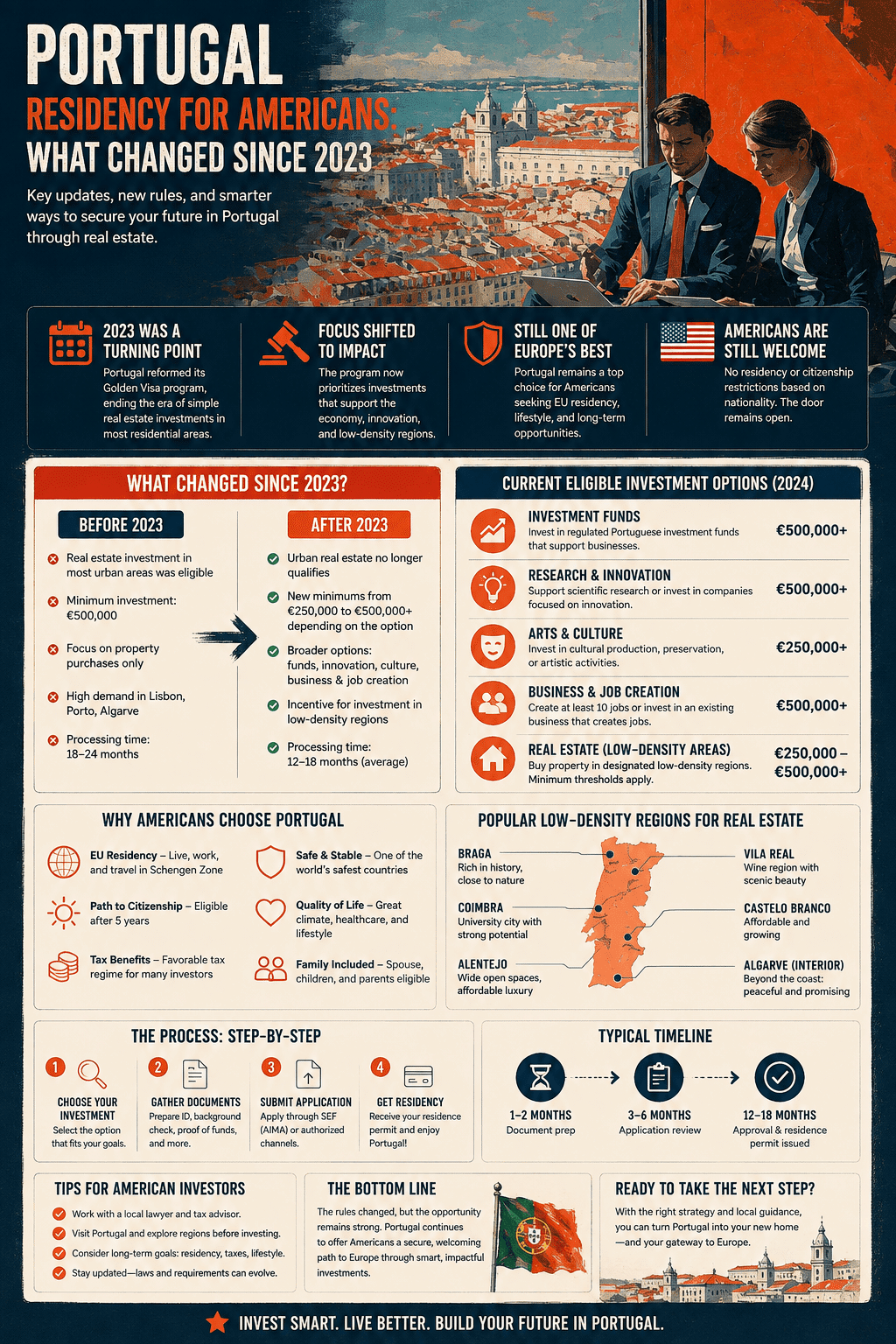
Infographic
Written by Claudio Pires, editor at Growwwth. Last reviewed October 2026 against AIMA’s ARI guidance, Lei Orgânica 1/2026, Decreto-Lei 97/2026, Decreto-Lei 76/2024, Portaria 352/2024/1, Banco de Portugal Macroprudential Recommendation 1/2026 and IRS guidance for Americans abroad. General information, not legal, tax or immigration advice.
