Decorative Wall Finishes: How to Choose Plaster, Limewash, Wallpaper or Panels
Compare decorative wall finishes, from limewash and Venetian plaster to grasscloth and wood slats, with installer advice on prep, light and repairs.
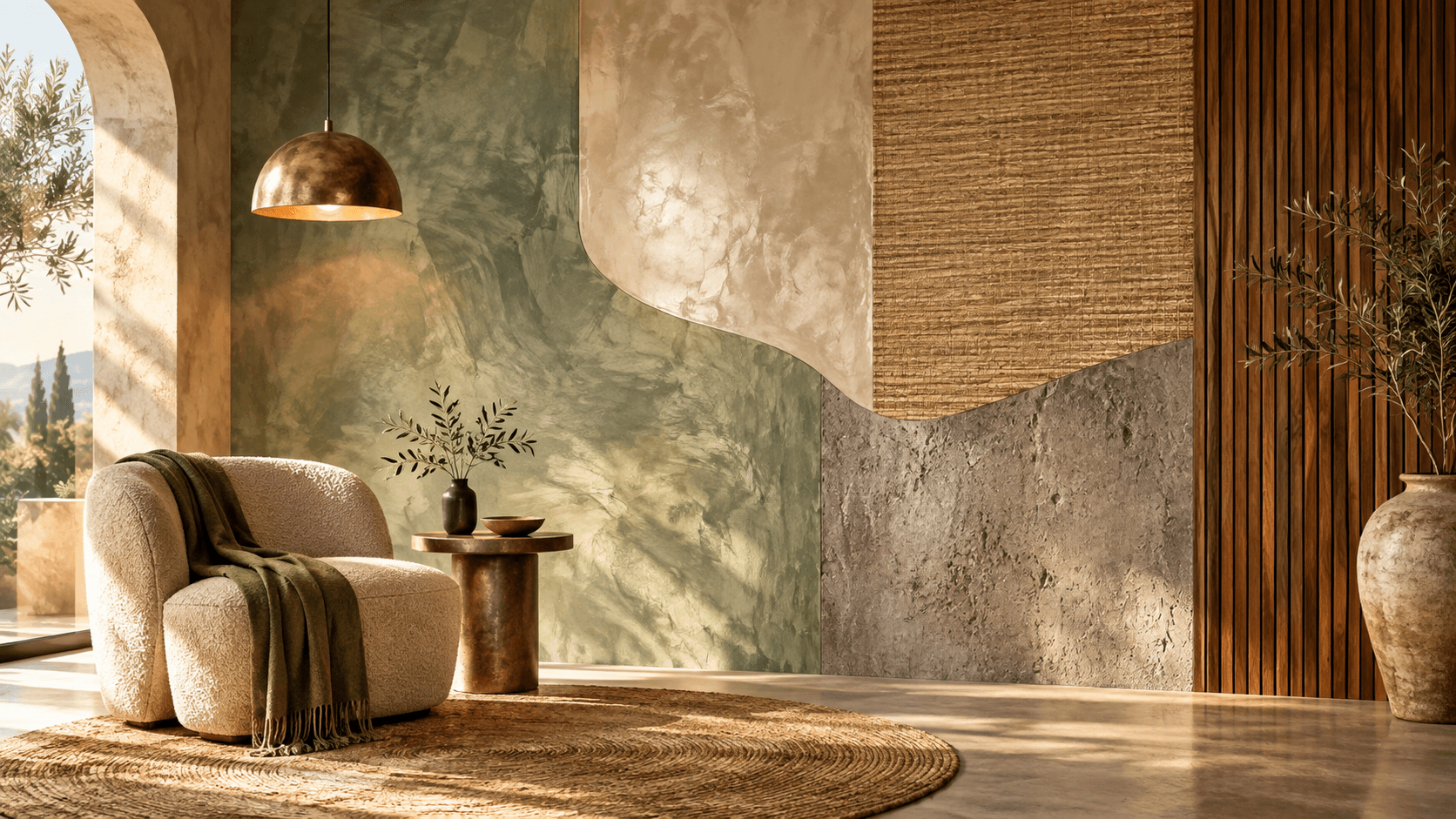
Decorative wall finishes are surface treatments that give a wall texture, pattern or depth that flat paint cannot. The main types are limewash, Venetian plaster and Marmorino, tadelakt, microcement and concrete effects, wallpaper and grasscloth, and wood slat or acoustic panels. Each one changes how a room handles light, how it ages and how easily it can be repaired.
For years, an accent wall meant one contrasting paint color. Today the same wall might be a hand-troweled lime plaster, a woven grasscloth or a run of oak slats, and choosing between them is harder than the photos suggest. A finish that glows on a showroom board can show every drywall seam under side light, fade on a sunny wall or water-mark beside a sink.
This guide compares the main types of decorative wall finishes side by side, explains what each one needs from the wall underneath, and shares lessons from installers who work with both wallcoverings and decorative plaster, including the problems homeowners rarely hear about before the estimate.
The short version:
- If the wall needs pattern, color or illustration, wallpaper does it fastest.
- If it needs depth, movement and a seamless surface, look at limewash, Venetian plaster or Marmorino.
- For showers and tubs, use a finish built for constant water, such as tadelakt or a waterproofed microcement system.
- For warmth and less echo, wood slat or acoustic panels do what no flat finish can.
- Whatever you choose, wall preparation and the installer affect the result as much as the material.
Table of contents
- What Counts as a Decorative Wall Finish?
- Types of Decorative Wall Finishes Compared
- What Drives the Cost of Decorative Wall Finishes
- Texture, Light and Why Photos Mislead
- Wallpaper or Decorative Plaster for an Accent Wall?
- Limewash vs Venetian Plaster vs Microcement
- Surface Preparation Decides the Result
- Breathability, Mold and Indoor Air
- Room by Room: Where Each Finish Works
- Repairs and Maintenance: How Each Finish Ages
- When Protecting Grasscloth Backfires
- Climate and Sunlight: Lessons From Colorado
- How to Sample a Finish Before You Commit
- DIY or Hire a Pro?
- For Designers and Installers: Field Knowledge Wins Clients
- Is Venetian Plaster Worth It, and Can Limewash Go Over Paint?
- The Best Statement Wall Starts With the Right Question
What Counts as a Decorative Wall Finish?
You will also see these materials called specialty finishes, textured wall finishes or faux finishes. They fall into three families, and each family solves a different design problem, so it helps to know which one you are shopping in before you compare products.
Lime and Mineral Finishes
- Limewash: a thin, chalky paint made from slaked lime, water and mineral pigment. It dries to a soft, cloudy matte with visible brush movement. On painted drywall, most brands require the mineral primer they specify.
- Venetian plaster: lime putty mixed with marble dust, applied in very thin layers with a steel trowel and burnished. Depending on the system and how hard it is polished, the result ranges from a quiet satin to a deep, marble-like sheen. Acrylic versions exist and are easier to apply, but they look and age differently.
- Marmorino: a coarser lime and marble plaster with a stone-like texture, from matte to satin. With the right system it also works outdoors.
- Grassello: aged lime putty (grassello di calce) used for the most polished Venetian finishes.
- Tadelakt: a Moroccan lime plaster compacted and polished with a stone, then treated with olive oil soap. That treatment makes it water-resistant enough for showers and baths.
Cement-Based Finishes
Microcement and concrete effects are thin cement and polymer coatings, usually a few millimeters thick, troweled over walls and often floors for a seamless, architectural look. Microcement walls can run straight into a matching floor with no grout lines. In wet areas they depend entirely on correct waterproofing and sealing.
Wallcoverings and Panels
- Non-woven wallpaper: a stable, breathable paper that is usually hung by pasting the wall rather than the back of the roll. It strips off dry when you want a change.
- Commercial vinyl (Type II): a heavier, scrubbable wallcovering built for hotels, offices and corridors, now common in busy homes too.
- Grasscloth wallpaper and natural fibers: woven grass, sisal, jute or similar fibers on a paper backing. Color shifts between panels and visible seams are part of the material, not installation faults.
- Peel-and-stick wallpaper: self-adhesive film that goes up and comes down easily, but struggles on textured walls, in humid rooms and over paint that has not fully cured.
- Murals and custom prints: large scenes supplied in numbered panels, where alignment matters more than on any standard paper.
- Wood slat, 3D and acoustic panels: dimensional panels that add shadow lines and warmth. A wood slat wall backed with acoustic felt also absorbs echo in open rooms. For video calls, podcasts and YouTube recording, panels on the wall behind and opposite you reduce the echo a microphone picks up in a bare room.
Types of Decorative Wall Finishes Compared
The table summarizes how the most common finishes behave once they are on a real wall rather than a sample board. Costs are relative, for installed work including labor, and vary widely by region, wall size and system.
| Finish | Look | Best for | Moisture tolerance | Repairs | DIY friendly? | Relative cost |
|---|---|---|---|---|---|---|
| Limewash | Soft, cloudy matte | Living rooms, bedrooms, fireplaces, exteriors | Low near splashes, not for showers | Easy, recoat to blend | Yes, with practice | $ |
| Venetian plaster | Satin to high polish, marble-like depth | Feature walls, entries, dining rooms, powder rooms | Good when waxed or sealed, not in showers unless the system is rated for it | Local patches by a skilled applicator | Rarely, it takes practice | $$$ to $$$$ |
| Marmorino | Matte to satin stone texture | Living areas, stairwells, some exteriors | Moderate | Local patches | No | $$$ |
| Tadelakt | Smooth, softly polished lime | Showers, tubs, sinks | Very high when properly finished | Specialist only | No | $$$$ |
| Microcement or concrete effect | Seamless, industrial | Kitchens, bathrooms, lofts, floor to wall | High when waterproofed and sealed | Hard to blend invisibly | No | $$$ |
| Non-woven wallpaper | Pattern, print, texture | Bedrooms, living rooms, offices | Low to moderate, check the washability rating | Replace a strip, batch matching needed | Yes, for simple patterns | $$ |
| Commercial vinyl (Type II) | Patterns, textures, faux grasscloth | Hallways, stairs, kids’ rooms, offices | Good, scrubbable | Replace a strip | Rarely, it is heavy | $$ |
| Grasscloth | Natural woven fibers, visible seams | Bedrooms, dining rooms, offices | Poor, water stains easily | Hard to match later | No | $$$ |
| Peel-and-stick | Printed film | Rentals, small accents | Low to moderate | Easy to replace | Yes | $ |
| Wood slat and acoustic panels | 3D lines, warmth | Living rooms, media rooms, home offices | Low unless rated for damp areas | Replace a panel | Often | $$ to $$$ |
Use the table to shortlist two or three options, not to make the final call. For material-by-material detail on installation methods, adhesives and preparation, the decorative wall finishes blog from Enjoy The Wall, a Colorado wallpaper and plaster installer whose field experience appears throughout this guide, goes deeper than a single article can.
What Drives the Cost of Decorative Wall Finishes
Two quotes for the same finish can be far apart, and the material is often the smaller part of the bill. Labor, preparation and access usually decide the total.
- Coats and layers. Limewash usually needs two or three thin coats. A polished Venetian plaster can take several troweled layers plus burnishing and wax, with drying time between each.
- Wall preparation. Removing old wallpaper, repairing cracks, skim coating and priming can cost as much as the finish itself on a rough wall.
- Pattern repeat and waste. Large wallpaper repeats need extra rolls to line up the pattern across strips, and natural fibers need careful panel sequencing, which adds labor.
- Height and obstacles. Stairwells, ceilings, arches, outlets and built-ins slow every finish down.
- Wet-area systems. Tadelakt and microcement in showers need waterproofing and sealers, which add materials and cure time.
When you compare quotes, ask each installer to list the preparation, the number of coats or layers, the primer and sealer, and who supplies the material. Prices that look far apart often cover very different amounts of work.
Texture, Light and Why Photos Mislead
Flat painted walls are practical, but they give light very little to work with. Decorative finishes introduce movement and variation that changes through the day as daylight and lamps move across the surface. That is why the same plaster can look calm at noon and dramatic at dusk, and why a photo shot in perfect conditions tells you only part of the story.
A few rules help when you picture a finish in your own room:
- Side light exaggerates texture. A window beside the wall, LED strips that graze the surface and low winter sun all make plaster look richer. They also make bumps, seams and patched drywall under wallpaper far more visible.
- Polished surfaces reflect points of light. A high-polish Venetian plaster will mirror spotlights and windows. A matte limewash diffuses them.
- Bulb color shifts the finish. Warm 2700K lamps pull lime finishes toward cream and ochre, while cooler 4000K light can turn the same wall gray.
- Viewing distance changes the effect. Fine texture disappears from across a large room, where overall color and rhythm carry the wall.
If the wall will also carry art or sit behind you on video calls, plan the finish and the lighting together. Our guide to choosing professional wall art for offices covers picture lights, glare and camera backgrounds, and the same thinking applies to a home office statement wall.
Wallpaper or Decorative Plaster for an Accent Wall?
One of the most common mistakes is choosing a wall treatment from a photograph alone. A material can look impressive online and behave very differently once it is installed in a real room, under real light, next to real furniture.
The core difference is simple. Wallpaper brings pattern, color, illustration or textile character, and large botanicals, geometrics, murals and grasscloth can establish a strong identity very quickly. Decorative plaster gets its character from texture, layering, tonal movement and the hand of the applicator. Neither is better in general. They answer different design questions, which shows up clearly room by room:
- Bedrooms often suit the warmth of a premium non-woven or textile wallcovering, or a soft limewash if you want calm rather than pattern.
- Fireplace walls usually work better with a continuous finish such as limewash, Marmorino or a concrete effect, which wraps corners without seams. Keep any combustible wallcovering outside the clearances the fireplace manufacturer specifies.
- Home offices can go either way: pattern if the room needs personality on camera, texture if it should stay quiet behind a screen.
- A textured accent wall in plaster suits rooms where the wall is a backdrop for furniture. A patterned one in wallpaper suits rooms where the wall is the main event.
The best material is decided by the room, the substrate, the lighting, how the space is used and what you want the wall to do. There is no universal ranking of finishes.
Limewash vs Venetian Plaster vs Microcement
These three are compared constantly because all of them promise a plaster look. In practice they are different materials with different strengths, and decorative plaster as a category is broader than most buyers expect.
Limewash
Limewash gives soft tonal movement and a relatively understated, matte surface. It suits living rooms, bedrooms, entries, fireplaces and contemporary interiors that want texture without a focal point. It is the most DIY-friendly of the three and the easiest to refresh, since you simply apply another coat. The tradeoff is durability: limewash can chalk or rub off in high-touch areas and does not take scrubbing well.
Venetian Plaster
Venetian plaster ranges from a subtle satin to a high polish with real depth and reflection. Depending on the formulation and the technique, it can evoke stone or marble without mechanically copying either. Once cured it is hard-wearing and can be waxed for extra protection in a powder room, but it is labor-intensive and the result depends heavily on the applicator.
Microcement and Concrete Effects
Concrete-effect finishes create a more architectural surface that fits industrial, loft, minimalist and high-tech interiors. Microcement can run continuously from floor to wall, and when it is waterproofed and sealed correctly it is one of the few decorative finishes that works inside a shower. Repairs are harder to blend invisibly than with lime-based plasters.
One point applies to all three: two installers using the same product can produce noticeably different walls. Ask to see samples made by the person who will do your job, not only the manufacturer’s display board.
Surface Preparation Decides the Result
One lesson repeats on almost every specialty wall project: expensive materials do not make up for poor preparation.
Wallpaper reveals wall defects, especially when the paper is thin, smooth or reflective, or when the wall is lit from the side. That is why drywall finishers use the highest finish level, Level 5, which adds a skim coat over the whole surface, on walls that will face strong side light.
Decorative plaster has its own demands. Cracks, unstable old coatings, uneven absorption and the wrong primer can all affect adhesion and how even the finished color looks. Some plaster systems need dedicated primers or base coats, while others tolerate minor variation because movement is part of their intended look.
Before any decorative layer goes on, a careful installer checks:
- Moisture. Damp patches, peeling paint, white salt deposits or a musty smell point to a water problem that no finish will survive. Find the source first. If you suspect hidden mold, this explainer on what a certified mold assessor does covers what a proper assessment involves.
- Old paint. In a home built before 1978, sanding or scraping existing paint can release lead dust. Follow EPA’s lead-safe renovation guidance for do-it-yourselfers, or hire a lead-safe certified contractor.
- Gloss and texture. Glossy paint needs deglossing or a bonding primer. Heavy orange-peel or knockdown texture may need skimming before a smooth wallpaper goes up.
- Cracks and movement. Hairline cracks telegraph through thin finishes. Recurring or structural cracks need fixing, not covering.
- Future wiring and plumbing. Anything that will be cut into the wall later is far cheaper to do before the finish than after it.
The correct specification starts with the existing wall, not with the sample board.
Breathability, Mold and Indoor Air
Walls also manage moisture, and some finishes let it pass through while others trap it. In bathrooms, basements and humid climates, that matters as much as the look.
- Lime finishes are vapor-open. Limewash, Marmorino and lime-based Venetian plaster let moisture move through the surface, and their high alkalinity makes them a poor place for mold to start, especially while fresh. They do not fix a leak or a damp wall, though.
- Vinyl wallcovering works like a vapor barrier. On the exterior walls of air-conditioned homes in hot, humid climates, moisture moving inward can get trapped behind vinyl and feed mold. A breathable non-woven or textile wallcovering is the safer choice on those walls.
- Check the data sheets. Most mineral finishes are low in VOCs, but adhesives, primers, sealers and waxes vary. Ventilate during and after application, especially in bedrooms and nurseries.
Room by Room: Where Each Finish Works
- Showers and tubs: tadelakt or a microcement system rated for wet areas. Outside the splash zone, waxed Venetian plaster or vinyl wallcovering works, provided the room is well ventilated.
- Powder rooms: with no shower steam, almost anything goes. Bold wallpaper and polished plaster both shine in a small room.
- Kitchens: washable surfaces near the cooktop and sink, such as sealed microcement, vinyl or plaster with a protective topcoat. Save grasscloth and limewash for walls away from splashes.
- Living rooms and fireplace walls: limewash, Marmorino, concrete effects, wood slats and large-scale murals.
- Bedrooms: non-woven wallpaper, textile wallcoverings, grasscloth and soft limewash.
- Nurseries: low-VOC options such as limewash, mineral paint or non-woven wallpaper, applied early enough to cure and air out before the room is in use.
- Home offices: acoustic or wood slat panels if the room echoes on calls, wallpaper or plaster for a backdrop that reads well on camera.
- Hallways, stairs and kids’ rooms: commercial vinyl or another scrubbable finish. Keep grasscloth and fresh limewash away from hands, bags and backpacks.
Repairs and Maintenance: How Each Finish Ages
Repairability rarely comes up in the showroom, yet it decides how a wall looks five years later.
Installers at Enjoy The Wall have had to open finished walls because electrical work was overlooked before the finish went on. In one case, a section of decorative plaster was cut out so an electrician could run new wiring. Once the work was done, the surface was rebuilt and the texture blended back into the surrounding finish. That kind of localized repair is one of the practical advantages of hand-applied finishes.
Wallpaper behaves differently. Replacing a single damaged strip is not always visually seamless. Rolls vary between production batches, and paper exposed to strong sun can shift color over time, so a new strip of the same pattern may still look slightly off next to the original.
A few habits make future repairs much easier:
- Buy every wallpaper roll from the same batch (run) number, and keep at least one spare roll stored flat in a dry closet.
- Keep a labeled container of leftover limewash or plaster with the product name and color formula.
- Photograph open walls before they are closed and finished, so you know where wiring and blocking run.
- Clean by finish: dust limewash and grasscloth dry, wipe Venetian plaster and vinyl with a damp soft cloth, and avoid abrasive pads or solvent cleaners unless the manufacturer approves them.
Factor repairability into the choice, especially on walls near switches, outlets or anything that might change in a future renovation.
When Protecting Grasscloth Backfires
More protection does not always mean a better result. Grasscloth and other natural wallcoverings are chosen for their irregular fibers, natural variation and tactile surface.
Clients sometimes ask for a clear protective coating to resist stains or moisture, and certain coatings can technically be applied to some materials. Enjoy The Wall has experimented with protective coatings on grasscloth and found that while a coating did change the surface characteristics, it also substantially changed the look that made the material worth choosing in the first place.
The broader lesson goes beyond grasscloth: a finish should not be modified just because modification is possible. If a room needs a wipeable surface, choose a material built for it, such as a vinyl with a grasscloth texture, instead of altering a natural one. Material authenticity is often part of the design.
Climate and Sunlight: Lessons From Colorado
Regional conditions affect wall finishes more than most buyers expect. Colorado is a useful example because its interiors deal with strong high-altitude sunlight, very low humidity, big seasonal temperature swings and long stretches of indoor heating.
- Sun. Prolonged direct sun can shift the color of wallpaper, depending on the material and printing method. Natural fibers such as grasscloth are especially prone to fading on south and west-facing walls.
- Dry air. Lime-based finishes harden slowly as they react with the air. In very dry or overheated rooms they can dry faster than intended, which can affect hardness and color consistency, so experienced applicators manage temperature and humidity during application and curing.
- Cold rooms. Unheated new builds, or rooms with the heat turned off, can slow drying and weaken adhesion.
- Winter water damage. In snowy climates, ice dams can push meltwater into walls and ceilings below the eaves. Stains there are a roof problem first, and this guide to roof and attic maintenance explains how to stop ice dams before you refinish anything.
These factors are easy to miss when materials are picked from photographs or showroom samples. Good local installers look at room orientation, sun exposure, the substrate and how stable the indoor environment is, and only then at the look.
How to Sample a Finish Before You Commit
- Ask for large samples. A 2 by 2 foot board, or a test patch on the actual wall, tells you far more than a palm-sized chip.
- Look at it three times a day: morning, late afternoon and at night under your own bulbs.
- Hold it where light rakes across it, close to a window or under a downlight near the wall.
- Judge it from where you will usually see the wall, such as the sofa or the doorway, not from arm’s length.
- For wallpaper, pin up a full-height length to check the pattern repeat and scale.
- For plaster, ask whether the sample was made by the person who will apply your wall.
- Get preparation, primer and cure time in writing, so the estimate covers the wall as well as the finish.
DIY or Hire a Pro?
Some finishes reward a confident DIYer. Limewash, peel-and-stick wallpaper and simple non-woven papers are realistic weekend projects. Venetian plaster, tadelakt, microcement, grasscloth and large murals are a different matter, because they depend on trowel skills, pattern planning or precise seam work that take years to learn.
Lime products are also strongly alkaline. Wear gloves and eye protection when mixing and applying limewash or lime plaster, and keep children and pets out of the room until it dries.
If you hire, ask for photos of finished work in that specific material, references from similar projects and whether the installer belongs to a trade body such as the Wallcovering Installers Association. A good installer will ask about your wall before quoting the finish.
For Designers and Installers: Field Knowledge Wins Clients
Homeowners now research terms like limewash, Marmorino, microcement and Type II vinyl before they ask for an estimate. The installers they end up trusting are often the ones who explained the difference first.
Notes from real jobs, like the electrical repair and grasscloth coating examples above, make stronger educational content than generic trend roundups, because they answer the questions buyers actually have about preparation, repairs and long-term care. If you run a finishing or renovation company, our guide to marketing a home renovation business covers how to turn project photos, reviews and local search into a steady flow of qualified leads.
Is Venetian Plaster Worth It, and Can Limewash Go Over Paint?
For everyday knocks and scrubbing, commercial Type II vinyl wallcovering and properly sealed microcement are the toughest options. Cured Venetian plaster is also very hard-wearing and can be waxed. Limewash and grasscloth are the most delicate, so keep them away from high-touch areas like hallways and kids’ rooms.
Usually, yes, as long as the existing paint is sound and you first apply the mineral or lime-compatible primer the limewash manufacturer specifies. Without it, limewash cannot bond properly to modern latex paint and may wipe off. Glossy paint needs deglossing first, and peeling or damp paint should be fixed before any finish goes on.
For a feature wall, entry, powder room or fireplace where depth and light matter, many homeowners find it worth it, because it lasts for decades with basic care and damaged spots can be repaired locally. For whole rooms on a tighter budget, limewash or a textured wallcovering creates a similar mood for less.
Yes, with the right system. Venetian plaster sealed with wax or a protective topcoat works well in powder rooms and on bathroom walls outside the splash zone. Inside a shower, use a finish designed for constant water, such as tadelakt or a waterproofed microcement system, applied by an installer experienced in wet areas.
Choose wallpaper if the wall needs pattern, color or illustration, and plaster if it needs texture, depth and a seamless surface. Think about light and repairs too: side light flatters plaster but exposes wall flaws under thin wallpaper, and a plaster patch usually blends more easily than a replacement wallpaper strip.
Match the method to the material. Dust limewash and grasscloth with a dry, soft brush or a vacuum brush attachment, and keep water off grasscloth. Wipe Venetian plaster, microcement and vinyl with a damp soft cloth and mild soap if the manufacturer allows it. Avoid abrasive pads and solvent cleaners on every finish.
Most lime and cement-based finishes are dry to the touch within hours, but lime keeps hardening for weeks as it reacts with carbon dioxide in the air. During that time, avoid scrubbing, hanging heavy items or pushing furniture against the wall, and follow the cure times on the manufacturer’s data sheet.
The Best Statement Wall Starts With the Right Question
The question is no longer simply what color a wall should be. A better starting point is what the wall should contribute to the room.
It may need pattern or softness. It may need architectural texture, or to reflect light, or to stay visually quiet while the furniture and art do the talking. Wallpaper, limewash, Venetian plaster, concrete effects, natural wallcoverings, wood panels and dimensional surfaces each answer that question differently.
The strongest interiors rarely have the most expensive finish or the most dramatic material. They are the ones where the wall treatment, architecture, lighting, furniture and the way the room is actually used all work together. That is why material knowledge and installation experience matter as much as design inspiration when you choose decorative wall finishes.
About this guide: installation observations in this article, including the electrical repair and grasscloth coating examples, come from Enjoy The Wall, a family-owned wallpaper and decorative plaster company in Colorado. Its projects are led by Kris A., Lead Installer and Design Consultant, a member of the Wallcovering Installers Association (WIA) and the Interior Design Society (IDS). Growwwth has no commercial relationship with the company.
