Tales from the Deck: The Funniest Boating Stories and What They Teach
Every funny sea story is a near miss that turned out fine. Here are the classics, and the anchoring and docking fixes hiding inside them.
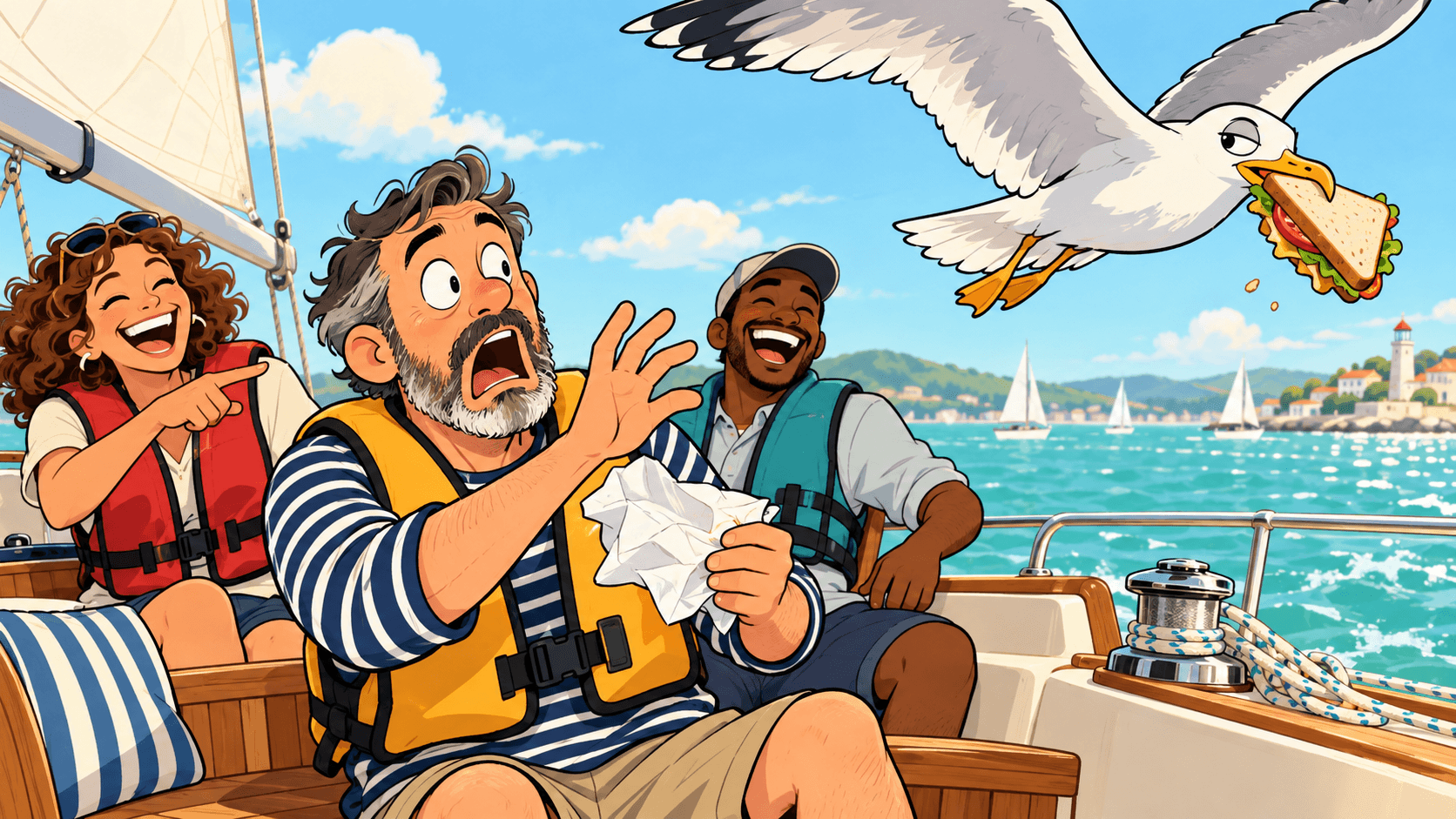
There is an unofficial three-part test for a funny boat story. It has to involve a boat. It has to be funny now. And it absolutely cannot have been funny at the time. Almost every sea story worth retelling passes all three.
What is easy to miss, sitting at a marina bar listening to someone describe the night their anchor walked half a mile across a bay, is how few different stories there actually are. Strip out the boat names and the swearing and you are left with maybe seven situations that produce nearly every funny boating story ever told. The anchor that would not set. The docking approach the wind rearranged. The gull. The squall. The winch handle that went over the side.
This is a guide to those seven situations, told the way boaters tell them, with the fix sitting right next to the punchline. If you have been on the water for more than a season you will recognize all of them. If you are heading out for the first time this year, treat the whole thing as a briefing disguised as entertainment.
Table of contents
- What Counts as a Funny Boat Story
- Every Funny Sea Story Is a Near Miss That Went Right
- Anchoring Stories: When the Hook Will Not Set
- Docking Fails and the Wind That Causes Most of Them
- Wildlife That Invites Itself Aboard
- Equipment That Fails at the Funniest Possible Moment
- The Squall Nobody Saw Coming
- Common Boating Mishaps and How to Avoid Them
- Why Boaters Keep Telling These Stories
- The Sea Gets the Last Word
- Frequently Asked Questions About Boating Mishaps and Sea Stories
What Counts as a Funny Boat Story
The genre has rules. A funny boating story needs a moment of total loss of control, a witness, and an outcome where nothing was damaged except dignity. Remove any one of those and it stops working. No witness and it is just a thing that happened. Real damage and it becomes an insurance claim, which nobody tells at a bar.
That structure explains something that surprises people: experienced sailors tell far more of these stories than beginners do. Beginners have fewer because they mostly stay well inside their limits. The stories come from the edge of competence, from the trip where you tried the tighter anchorage or the shorter weather window. Anyone who has thought about the value of a calculated risk will recognize the pattern, because the interesting outcomes and the embarrassing ones come from exactly the same decisions.
Every Funny Sea Story Is a Near Miss That Went Right
Here is the part that gets left out of the retelling. According to the U.S. Coast Guard’s Recreational Boating Statistics, the factors sitting at the top of the incident list year after year are not dramatic ones. Operator inattention, improper lookout, operator inexperience, machinery failure and excessive speed. Roughly seven in ten fatalities occur on boats where the operator had never taken a safety course.
The detail worth sitting with is the conditions. Most incidents happen in calm water, light wind and good visibility. The same afternoon that produces a relaxed day out and a funny story later.
So the honest framing for every story below is that it is a near miss that went the right way. Keep telling them. Just notice what was actually happening in each one, because the gap between a dock story and an incident report is usually one habit that somebody had, or did not have.
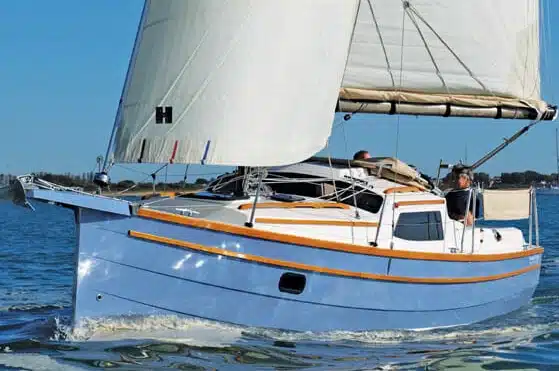
Anchoring Stories: When the Hook Will Not Set
The most-told anchoring story is the one where somebody heaves the anchor over the side and watches the bitter end of the rode follow it into the water. Every marina has a version. It is funny because it is completely avoidable and because there is absolutely nothing you can do once it has happened.
The more common story is quieter. You set the anchor, it feels fine, you go below, and an hour later you are two hundred meters from where you started. Almost always the cause is scope, meaning the ratio between the rode you have out and the depth of water measured from the bow roller, including the tide that is going to come in while you sleep. Five to one is the settled-weather minimum. Seven to one or more once there is wind in it. A boat anchored in four meters of water on twelve meters of chain is not anchored. It is parked.
Two other things decide whether the hook holds. Holding ground, where sand and firm mud hold well while weed and rock mostly do not. And setting technique, which means backing down on the anchor at idle and watching a fixed point ashore to confirm it has bitten instead of assuming it has.
Anchor design matters more than most new owners expect. A modern scoop or spade pattern sets faster and resets more reliably after a wind shift than the older fisherman and grapnel designs still sitting in plenty of lockers. European chandlers such as ForBoat list the modern types side by side with weight recommendations by boat length, which is the quickest way to find out whether the anchor on your bow is sized for your boat or for the boat the previous owner had.
Docking Fails and the Wind That Causes Most of Them
Docking produces the highest concentration of witnesses, which is why it produces the best stories. The classic version goes like this: the approach is perfect, the boat touches the dock gently, and then the wind gets on the beam and pushes the bow out while somebody stands on the foredeck holding a line and no plan.
Three habits fix most of it.
- Set fenders before you enter the fairway. Adjusting fender height while the boat is already moving toward concrete is how the stories start.
- Use a midship spring line. This is the technique almost nobody teaches beginners and almost every professional uses. Get one line from a midship cleat onto a dock cleat, put the engine gently ahead against it, and the boat pulls itself alongside and stays there while you sort out bow and stern lines at walking pace.
- Brief the crew on land. Who takes which line, which cleat, and what the word for stop is. Shouting a new plan across eight meters of water while the wind builds has never worked for anyone.
Peak season in a crowded Mediterranean marina is where these stories get manufactured at scale. Anyone who has tried to med-moor in August around the islands and harbor towns you can reach on a road trip out of Split has either produced one of these stories or stood on a quay watching three.
Wildlife That Invites Itself Aboard
The gull that takes an entire sandwich mid-bite is real, and it is not an accident. Gulls in marinas and popular anchorages have learned that people on boats carry food and mostly react slowly. The fix is genuinely just this: food lives in a closed cooler or below deck, never open on a cockpit table while you go forward for two minutes.
Dolphins riding the bow wave is the better story and the one everyone films. If it happens, hold your course and your speed. Turning toward them or slowing sharply for a closer look is how you lose them, and occasionally how you put one under the hull.
Seals treat swim platforms as public property. They are considerably heavier than they look and they do not negotiate.
Equipment That Fails at the Funniest Possible Moment
Winches jam. Halyards wrap. Cam cleats let go under exactly the load you needed them to hold. These make good stories because the failure is usually small and the reaction is usually loud.
Most of them are preventable in about four minutes at the dock. Fuel level and fuel filter. Battery and engine start. Bilge dry and bilge pump working. Steering moving lock to lock. A radio check on VHF channel 16 or the local working channel. Navigation lights, because you will come back later than you planned.
On the sailing side, jammed rope clutches and cam cleats are almost always a loading problem rather than a hardware problem. If a clutch will not release, take the load onto a winch first, then open it. Forcing a loaded clutch either breaks the clutch or costs you a finger, and only one of those ends up as a funny story.
The Squall Nobody Saw Coming
The hat overboard story is universal because a hat is the one item on a boat that nobody ever secures. A gust takes it, it lands twenty meters astern, and somebody has to decide whether it is worth a turn.
It is worth a turn, and not because of the hat. A hat in the water is the most realistic man overboard drill you will ever get for free. Practicing the turn, the approach and the retrieval on something that costs fifteen dollars is a much better plan than practicing it for the first time on a person.
Squalls are the other weather story. Afternoon thermal buildup can take you from flat water to twenty-five knots in the time it takes to make lunch. The rule experienced crews follow is to reef at the first moment you wonder whether you should reef. If you are still wondering ten minutes later, you have already left it late.
These stories cluster around short coastal hops, the kind you plan casually from a holiday base like Malta’s north coast around Qawra, where the water looks flat from the balcony and the afternoon has its own opinions.
Common Boating Mishaps and How to Avoid Them
| The story you will hear | What actually caused it | The fix |
|---|---|---|
| The anchor dragged all night | Too little scope for the depth plus tide | 5:1 in settled weather, 7:1 or more in wind, measured from the bow roller |
| The anchor went over with no line attached | The bitter end was never secured in the locker | Check the bitter end is made fast at the start of every season |
| The boat hit the dock sideways | Wind or current on the beam with no spring line rigged | Rig a midship spring line and let the engine pivot the boat alongside |
| The fenders were in the wrong place | Fender height set during the approach | Fenders positioned and agreed before entering the fairway |
| A gull stole the sandwich | Open food on an open deck in a busy anchorage | Food in a closed cooler or below, always |
| The hat went overboard | No lanyard | Lanyard, and use any retrieval as a free man overboard drill |
| Too much sail up when it piped up | Waiting to see if the wind would ease | Reef at the first thought of reefing |
| The engine would not start at the ramp | No pre-departure check | Four-minute check: fuel, battery, bilge, steering, VHF, lights |
Why Boaters Keep Telling These Stories
Swapping sea stories is old, and it was never only entertainment. It is how the practical knowledge in this article got transmitted for a few thousand years before anyone wrote a manual. A story about somebody else’s dragged anchor teaches scope better than a number in a book, because it arrives attached to a consequence and a laugh.
That mechanism is not unique to boats. It is why a well-told story outperforms a specification sheet in almost every field, something brands building content around authentic storytelling run into constantly. Specifics stick. Abstractions evaporate.
The rest of it is social. A crew that can laugh at a bad docking recovers faster than one that cannot, and a skipper who tells a story about their own mistake gives everybody else permission to admit theirs. On a boat, where somebody quietly hiding a mistake for an hour can get genuinely expensive, that is worth more than it sounds.
The Sea Gets the Last Word
Nothing goes entirely to plan on the water. The anchor drags, the gull wins, the forecast lies, and the person on the dock always seems to be filming. The good news is how short the list is. Seven situations, a handful of fixes, and everything left over is material.
Learn the fixes and you will collect fewer of these stories. You will also collect better ones, because the best ones come from people who knew exactly what was happening and still could not stop it.
Frequently Asked Questions About Boating Mishaps and Sea Stories
Human factors, not equipment or weather. U.S. Coast Guard data consistently puts operator inattention, improper lookout, operator inexperience, machinery failure and excessive speed at the top of the list. Most incidents also happen in calm water with light wind and good visibility, which is the opposite of what people expect.
Nine times out of ten it is insufficient scope. People measure depth from the waterline instead of from the bow roller, and they forget the tide that will raise the water level overnight. The other two causes are poor holding ground, meaning weed or rock instead of sand or firm mud, and never properly setting the anchor by backing down on it.
Five to one in settled conditions and seven to one or more when there is wind forecast. Measure from the bow roller to the seabed and add the maximum tidal rise you expect. All-chain rode can work at slightly shorter scope than rope and chain because of its catenary, but shortening scope to fit a crowded anchorage is the most common reason boats drag.
Rig a midship spring line before you approach and use it first. Get that single line onto a dock cleat, put the engine gently ahead against it with the helm turned toward the dock, and the boat will pull itself alongside and hold there while you attach bow and stern lines calmly. Set fender height before entering the fairway, and brief every crew member on land about which line they take and where.
Six things, about four minutes total. Fuel level and filter. Battery and engine start. Bilge dry with a working pump. Steering moving freely lock to lock. A VHF radio check on channel 16 or the local working channel. Navigation lights, because you will almost certainly come back later than planned.
Yes, and it is completely voluntary on their part. They are riding the pressure wave off the bow because it costs them less energy than swimming. Hold your course and your speed. Turning toward them or slowing sharply to get a better view usually ends the encounter and occasionally puts an animal in a dangerous position near the hull.
The best ones live in community forums rather than articles. YachtForums, OffshoreOnly, the sailing and boating subreddits, and regional cruising association groups all have long-running story threads going back years. Local sailing clubs and charter bases are the offline equivalent, and the stories told there are usually better because the person who was on the foredeck is standing right in front of you.
Editorial note: ForBoat is cited as an example of a chandler that publishes anchor weight recommendations by boat length, which is useful for readers checking whether their anchor is correctly sized. Growwwth has no commercial relationship with ForBoat and received nothing for the mention.
