Car Rental in Qawra: Parking, Driving Tips and Day Trips
Where to park in Qawra, how Malta’s road markings work, the Gozo ferry rule most drivers miss, and the day trips worth renting a car for.
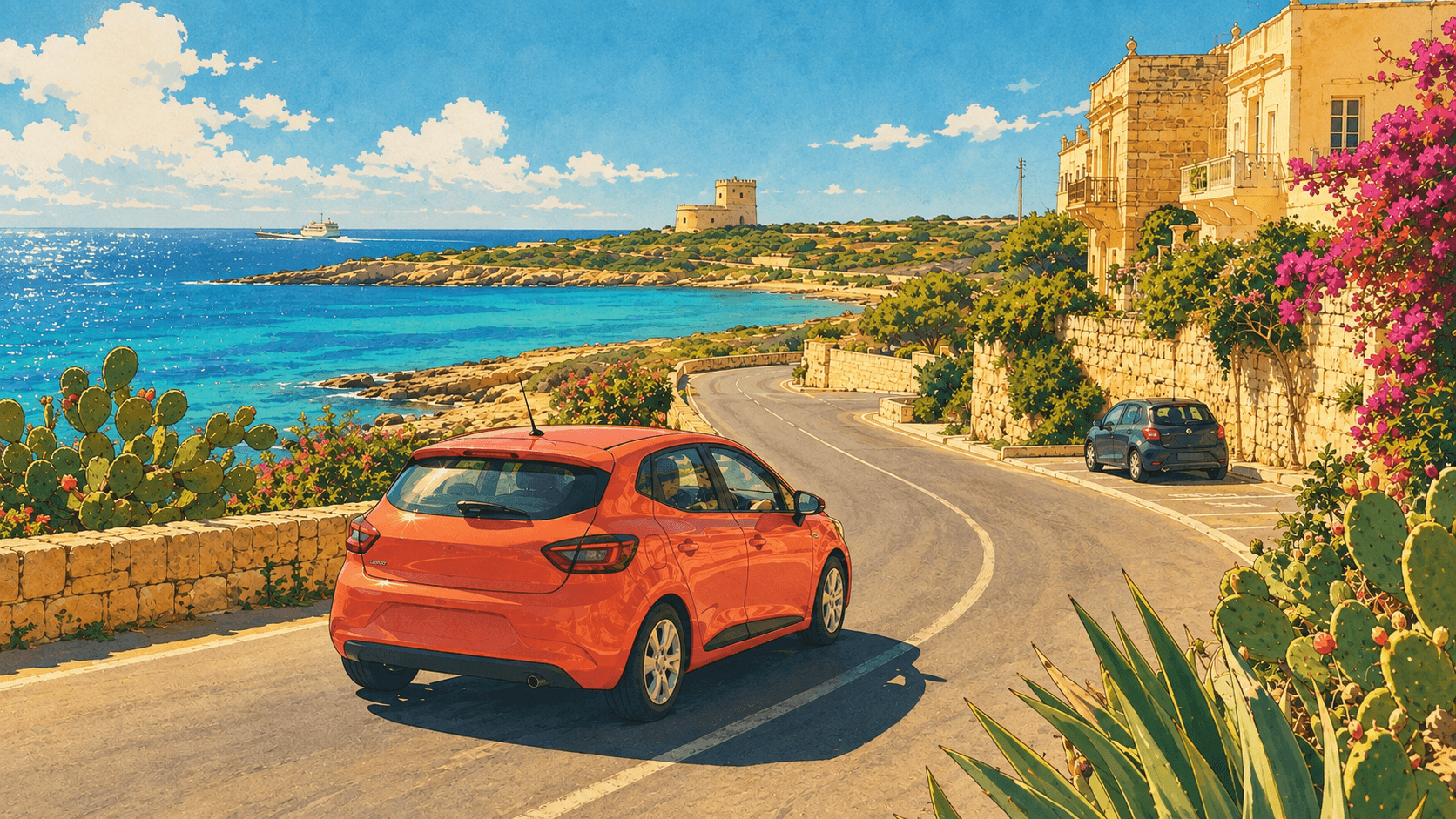
Qawra works as a base for one specific reason: it puts you within half an hour of most of northern and western Malta while still being a resort you can walk around at the end of the day. The seafront, restaurants and hotels sit close together, and Bugibba and central St Paul’s Bay run straight into it, so the everyday business of eating and swimming needs no car at all.
The question is what happens beyond the promenade. Mellieħa, Għadira Bay, Golden Bay, Mdina, the Ċirkewwa ferry to Gozo: none of these are far, but reaching several of them by bus can eat up a morning that a car would handle in twenty minutes. That is the real case for car rental in Qawra, and it is worth being honest that it does not apply to every trip.
This guide covers the parts most rental guides skip: what Malta’s road markings actually mean, where you can realistically park in Qawra in August, the Gozo ferry rule that surprises almost every first-time driver, and which day trips repay the cost of the car.
Table of contents
- Do You Need a Car in Qawra?
- Where to Collect a Rental Car
- Driving Around Qawra and St Paul’s Bay
- Malta’s Road Rules in Numbers
- Parking in Qawra
- Which Type of Car Works Best?
- Places to Visit from Qawra by Car
- Drive Times from Qawra
- Renting Without a Credit Card
- What to Check Before Booking
- Inspecting and Returning the Car
- When Renting a Car in Qawra Is the Wrong Call
- Exploring Malta from Qawra
- Frequently Asked Questions About Car Rental in Qawra
Do You Need a Car in Qawra?
You probably don’t need a car every day on a short stay. Qawra, Bugibba and the central part of St Paul’s Bay form one connected urban area with hotels, cafés, shops and a long promenade. Once you are settled at your accommodation, you can make many everyday journeys on foot.
Hiring a car makes more sense when you want to see Malta beyond the resort strip. It lets you leave before the busiest hours, combine a beach with a village, and stop at smaller places that would otherwise require a change of bus.
Families may also appreciate having a car for carrying beach bags, a pushchair or shopping. For couples spending most of the holiday beside the hotel pool or taking organized excursions, paying for a vehicle and parking it every evening may offer little benefit. This matters more at Għadira and Golden Bay than it sounds, because both involve carrying everything a reasonable distance from wherever you find a space.
A useful compromise is to collect a car for only part of the stay. Spend the first days walking around Qawra and Bugibba, then use a vehicle for the days devoted to western Malta, Mdina or Gozo.
Where to Collect a Rental Car
There are three common arrangements for car hire in Qawra: collection at Malta International Airport, delivery to your accommodation, or pickup from an office elsewhere in the St Paul’s Bay area. Airport collection usually carries a premium location fee. Weigh it against the transfer you would otherwise pay: Malta’s airport taxi fares are set by fixed zones, and the St Paul’s Bay zone runs to roughly €30 each way. Whether the airport is genuinely the expensive option depends on whether the supplier charges a one-off location fee or a percentage of the rental, so check which it is before assuming.
Hotel delivery may suit travelers who do not want to drive immediately after a flight. It can also be convenient if you need the car for only two or three days in the middle of the holiday.
Check whether delivery is included in the price or charged separately. Handover may take place outside the hotel, in a nearby public parking area, or at another agreed meeting point if access beside the property is limited.
Save the supplier’s telephone number before collection. Keep the confirmation available offline and make sure the company knows the correct hotel name, address and arrival time.
The main driver will normally need the original driving license, passport or accepted identity document and the payment card stated in the booking conditions. Confirm in writing any agreement involving a debit card, cash payment, or reduced deposit.
Driving Around Qawra and St Paul’s Bay
Traffic in Malta keeps to the left. The adjustment is usually manageable, but the first roundabouts and turns require concentration if you normally drive on the right.
Qawra’s roads are more busy than technically difficult. The main routes are easy to recognise, while residential streets can become tight because of parked cars, delivery vehicles and short spaces between junctions.
Take extra care when leaving a hotel garage or roadside space. The reliable habit is to say the side out loud before you move, every time, for the first two days. Drivers most often revert to their home side when pulling out of a space rather than at junctions, because a junction has a roundabout to focus on and a space does not.
Traffic slows around Bugibba, the seafront and the roads leading towards Mellieħa during busy periods. A journey that appears very short on a navigation app can take considerably longer in the late afternoon or on a summer weekend.
Choose the correct lane before entering a roundabout and follow the road markings. Sudden lane changes are more stressful than missing an exit and safely turning back.
Navigation apps are useful, but they do not show the actual width or gradient of every street. A route can be technically open while still being uncomfortable in a large vehicle. When two routes look similar, the main road is often the easier choice.
Malta’s Road Rules in Numbers
Malta drives on the left, but the rest of the rulebook is where visitors get caught out, partly because a lot of what is published online is out of date.
Speed limits are 50 km/h in built-up areas and 80 km/h outside them, and there are no motorways anywhere on the islands. Some residential streets and school zones drop to 30 km/h, and the sign always overrides the general rule. Fixed and mobile speed cameras are in use on the main routes, and fines are pursued through the rental company if you are not an EU license holder.
The drink-drive limit is 0.5 g/l, or 50 mg per 100 ml of blood. It is 0.2 g/l for probationary drivers and commercial drivers, and zero for bus and coach drivers. This matters because a great many travel pages, including some large motoring sites, still quote Malta’s old 0.8 g/l limit. Malta reduced it in late 2018 as part of the National Alcohol Policy, and the current figures are listed by the European Transport Safety Council. Following the old number now would put you well over. In practice, the safest position on a holiday is not to drink at all on a driving day, particularly since the roads back from Mellieħa and Golden Bay are dark and narrow after sunset.
Seat belts are required in every seat. Phones must be hands-free, and holding one while stationary in traffic still counts. At roundabouts, traffic already on the roundabout has priority, and you must give way to buses pulling out.
One small detail that helps: Maltese rental cars carry a K or Z on the number plate. Local drivers can spot a hire car instantly, and most of them will leave you a little more room at a junction because of it. It is not a license to hesitate, but it does mean the roundabout you are dreading is less hostile than it looks.
If you have driven a similar island destination before, the mental model transfers better than the specifics do. Driving in Tenerife: Road Rules, Parking Tips and Local Advice for Visitors covers a comparable case where the parking color codes are laid out clearly, and it is a useful reminder that marking systems do not carry over between countries even when the roads feel familiar.
Parking in Qawra
Check parking before you book the hotel, not after you collect the car. Some properties have garages or reserved spaces, while others depend entirely on public parking.
Ask the accommodation for precise instructions. The garage entrance may be behind the building or on a different street from reception. A photograph or map pin from the hotel can be more useful than the official address.
Public spaces near the promenade and restaurant areas tend to fill during the evening. Arriving back from a day trip at the busiest time may mean parking farther from the hotel than expected.
Read the signs and road markings rather than assuming that an empty space is available for unrestricted use. Access points, garages, loading areas and reserved spaces are not always obvious at first glance.
What the Road Markings Mean
Transport Malta’s parking policy designates general on-street parking with white lines. Yellow marks restrictions and reserved bays, almost always alongside a vertical sign stating what the reservation is. A solid yellow line means no waiting at any time, including stopping to drop someone off. Wardens enforce it, and cars can be clamped or towed.
Any other color signals a local scheme, and this is where visitors get fined. Blue and green bays exist in different towns under different rules, and published guides genuinely contradict each other about which is which. Do not learn a color code and trust it. The vertical sign beside the bay is the authority, and if there is no sign, the safest assumption is that the bay is not for you.
Qawra, Bugibba and St Paul’s Bay are simpler than the rest of Malta on this point. Bays here are marked with white lines only. Anything yellow, and anything blocking a garage entrance, will get a ticket. So will parking within five meters of a corner, which is the one that catches people out most often because the space genuinely looks free.
Where to Actually Park in Qawra
Three practical options, in rough order of reliability.
The Dolmen Hotel multi-story on the Qawra Front has around 400 spaces and is the most dependable paid option in the area, including in August. Qawra Point car park sits beside the Malta National Aquarium and is convenient if your day ends on that side of the headland. A public car park is also available on Triq il-Maskli, opposite the Hotel Santana.
Street parking in the residential grid behind the seafront works well most weeks. The exception is Saturday evening, when a large share of Malta drives out to Bugibba and Qawra to eat, and the whole area fills. Regular visitors handle this the same way: park up on Saturday afternoon and leave the car until Sunday morning rather than trying to find a second space at nine in the evening.
If you are attached to a specific hotel, ask before booking whether parking is included or merely nearby. Those are very different promises, and the answer changes whether renting a car in Qawra makes sense.
A compact car is a genuine advantage here. It fits more easily into shorter spaces and is less awkward when vehicles are parked on both sides of a narrow street.
Which Type of Car Works Best?
A small hatchback is enough for most journeys from Qawra. Malta’s main attractions are reached on regular roads, so a large SUV is rarely necessary for ordinary sightseeing.
For two people with one or two suitcases, an economy model is usually the easiest choice. It costs less to run and is more comfortable to park around Qawra, Mdina and the smaller villages.
Families should check boot capacity rather than relying only on the number of seats. A five-seat model may not have enough room for four passengers, several large suitcases and beach equipment.
An automatic car can make left-hand driving more comfortable because the driver has one less unfamiliar task to manage. Automatic models are often less available, especially during peak holiday season.
Compare the entire booking rather than choosing the lowest daily rate. A slightly more expensive offer may have a smaller deposit, clearer insurance, better cancellation terms or delivery to the hotel.
Places to Visit from Qawra by Car
Mellieħa and Għadira Bay
Mellieħa is one of the easiest destinations to combine with a stay in Qawra. The route leads north towards the hillside village and the long sandy beach at Għadira Bay.
The beach is popular with families, so parking close to the water becomes harder later in the morning during summer. An early departure also leaves time to explore Mellieħa village or continue farther north.
The roads through the village can be steep and lined with parked cars. Take your time and avoid following narrow shortcuts simply because the navigation app suggests that they save a minute.
Golden Bay and Għajn Tuffieħa
The western coast feels very different from the built-up seafront around Qawra. Golden Bay is easy to access and has beach facilities, while nearby Għajn Tuffieħa is known for its natural setting and coastal views.
Both areas attract large numbers of visitors during warm weather. Arrive early if parking close to the beach matters, particularly at weekends.
Leave bags and valuables at the accommodation rather than visible inside the car. Take water and suitable shoes if you plan to walk along the coast or use paths with steps.
Mdina and Rabat
Mdina and Rabat make an easy cultural day away from the beach. Leave the car outside Mdina’s historic walls and explore the old city on foot.
Rabat begins just beyond Mdina and has its own restaurants, residential streets and historic attractions. There is no need to return to the car between the two places.
Allow enough time for lunch and wandering rather than treating Mdina as a brief photography stop. The quieter side streets are often more memorable than rushing between the main viewpoints.
Valletta and the Three Cities
Valletta can be reached by car from Qawra, but the vehicle is best left outside the historic centre. Driving from one central attraction to another will not save time once parking and restricted streets are considered.
You can visit the Three Cities in one day, although each deserves time of its own. Vittoriosa, Senglea and Cospicua offer waterfront walks, fortifications and quieter historic streets.
Traffic towards the harbour area becomes heavier during commuting hours. Leaving Qawra after the morning peak can make the journey less frustrating.
Gozo and the Ċirkewwa Ferry
Qawra is well placed for Gozo. Ċirkewwa is about 13 km north, roughly 20 to 25 minutes off-peak, and the Gozo Channel ferry is the only crossing that carries vehicles. The two fast catamaran services, one from Valletta and one from Sliema via Bugibba, carry foot passengers only.
Here is the part that surprises nearly every first-time driver. You do not pay to board at Ċirkewwa. You drive straight into the holding lanes with no ticket, cross to Mġarr, and buy the return ticket on the Gozo side before coming back. People routinely spend ten minutes hunting for a ticket booth at Ċirkewwa that does not exist for them, or assume they have accidentally skipped a queue. The current fares, ticketing conditions and timetable are published by the operator at Gozo Channel, and are worth checking before you drive north, because the night fare and the seasonal timetable both change.
The crossing takes about 25 minutes. You cannot reserve a specific sailing: you turn up and take the next one. In July and August, the vehicle queue at Ċirkewwa can swallow a crossing or two, so build in half an hour of slack, and be aware that the return queue on a Sunday evening is worse than the outbound one.
Before anything else, confirm your rental agreement permits taking the vehicle to Gozo. The ferry carrying cars does not mean your provider allows it, and this is one of the conditions most likely to differ between vehicle categories from the same company. Get the permission in writing.
A full day is the realistic minimum. Gozo’s villages, beaches and viewpoints are genuinely spread out, which is the whole argument for taking the car rather than crossing on foot and hiring locally.
Popeye Village and Anchor Bay
Anchor Bay is another straightforward trip from Qawra. The viewpoint above Popeye Village is a popular stop, and you can combine the surrounding northwestern coast with Mellieħa or a beach visit.
The road is manageable, but parking and visitor numbers increase during the main season. Check opening arrangements separately when planning to enter the attraction, not just to visit the viewpoint.
Drive Times from Qawra
Approximate off-peak driving times. Summer afternoons and Valletta commuter hours can add half again to the southern routes.
| Destination | Distance | Off-peak drive |
|---|---|---|
| Għadira Bay, Mellieħa | ~9 km | 15 to 20 min |
| Golden Bay | ~11 km | 20 to 25 min |
| Ċirkewwa ferry terminal | ~13 km | 20 to 25 min |
| Mdina and Rabat | ~13 km | 25 to 30 min |
| Valletta | ~17 km | 30 to 45 min |
| Malta International Airport | ~20 km | 30 to 40 min |
The pattern in that table is the whole argument. Everything north and west of Qawra is a genuinely short hop, which is where a car earns its cost. Valletta is the outlier, and the honest advice is to take the bus or park outside the walls rather than drive into a city with a Controlled Vehicular Access charge and almost no parking.
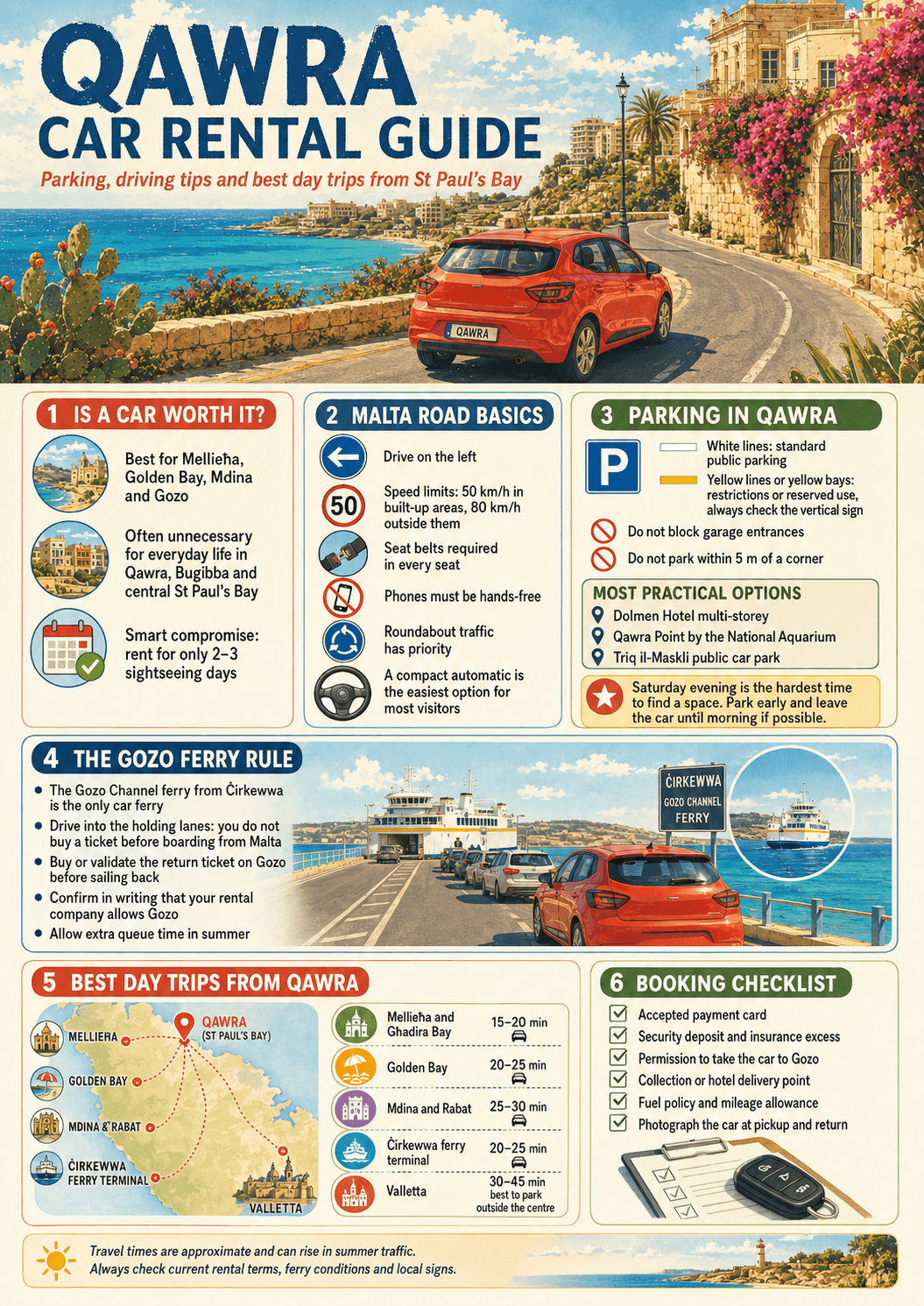
Infographic Car Rental in Qawra at a Glance
This is the same route-planning logic that applies to any coastal base. Best Places to Visit from Split by Car in 2026 works through the equivalent exercise in Croatia, where the useful skill is grouping destinations by direction rather than trying to see everything from one hotel.
Renting Without a Credit Card
Some local rental companies accept debit cards or cash payment on selected cars. The wording should be read carefully because debit card acceptance does not automatically remove the security deposit.
One provider may block a refundable amount on the debit card. Another may offer a low-deposit or no-deposit vehicle under different insurance conditions.
The payment card may need to belong to the main driver and show the same name as the reservation. Virtual and prepaid cards aren’t always accepted when the company needs to verify the cardholder or place a temporary hold. Revolut, Wise and similar cards are a common failure point at Maltese rental desks even where the provider’s website does not exclude them. If you intend to use one, get written confirmation naming the card issuer before you fly.
Always check the terms attached to the exact vehicle. Payment rules may vary between categories offered by the same rental company.
What to Check Before Booking
- the exact collection or hotel delivery point
- whether delivery and collection cost extra
- which payment cards are accepted
- the amount of the security deposit
- the insurance excess and main exclusions
- whether the deposit is blocked or charged
- the fuel policy and mileage allowance
- the cost of adding another driver
- whether the car may be taken to Gozo
- the return address and key procedure
Keep any exceptions in writing, especially when they concern debit cards, cash payment, late delivery, or a reduced deposit.
Once you know what you are comparing, it is worth checking two or three providers side by side rather than booking the first result. Local Maltese operators and international brands price deposits and excess very differently, and the gap between them is usually bigger than the gap in daily rate. Travellers who want to compare vehicles and booking conditions can start with RentGo Malta, then check the same vehicle category on one international comparison site so you can see whether the deposit and excess are genuinely competitive.
Inspecting and Returning the Car
Before driving away, photograph the doors, bumpers, wheels, windscreen and any marks already present. Check the mileage and fuel level against the handover report.
Save the provider’s contact number and ask what to do after an accident, breakdown or tyre problem. The procedure may differ from one company to another.
Before the return, check whether the car will be collected from your hotel or must be taken to another address. When returning it to the airport, allow time for traffic from northern Malta.
Refuel according to the agreed policy and keep the receipt. Take another set of photographs showing the exterior, fuel gauge and mileage before handing over the keys.
Keep the final handover confirmation until the provider has released any deposit.
When Renting a Car in Qawra Is the Wrong Call
Most guides on this topic are written by people who benefit from you renting a car. It is worth saying plainly when you should not.
If you are staying five nights or fewer and your plan is the pool, the promenade and one organised excursion, a car is dead money. Malta’s bus network is flat-rate and Bugibba is a major terminus. Route 41 reaches the Ċirkewwa ferry in about half an hour, the X1 gets you to Mellieħa in around twenty minutes, and routes to Valletta and St Julian’s run frequently. For a couple, a week of bus travel costs less than two days of rental, plus fuel and parking stress.
If your accommodation has no parking and you are visiting in July or August, think carefully. Circling Qawra at ten at night looking for a legal space is a genuinely bad end to a good day, and it happens more than the brochures suggest.
If you have never driven on the left, and you are nervous about it, and your trip is four days long, the adjustment cost may outweigh the benefit. The roundabouts are fine after a day. The problem is that you only have four days.
The strongest option is a split rental: walk Qawra and Bugibba for the first few days, then take a car for two or three days to cover the west coast, Mdina, and Gozo. You pay for the vehicle only when you’re using it, and you avoid parking it every night of the holiday.
If this is your first time hiring a car outside your home country, the general preparation transfers even when the specifics do not. Driving in Georgia: Complete Guide for Tourists Renting a Car covers the documents, deposit and insurance questions in more depth, and the section on reading insurance conditions before comparing daily rates applies directly to Malta.
Exploring Malta from Qawra
Car rental in Qawra is most useful for travelers who want to go beyond the seafront and see several parts of Malta independently. Mellieħa, Mdina, the western beaches and the Gozo ferry are all easier to combine when you control the route and departure time.
For most visitors, the best choice is not the largest or cheapest vehicle. It is a compact car with enough luggage space, clear insurance terms and a collection arrangement that suits the holiday.
Qawra remains convenient even when you use the car only on selected days. You can enjoy the resort on foot, then drive out when the day calls for beaches, villages or a ferry to Gozo.
Frequently Asked Questions About Car Rental in Qawra
Not for daily life. Qawra, Bugibba and central St Paul’s Bay form one walkable area with hotels, restaurants and a long promenade. A car becomes worthwhile when you want Mellieħa, the western beaches, Mdina or Gozo, and it is most cost-effective when hired for only part of the stay.
About 20 km. Off-peak, that is about 30 minutes by car. Allow closer to an hour on a summer afternoon or during commuter traffic, particularly on the return leg when you have a flight to catch.
Only if your rental agreement permits it. The Gozo Channel ferry from Ċirkewwa is the only crossing that carries vehicles, but the ferry accepting cars does not mean your provider allows the trip. Confirm it in writing before booking, and check whether the permission applies to your specific vehicle category.
No. You board at Ċirkewwa without a ticket and buy the return fare at Mġarr on the Gozo side before crossing back. This catches out most first-time visitors. You can’t reserve a specific sailing, so in peak season allow extra time for the vehicle queue.
Bays in Qawra, Bugibba and St Paul’s Bay are marked with white lines. The Dolmen Hotel multi-story on the Qawra Front is the largest paid option, with car parks also at Qawra Point by the National Aquarium and on Triq il-Maskli. Street parking works most days, but Saturday evening fills the whole area.
A solid yellow line means no parking and no waiting at any time, including stopping to drop someone off. Yellow is also used for reserved bays, in which case a vertical sign states the reservation. Cars on yellow lines are clamped or towed. Parking within five meters of a corner will also earn a ticket even where there is no line.
0.5 g/l, or 50 mg per 100 ml of blood, and 0.2 g/l for probationary and commercial drivers. Malta reduced the limit from 0.8 g/l in late 2018, but many travel and motoring sites still list the older figure. Penalties are severe and include fines running into four figures.
EU licenses are accepted, and licenses in Latin script are generally fine. Rental companies set their own document requirements on top of the legal minimum, including minimum age, minimum license-held period and accepted payment cards, so check the conditions attached to the exact vehicle rather than the company in general.
For most visitors who normally drive on the right, yes. It removes one unfamiliar task while you adapt to left-side driving, gear changes with the opposite hand, and narrow streets at the same time. Automatics are less widely available in Malta during peak season, so book early rather than expecting to upgrade at the counter.
