How to Choose a Beauty Marketing Agency: The Playbook
How to choose a beauty marketing agency: test creative velocity, claim compliance, creator seeding, retention and contract terms before you sign.
Scaling a beauty brand used to follow a predictable script. You hired a boutique creative agency to shoot a polished campaign, mailed PR boxes to a few big influencers, ran Meta ads to a Shopify store and watched sales climb.
That script has stopped working. Paid acquisition costs keep rising, short-form video ads can wear out within a week or two, and TikTok Shop, Amazon and AI-powered search have changed how people discover and buy skincare, cosmetics and hair care. A shopper might hear about your serum in a creator’s live stream, ask an AI assistant whether niacinamide suits her skin, read Amazon reviews and then buy a bundle on your own site.
That is why choosing a beauty marketing agency is now a financial decision as much as a creative one. The right partner connects every video, creator post and email to your unit economics. It knows where cosmetic claims end and drug claims begin, runs creator programs that follow disclosure rules and keeps customers reordering after the first purchase. An agency that cannot link its ideas to your margin will spend your budget quickly and leave little behind.
The short answer: judge every candidate on six things:
- How fast it produces and tests new creative.
- How well it handles cosmetic claims and influencer disclosure.
- How it runs creator seeding, including usage rights.
- Whether it coordinates DTC, Amazon, TikTok Shop, retail and search.
- How it grows repeat purchases after the first order.
- Whether its contract lets you leave with your data and assets.
This playbook explains how to choose a beauty marketing agency step by step: what good looks like in each area, the questions to ask, the red flags to watch for, a scorecard you can reuse and what agencies typically cost. The criteria are the same whether you are hiring a skincare marketing agency for a serum launch, a cosmetics marketing agency for a color line or a full-service team to run beauty brand marketing across every channel.
Table of contents
- Start With What You Are Actually Hiring For
- 1. Creative Velocity and Asset Testing
- 2. Regulatory Compliance and Ingredient Literacy
- 3. Scalable Micro-Seeding Engines
- 4. Multi-Channel Execution: DTC, Amazon, TikTok Shop and Search
- 5. Retention Economics and Customer Lifetime Value
- How to Vet a Beauty Marketing Agency Step by Step
- Interview Checklist: Red Flags vs. Green Flags
- A Weighted Scorecard for Comparing Agencies
- What Does a Beauty Marketing Agency Cost?
- Setting Up the Agency Contract for Success
- Your First 90 Days With a New Agency
- Choosing the Right Beauty Marketing Partner
- Hiring a Beauty Marketing Agency: Costs, Timelines and Compliance
Start With What You Are Actually Hiring For
Most bad agency relationships start before the first call. A brand sends a vague brief, receives polished pitches built for a different problem and picks the most charismatic team. Spend an afternoon defining the job first, because the right type of agency depends on where your growth is actually stuck.
Match the Agency Type to Your Bottleneck
| Agency Type | Best When | Watch Out For |
|---|---|---|
| Full-service growth agency | You need creative, paid media, creators and retention run as one system | Thin senior attention if your budget is small for them |
| Performance or paid social specialist | You have a proven hero SKU and need to scale Meta, TikTok or Google profitably | Optimizing platform ROAS while ignoring margin and repeat purchases |
| Influencer and creator agency | Awareness, seeding and content supply are your main gaps | Big reach with no usage rights or sales tracking |
| Beauty PR agency | You need editorial coverage, awards and retail credibility | Coverage that never connects to search demand or sales |
| Retention and lifecycle specialist | You have customers but weak reorder rates | Discount-heavy flows that train buyers to wait for codes |
| Amazon or marketplace agency | Amazon is, or should be, a major revenue channel | Price and offer conflicts with your own store |
Write a One-Page Brief
Before you contact anyone, put these facts on one page: your hero SKUs and their gross margin, current and target customer acquisition cost (CAC), average order value, 60 or 90 day repeat purchase rate, the channels you sell through, your monthly budget for fees, ad spend and seeding product, and the claims your formulas can and cannot support. Agencies that read the brief and come back with sharp questions are already showing you how they think.
1. Creative Velocity and Asset Testing
In beauty advertising, ad fatigue is the enemy. As a rule of thumb, a winning short-form video on TikTok or Instagram Reels can lose its edge within one to two weeks once spend is meaningful. When ads stop converting, the targeting is rarely the problem. More often, the audience is tired of the same visual setup and the same opening hook.
A generalist agency that offers a quarterly studio shoot or a dozen polished videos a month will struggle here. You need a partner with a production engine that delivers fresh, modular concepts every month, built from creator footage, in-house shoots and remixes of past winners. Each concept also needs native edits for each feed, because adapting one video concept for TikTok and Reels takes more than resizing a file.
Ask every candidate to back its creative volume with evidence you can check. Published case studies are a good starting point: Brenton Way’s beauty marketing services page, for example, cites a MoxieLash engagement that ran more than 100 ad creatives per week. Treat a figure like that as the start of a conversation. Ask how many assets were net-new concepts rather than resized variants, what share became winners and what each usable asset cost.
Editor’s note: Growwwth has no commercial relationship with Brenton Way. We reference its beauty page because it publishes specific client metrics, which makes it a useful example of the kind of evidence to ask any agency for.
Essential Beauty Ad Formats
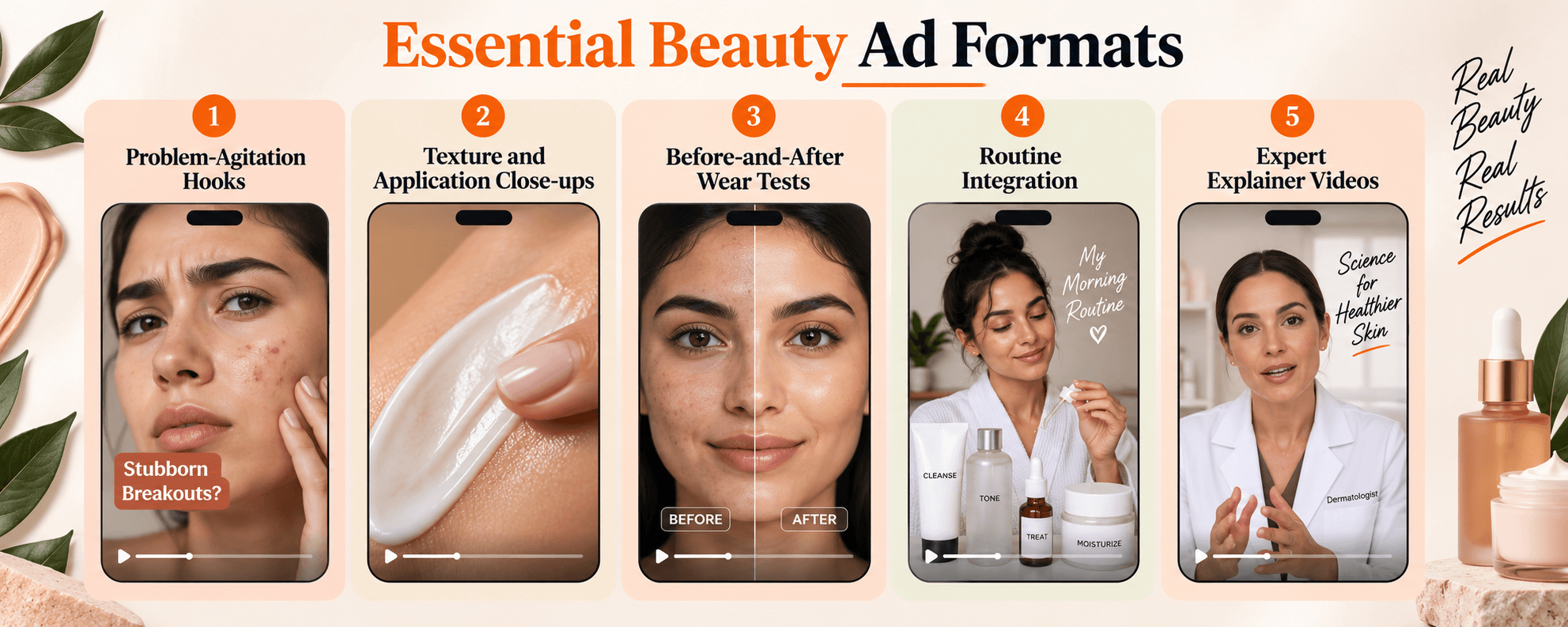
- Problem-agitation hooks: Short clips that name a specific concern in the first two seconds, such as dull-looking skin, visible dark spots or frizz after washing. Be careful here: naming a medical condition such as acne or eczema can turn a cosmetic ad into a drug claim.
- Texture and application close-ups: High-definition video showing how a product feels, glides and absorbs. Beauty shoppers want to see the texture clearly before buying.
- Before-and-after wear tests: Side-by-side clips or time-lapses showing real coverage, hydration or finish over 8 to 12 hours, filmed without filters or retouching so the result is honest.
- Routine integration: User-generated content showing how your SKU fits into a morning or night regimen alongside products the viewer already owns.
- Expert explainer videos: Educational clips featuring dermatologists, estheticians or cosmetic chemists explaining why a formula works, with any paid relationship clearly disclosed.
What a Disciplined Creative Testing Process Looks Like
When you interview agencies, ask them to walk you through their weekly creative testing process. Testing five hooks against two visual angles and three calls to action sounds rigorous, but that is 30 combinations. Most beauty budgets cannot give each one enough spend to produce a reliable result. A stronger process runs in stages:
- Test hooks first, keeping the body and offer constant, because the opening two seconds drive most of the difference in watch time.
- Take the top one or two hooks and test the body of the ad: product demo, customer testimonial or expert angle.
- Test offers and calls to action only once a concept has proven itself.
- Agree kill and scale rules in advance, such as a minimum spend or number of conversions before a verdict, so decisions are not made on gut feel.
Then ask to see the last 30 days of tests on a beauty account, including the losers. An agency that only shows you winners is showing you a highlight reel, not a process.
2. Regulatory Compliance and Ingredient Literacy
Cosmetics, skincare and personal care are regulated categories. An unsupported claim can get ads rejected or accounts restricted, invite FTC action over deceptive advertising or trigger an FDA warning letter. Agencies without beauty experience often fail here because they treat claims as copywriting rather than as legal statements about what a product does.
The core US rule is simple to state and easy to break. Under the Federal Food, Drug, and Cosmetic Act, a product’s intended use decides whether it is a cosmetic or a drug. The FDA judges intended use from your labels, ads, website, social posts, consumer perception and ingredients with a well-known therapeutic use. Its guide on whether a product is a cosmetic, a drug, or both lists claims such as restoring hair growth, reducing cellulite or regenerating cells as drug claims, even for products sold as cosmetics. Sunscreens, acne treatments and anti-dandruff shampoos are regulated as over-the-counter drugs with their own labeling rules. And a creator saying a serum “cured my acne” can cause the same problem as your own landing page saying it.
What MoCRA Changed for Beauty Brands
The Modernization of Cosmetics Regulation Act of 2022, known as MoCRA, is what the FDA calls the most significant expansion of its authority to regulate cosmetics since 1938. It requires the companies behind cosmetic products to:
- Register manufacturing facilities and list each product, including its ingredients, with the FDA.
- Keep records that substantiate the safety of each product.
- Report serious adverse events to the FDA within 15 business days.
Some small businesses are exempt from facility registration and product listing, but safety substantiation and adverse event reporting still apply to them.
This matters to your marketing agency more than most brands realize. The team managing your comments, DMs and creator inboxes often hears about a rash or reaction before your customer service team does. A competent agency has a written process to route those reports to you the same day, and it never deletes them or argues with customers in public.
Influencer Disclosure and the FTC
In the United States, the FTC treats a free or discounted product as a material connection between a creator and a brand, and that connection has to be disclosed. The FTC’s Disclosures 101 guide for social media influencers asks for plain words such as “ad,” “sponsored” or “Thanks to [brand] for the free product,” placed where viewers will actually see them. In practice, that means:
- Put the disclosure in the video itself, not only in the description, and repeat it during live streams.
- Never bury it in a cluster of hashtags or behind a “more” link.
- Avoid vague tags such as “collab,” “spon” or “sp.”
- Use the platform’s paid partnership tool as an extra layer, not as the only disclosure. FTC staff advise against relying on it alone.
Since October 2024, the FTC’s rule on consumer reviews and testimonials has also banned:
- Fake or AI-generated reviews and testimonials.
- Paying for reviews that must be positive or negative.
- Insider reviews from employees or their families without clear disclosure.
- Buying or selling fake followers or views.
The FTC can seek civil penalties for each violation. Your agency should brief creators on these rules in writing and check posts before amplifying them. Beauty is not the strictest category for creator work. Gambling brands face follower-age tests in the UK and outright influencer bans in the Netherlands, as our guide to influencer rules for gambling brands explains.
Core Areas of Regulatory Knowledge
- Cosmetic vs. drug claims: The team must know the difference between cosmetic claims about appearance, such as “visibly brightens skin” or “reduces the look of fine lines,” and drug claims about treating disease or changing how the body works, such as “cures eczema,” “eliminates acne” or “boosts collagen production.”
- Clinical claim translation: Instrumental results, measured by a device or an expert grader, are different from consumer perception results, which record what participants said. A line like “92% saw brighter skin” must be labeled as self-assessed, with the number of participants and the study length. A landing page should never stretch a four-week result into a permanent promise.
- Creator guidelines: Every creator should receive a written list covering banned claims, required disclosures and how to describe results honestly.
- Rules beyond the US: In the EU, cosmetic claims must meet the common criteria in Regulation (EU) No 655/2013, including truthfulness and evidential support. In the UK, the Advertising Standards Authority enforces similar standards through the CAP Code.
Content that touches skin health is also judged more strictly by Google, so expert reviewers and real credentials matter on your blog and product pages. For a practical checklist, see how to build E-E-A-T for direct-to-consumer brands in a way search engines can recognize.
3. Scalable Micro-Seeding Engines
Paying tens of thousands of dollars for one sponsored post from a macro-influencer is usually an expensive gamble. Single big-name posts are hard to attribute, and the fee rarely includes the rights you need to reuse the video in paid ads.
Beauty influencer marketing works best as a system. Strong agencies run product seeding as a steady pipeline: they send product to micro-creators, estheticians and makeup artists whose audiences match your customer, then pay or reward the ones whose content performs. Scale the volume to your stage. As a rough guide, an emerging brand might start with 30 to 50 targeted sends a month to learn which creator profiles post and convert, while an established brand with inventory and fulfillment support can run 100 to 300 a month.
What to Look for in a Seeding Program
- Rights negotiation: The agency secures paid usage and whitelisting rights up front, with the term, platforms and fee in writing. You can then run creator content through tools like TikTok Spark Ads or Meta partnership ads.
- Affiliate infrastructure: Tiered commissions on platforms such as ShopMy, LTK or the TikTok Shop affiliate program give creators a reason to post more than once.
- Professional networks: Relationships with credentialed experts, such as board-certified dermatologists, licensed estheticians and trichologists, add real authority. Their endorsements must reflect their genuine opinion and expertise, and any payment or free product must be disclosed. Check that the credential covers what the expert is shown doing. In Texas, for example, an esthetician license does not cover dermaplaning, as this guide on who can legally perform dermaplaning in Texas explains.
- Disclosure enforcement: Every gifted or paid creator receives written disclosure instructions, and the agency checks live posts before boosting them.
- Seeding metrics that matter: Track the post rate (the share of gifted creators who actually post), cost per usable asset and sales attributed through codes or affiliate links, not just reach.
4. Multi-Channel Execution: DTC, Amazon, TikTok Shop and Search
Beauty buyers do not follow a straight line from discovery to purchase. Someone might find your brand during a TikTok live stream, check reviews on Google, ask an AI assistant to compare your formula with a competitor’s, look at Amazon for fast shipping and finally buy a bundle on your own site.
When channels run in silos, agencies end up competing against themselves for the same customer. Your marketing partner needs to manage your entire channel ecosystem so every touchpoint supports the others, with consistent pricing, offers and claims everywhere.
| Sales Channel | Core Strategic Focus | Key Agency Deliverable |
|---|---|---|
| DTC (Shopify) | Higher average order value, custom bundles, first-party data | Conversion landing pages, diagnostic quizzes, post-purchase offers |
| TikTok Shop | Native social selling, affiliate outreach, live shopping | Creator affiliate management, promotions, live-shopping calendar, hook testing |
| Amazon | High-intent conversion, brand protection | Storefront and A+ Content, Sponsored Products and Sponsored Brands, review monitoring, unauthorized seller checks |
| Retail Support | Sell-through for launch partners such as Sephora and Ulta | Geo-targeted social campaigns, retail media coordination, in-store event promotion |
| Search and AI Answers | Ingredient research, skin concern queries, product comparisons | Concern-led content, product structured data, review strategy, monitoring of AI citations |
The last row is the one most beauty agencies still underplay. Shoppers search for things like “can I use retinol with vitamin C” or “best serum for dark spots,” and a growing share get their first answer from an AI summary rather than a list of links. An agency that builds expert, concern-led content and tracks whether your brand is cited holds an advantage that compounds over time. Our breakdown of how to rank in Google AI Overviews explains how Google picks those sources.
Your agency should also manage channel conflict on purpose. If Amazon listings undercut your own store, your DTC conversion rate is likely to suffer, and a good agency will spot the gap before you do.
5. Retention Economics and Customer Lifetime Value
Acquiring beauty customers through paid channels is expensive, so one-off sales rarely pay back. Sustainable growth depends on repeat buyers and strong customer lifetime value (LTV). Your agency has to own post-purchase marketing instead of stopping the moment a customer completes the first checkout.
Essential Retention Strategies
- Replenishment timing: Base reorder prompts on how fast the product actually runs out. Days of supply equals product volume divided by daily use. If a customer applies about 0.25 ml of a 30 ml serum twice a day, the bottle lasts roughly 60 days, so the first reminder belongs around day 45 to leave time for shipping. Check that estimate against your own data, such as the median number of days between first and second orders.
- Routine building: Post-purchase email and SMS should show how the product works with complementary items in your line. That raises average order value and builds a daily habit.
- Subscriptions done right: Offer clear perks such as free shipping or early access to launches, and make cancelling as easy as signing up. Several US states enforce automatic renewal laws, and hidden cancellation flows create chargebacks and complaints.
- Behavior-based triggers: Browse, cart and replenishment flows should be driven by what customers actually do. The tracking and segments behind them are covered in our guide to using behavioral data to personalize the customer journey.
- Financial metrics: The agency should report Marketing Efficiency Ratio (MER, total revenue divided by total ad spend), CAC, contribution margin after marketing and 60 or 90 day repeat purchase rate, not platform ROAS alone.
How to Vet a Beauty Marketing Agency Step by Step
Before you hire a beauty marketing agency, run every candidate through the same process so you compare evidence rather than pitch decks.
- Build a longlist from referrals and evidence. Ask founders of non-competing beauty brands who they use, and favor agencies with beauty case studies you can question.
- Send the same one-page brief to three to five agencies. Identical inputs make proposals comparable.
- Run structured interviews. Use the questions below, and insist on meeting the people who will actually work on your account.
- Call two references, including one former client. Ask why the relationship ended and what the agency did badly.
- Start with a paid audit or a 60 to 90 day pilot. Set clear targets before agreeing to a long retainer.
- Score every finalist the same way. Use the red flag table and the weighted scorecard below, then decide.
Questions to Ask a Beauty Marketing Agency
- Which beauty brands have you worked with in the last 24 months, and can I speak to one of them?
- Who exactly will work on my account, and how many other accounts does each person manage?
- Can you walk me through last month’s creative tests for a beauty client, including the losers?
- How do you review claims before an ad, landing page or creator brief goes live?
- What happens when a comment or DM reports a skin reaction?
- How do you secure usage rights and disclosure from creators?
- Which metrics will you report every week, and how do you calculate them?
- Do you work with any brands that compete directly with mine?
- Who owns the ad accounts, creative files and data if we part ways?
How to Read an Agency Case Study
Big numbers on agency websites are marketing, not audits. For every headline result, ask for:
- The baseline before the agency started.
- The time window.
- The monthly spend involved.
- Whether ROAS is platform-reported or blended across all revenue.
- What else changed at the brand during that period, such as a viral moment or a new retail launch.
A 10x ROAS on a small retargeting budget tells you very little about the agency’s ability to scale new-customer acquisition.
Interview Checklist: Red Flags vs. Green Flags
When interviewing prospective beauty marketing agencies, use this breakdown to evaluate their answers.
| Area | Red Flag Responses | Green Flag Responses |
|---|---|---|
| Performance Reporting | Focuses only on platform ROAS, video views and social impressions. | Tracks MER, CAC, average order value, contribution margin and 60-day repeat purchase rate. |
| Creative Assets | Delivers 2 to 4 studio videos per month and relies mainly on static graphics. | Delivers 20 to 40 modular short-form video assets monthly with a structured testing system. |
| Influencer Strategy | Recommends spending most of your budget on a few expensive macro-influencer posts. | Runs a scalable micro-seeding program with usage rights, whitelisting and written disclosure rules. |
| Regulatory Knowledge | Assumes ad platforms will catch problematic claims before launch. | Employs copywriters trained on cosmetic claims and checks every brief against the brand’s substantiation. |
| Channel Strategy | Treats Amazon, TikTok Shop and DTC as separate, competing accounts. | Coordinates inventory, offers and messaging across all digital and retail channels. |
| Case Studies | Shows headline ROAS with no baseline, spend or time frame. | Shares context and references, and talks openly about tests that failed. |
| Team and Access | Senior people pitch while juniors deliver; ads run in the agency’s own accounts. | Names the team in the contract; ads run in accounts your brand owns. |
A Weighted Scorecard for Comparing Agencies
Gut feel favors the best presenter. A weighted scorecard keeps the decision tied to the criteria in this playbook. Score each agency from 1 to 5 on every row, multiply the score by the weight, divide by 5 and add up the results for a total out of 100. For example, a 4 on creative testing earns 16 of the 20 available points.
| Criterion | Weight | What a 5 Looks Like |
|---|---|---|
| Creative velocity and testing | 20 | Staged testing process, shows recent losers as well as winners, clear kill and scale rules |
| Claim compliance and disclosure | 20 | Written claim review, creator disclosure rules, a same-day process for adverse event reports |
| Creator seeding program | 15 | Usage rights in writing, affiliate structure, post rate and cost per usable asset tracked |
| Channel coordination | 15 | One plan across DTC, Amazon, TikTok Shop, retail and search with consistent pricing and claims |
| Retention and reporting | 15 | Owns post-purchase flows and reports MER, CAC, contribution margin and repeat purchase rate |
| Contract and transparency | 15 | Short initial term, named team, brand-owned accounts and clear exit terms |
Treat compliance as a knockout criterion. An agency that scores 1 or 2 there should not make your shortlist, whatever its total.
What Does a Beauty Marketing Agency Cost?
Pricing varies widely by scope, so compare what each fee buys rather than the headline number. Published 2026 rate cards from beauty-focused agencies show the spread: single-channel work such as SEO or paid search can cost a few thousand dollars a month, while integrated programs covering creative, paid media, creators and retention run well into five figures. Ad spend, creator fees, usage rights and the product you send out for seeding are usually billed on top.
| Pricing Model | How It Works | What to Watch |
|---|---|---|
| Flat monthly retainer | Fixed fee for a defined scope of work | Vague deliverables and scope creep; get output and hours in writing |
| Percentage of ad spend | Fee rises as the media budget grows | Rewards spending more, not spending well |
| Hybrid with performance bonus | Lower base fee plus a bonus tied to agreed targets | Define the metric precisely, ideally net revenue or contribution margin |
| Project or sprint | Fixed price for an audit, launch or creative batch | Good for testing fit, but limited learning over time |
Ask every agency to show the hours and roles behind its fee. A low retainer that promises paid media, creators, email and compliance review across three channels usually means someone junior is stretched across too many accounts.
Setting Up the Agency Contract for Success
Once you identify an agency that meets these standards, structure the agreement to keep incentives aligned:
- Avoid long initial lock-ins: Request a 90-day trial followed by a rolling monthly agreement with a 30-day notice period. A confident agency will agree to be judged on ongoing performance.
- Align payment structures: Consider a hybrid model with a fair base retainer to cover production costs, paired with a bonus tied to net revenue growth or an agreed efficiency target.
- Set clear deliverables in writing: Your statement of work should state exact monthly output, including new ad variations, seeding packages sent, landing pages built and email sequences created.
- Retain full asset ownership: Your brand should own all raw video files, ad accounts, creator permissions, email templates and data from day one. Ads should run in accounts you control, with the agency added as a partner.
- Track usage rights terms: Record how long and where you can use each creator’s content, so ads do not keep running after a license expires.
- Add a conflict clause: The agency should disclose any competing clients in your product category.
- Plan the exit: Define a handover period, access transfers and a deadline for delivering files if the relationship ends.
Your First 90 Days With a New Agency
- Days 1 to 30: Audit tracking, ad accounts, product pages and claims. Agree baselines for CAC, MER and repeat rate, and set the creative testing calendar and seeding brief.
- Days 31 to 60: Launch the first creative test cycles and seeding cohort. Build or repair core email and SMS flows such as welcome, post-purchase and replenishment.
- Days 61 to 90: Scale proven concepts, cut what failed, review creator post rates and costs, and agree a plan for the next quarter based on what the data showed.
By day 90 you should know whether the agency learns fast, reports honestly and protects your margin. If those answers are still unclear, the trial period has done its job.
Choosing the Right Beauty Marketing Partner
The best beauty marketing agency for your brand combines high-volume, compliant creative with real financial discipline. Hold every candidate to the same standards:
- Test creative systematically.
- Respect the line between cosmetic and drug claims.
- Run creator programs with rights and disclosure in place.
- Coordinate every channel.
- Measure success by margin and repeat purchases.
A partner that meets those standards will grow revenue you can keep and build brand value that outlasts any single viral video.
About this guide: This playbook draws on current FDA and FTC guidance and on case studies and rate cards that beauty-focused agencies published in 2026. Volume and timing ranges are rules of thumb, not guarantees. It is general information, not legal advice; have your claims and creator briefs reviewed by a regulatory professional. Last reviewed October 2026.
Hiring a Beauty Marketing Agency: Costs, Timelines and Compliance
It depends on scope. Single-channel work such as SEO or paid search can cost a few thousand dollars a month, while integrated programs covering creative, paid media, creators and retention often run well into five figures. Ad spend, creator fees, usage rights and seeding product are usually extra. Compare proposals by the hours, roles and monthly output behind each fee.
Expect the first 30 days to go to audits, tracking fixes and the first creative tests. Early signals such as winning hooks and creator post rates usually appear in months two and three. Reliable changes in customer acquisition cost and repeat purchase rate typically need a full quarter or more, because repeat buying takes time to measure.
A specialist usually ramps up faster because it already understands cosmetic claims, creator seeding, replenishment cycles and retail dynamics. A general agency can work if it has strong ecommerce experience and is willing to learn the compliance rules, but you will pay for that learning curve. Ask either type for beauty case studies and references.
Ask who will work on your account, how many accounts each person handles, how they test creative, how they review claims, how they handle reports of skin reactions, how they secure creator usage rights and disclosure, which metrics they report and who owns the ad accounts, files and data if the relationship ends.
In the United States, yes. The FTC treats free or discounted products as a material connection. Creators should use clear words such as ad, sponsored or a thank-you to the brand for the free product, placed in the post or video itself. A platform paid partnership label helps, but it should not be the only disclosure, and brands are expected to brief creators and monitor their posts.
Cosmetic claims describe appearance, such as visibly brightens skin or reduces the look of fine lines. Claims that a product treats a condition or changes the structure or function of the body, such as curing acne, regrowing hair or boosting collagen, are drug claims under FDA rules. Every claim also needs evidence that supports it.
MoCRA is the Modernization of Cosmetics Regulation Act of 2022. It requires facility registration, product listing, safety substantiation records and reporting of serious adverse events to the FDA within 15 business days, although some small businesses are exempt from registration and listing. Agencies that manage your comments and messages often see reaction reports first, so they need a process to pass them to you the same day.
Your brand should. Ad accounts, pixels, analytics properties, raw video files, email templates and creator permissions should sit in accounts you control, with the agency added as a partner. Put this in the contract so you can change agencies without losing data or rebuilding your history from scratch.
Look for Marketing Efficiency Ratio, customer acquisition cost, average order value, contribution margin after marketing and 60 or 90 day repeat purchase rate, alongside creative test results and creator post rates. Platform ROAS and video views are useful diagnostics, but they should never be the main measure of success.
Many brands bring strategy in house first, hiring a growth lead who owns the numbers, the data and the agency relationships, while creative production, paid media or creator sourcing stay with specialists. Moving a whole channel in house makes sense once it is large and stable enough to keep a dedicated specialist busy and your team can match the testing speed an agency delivered.
