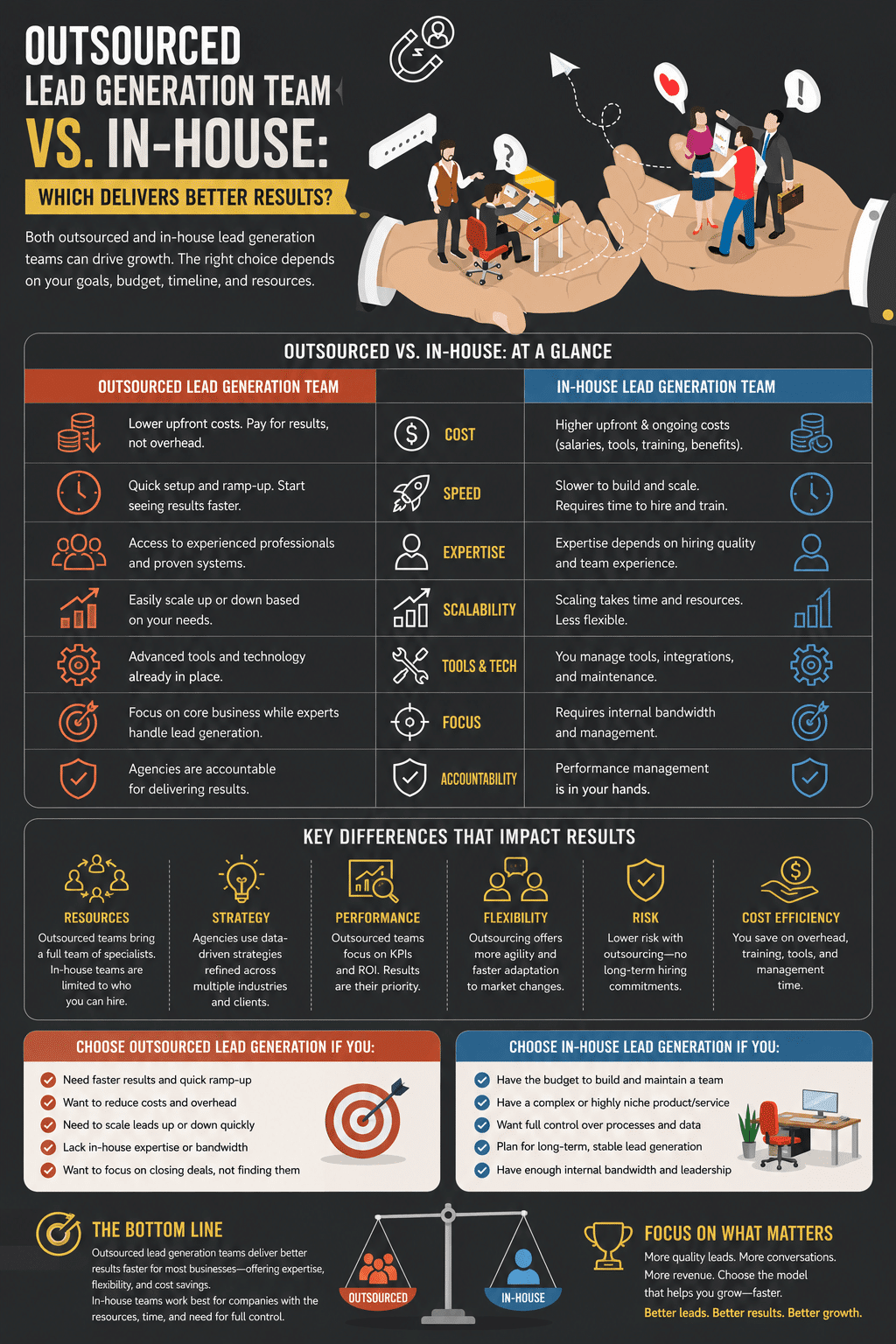
Outsourced Lead Generation Team vs. In-House: Which Delivers Better Results?
More B2B companies are rethinking how they generate leads. Acquisition costs keep climbing, sales cycles stretch longer than anyone wants, and leadership teams are under pressure to keep a predictable pipeline moving every month. That’s usually when the big question comes up: should you outsource your lead generation to a dedicated team, or invest in […]

More B2B companies are rethinking how they generate leads. Acquisition costs keep climbing, sales cycles stretch longer than anyone wants, and leadership teams are under pressure to keep a predictable pipeline moving every month. That’s usually when the big question comes up: should you outsource your lead generation to a dedicated team, or invest in building your own in-house department? In this article, we’ll explore the battle of outsourced lead generation team vs. in-house and check which delivers better results.
Both options can work, but they deliver very different experiences, levels of flexibility, and long-term outcomes. The right choice depends on your goals, timelines, and how fast you need results.
What an Outsourced Lead Gen Team Typically Includes
An outsourced team is usually ready to go. You get SDRs who handle outreach, researchers who gather and validate data, copywriters who craft messaging that actually gets replies, and QA specialists who keep quality high across every campaign. On top of that, account managers coordinate everything and keep the process aligned with your sales goals.
Services by SalesAR also include access to strong data sources, enrichment platforms, automation tools, and tech you likely wouldn’t maintain internally. Most agencies operate across multiple channels at once, applying strategies proven across hundreds of clients. And because the team is already assembled, they can scale campaigns up or down without the lengthy onboarding, training, or hiring cycles that slow in-house teams down.
What an In-House Lead Generation Team Looks Like
Building an internal team gives you full control, but it also comes with a long list of responsibilities before you ever send the first outreach message. You need the right people, the right tools, and the time to train everyone so they can work as a cohesive unit. Even with strong leadership, progress often slows down because experimentation takes longer and capacity stays limited.
- Core roles you’ll need to hire include an SDR, a data researcher, a copywriter, and an operations specialist to manage workflows.
- Training and onboarding fall entirely on your team, along with continuous coaching to maintain consistency.
- The tool stack adds up quickly: CRM, email warmup tools, data providers, enrichment platforms, sequence tools, and dialers.
- Internal teams often run into constraints like limited bandwidth, slower testing cycles, and reliance on other departments for approvals or data.
Cost Comparison: Outsourced Lead Team vs. In-House
The financial side is usually where the differences become very clear. Building an in-house team means covering multiple salaries, taxes, benefits, and the ongoing cost of your tech stack. Even a small internal setup adds up fast once you factor in tools, training time, and the months it takes for the team to perform at a steady level. Those hidden ramp-up costs often surprise companies that expect quick results.
| Cost Category | Outsourced Lead Gen Team | In-House Lead Gen Team |
| Monthly Cost | $4,000–$12,000 (fixed fee) | $25,000–$40,000+ (combined salaries & tools) |
| SDR Salary | Included | $4,000–$7,000/month |
| Researcher Salary | Included | $3,000–$5,000/month |
| Copywriter Salary | Included | $3,500–$6,000/month |
| Operations / Manager | Included | $5,000–$8,000/month |
| Benefits & Taxes | Included | +25–30% on top of salaries |
| Tools (CRM, data, warmup, dialer, automation) | Included | $1,500–$3,000/month |
| Ramp-Up Time | 2–4 weeks | 3–6 months |
| Scalability | Immediate | Slow; requires new hires |
| Experimentation Speed | Fast | Limited by internal capacity |
Outsourcing tends to be more cost-efficient when you need results quickly, want access to advanced tools without paying for them separately, or don’t have the resources to manage a team internally. An in-house setup becomes viable when you already have a strong sales infrastructure, a long planning horizon, and the budget to hire, train, and support a full department.
A fairer starting point, and what the table doesn’t show
The table above compares outsourcing against the most expensive possible in-house build. A leaner in-house starting point looks different: a single experienced SDR handling outreach, research, and light copywriting, often in the $5,000 to $8,000 monthly range including a reasonable tool stack, closer to outsourced pricing than the full four-role comparison suggests. This is a common and often sensible starting point for smaller teams or earlier-stage companies, with a plan to add specialized roles as volume justifies it, rather than a false choice between one outsourced fee and four immediate hires.
Cost isn’t the only variable worth weighing before choosing, either. You remain the data controller under GDPR and most US state privacy laws regardless of who executes the outreach, which means an outsourced vendor’s mistake becomes your legal exposure unless the contract explicitly assigns liability and the vendor carries adequate insurance. The FTC has been explicit that a business remains liable for CAN-SPAM violations even when an agency sends the email on its behalf, responsibility isn’t transferable simply because someone else executes the send. Penalties for violations can run well into five figures per instance, adjusted periodically for inflation.
Data ownership is worth clarifying before signing, not after the relationship ends. Enrichment work, lead scoring history, and messaging performance data can end up trapped inside a vendor’s own systems if the contract doesn’t specify what transfers to you when the engagement ends. And in crowded outsourcing markets, some agencies run shared SDR pods across multiple clients in the same vertical, meaning your outreach rep may be working a direct competitor’s account in the same week. Getting this right depends heavily on why brand voice and message quality carry real weight in outsourced outreach, since a vendor representing your company to prospects is, in effect, an extension of how your expertise and credibility get communicated, not just a delivery mechanism.
None of this means outsourcing is the wrong choice. It means the decision is genuinely more complex than a monthly price comparison, and a company weighing both options deserves to see the full picture before committing to either one.
If you do outsource, a practical vetting checklist
A few concrete steps meaningfully reduce the risks above before signing a longer-term contract.
Run a 30 to 60 day pilot before committing to anything longer. This validates whether the vendor’s messaging, targeting, and data quality actually fit your ICP before a 12-month minimum locks you in.
Ask directly about data ownership and portability. Confirm in writing that enrichment data, lead scoring history, and campaign performance data transfer to you if the relationship ends, not just contact names.
Verify compliance certifications rather than taking a sales page’s word for it. SOC 2 compliance and explicit GDPR, CCPA, and CAN-SPAM practices should be documented, not just claimed.
Ask whether SDRs are dedicated to your account or shared across clients, and if shared, in which verticals, to understand whether a conflict of interest with a direct competitor is even possible.
Request live campaign dashboards from day one rather than periodic summary reports. Vendors reluctant to share real-time performance data are signaling something about how transparent the engagement will actually be.
Negotiate an exit clause with a defined notice period, a 60-day out is a common and reasonable ask, so the relationship stays optional rather than a long-term structural dependency regardless of performance. This kind of due diligence matters just as much when evaluating how a B2B marketing agency relationship holds up over the long term, since a lead generation vendor is one specific example of a broader category of outsourced marketing relationship with the same underlying trust and accountability questions.
Performance & Scalability Differences: Lead Team vs. In-House
Performance often separates the two models more than anything else. Outsourced teams launch campaigns quickly because everything is already set up. They can also test new ICPs or shift into new regions without slowing down your internal operations. This helps maintain consistent volume, even when your sales team gets busy or priorities change.
In-house teams usually take longer to get campaigns off the ground. They rely on internal approvals, limited bandwidth, and smaller teams that can get stretched thin. Seasonality and employee churn also hit harder. When someone leaves or takes time off, lead flow drops until a replacement is hired and trained. Outsourced teams avoid that dip because they have built-in redundancy and can rebalance workloads immediately.
Data Quality & Outreach Expertise
Data quality plays a huge role in outreach results, and this is where agencies usually have the upper hand. They work with fresh datasets every day, use multiple enrichment platforms, and run ongoing validation to keep bounce rates low. Their researchers specialize in maintaining lead lists that are accurate, up to date, and aligned with your ICP.
In-house teams rarely have the same level of tooling or dedicated data staff. They often rely on a single platform or outdated lists that gradually lose accuracy. When data goes stale, reply rates drop, prospects disengage, and meetings become harder to book. Agencies also bring tested outreach playbooks, messaging variations, and multichannel experiences.
Conclusion
There isn’t a single winner for every company. Both models have strengths, and the right choice depends on where you are right now, how fast you need results, and what you can realistically support. An outsourced lead generation team gives you speed, broader expertise, and a more transparent cost structure, especially in the early stages or during periods when growth needs to be more predictable.
Outsourced vs. in-house lead generation FAQ
Your company is, not just the vendor. The FTC has been explicit that responsibility for CAN-SPAM compliance cannot be transferred simply because another party executes the sending. Contracts should explicitly assign liability and require adequate insurance coverage from the vendor, but the underlying legal exposure to your business doesn’t disappear through outsourcing.
It depends entirely on what the contract specifies. Enrichment work, scoring history, and campaign data can remain trapped inside a vendor’s own systems unless the agreement explicitly states what transfers to you at termination. This is worth clarifying in writing before signing, not after the relationship ends.
Yes, and many companies do exactly this at an earlier stage, often a single experienced SDR handling outreach, light research, and messaging together, before adding specialized roles as volume grows. A full four-role department is one version of in-house, not the only one.
30 to 60 days is a common and reasonable window to validate messaging fit, data quality, and lead relevance before committing to a longer-term contract, which often carries a 12-month minimum in this industry.
Infographic