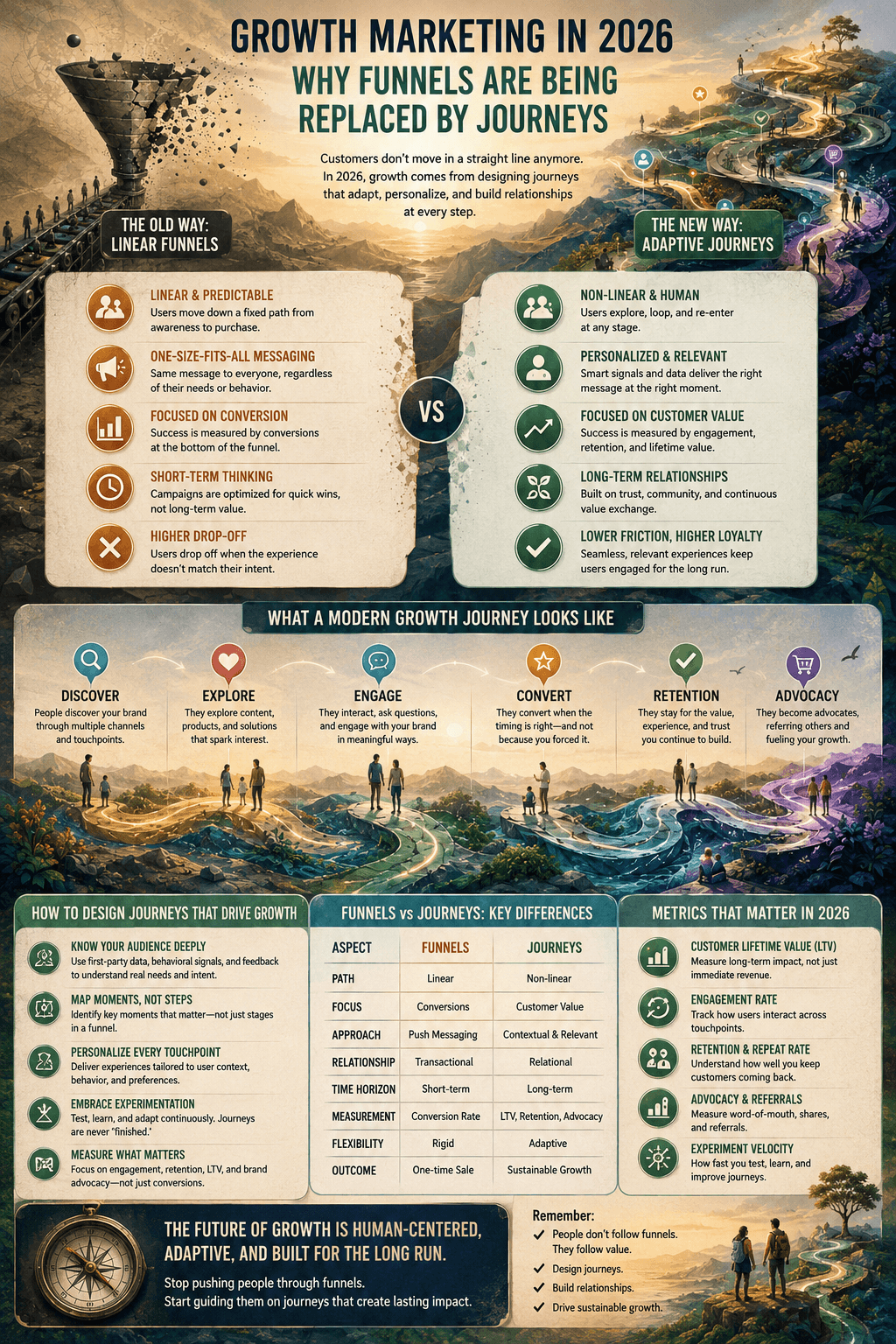
Growth Marketing in 2026: Why Funnels Are Being Replaced by Journeys
Why growth marketing in 2026 favors journeys over funnels, when funnels still work, and how to measure success either way.

There was a time when growth felt simple. You launched a campaign, drove traffic to a landing page, optimized conversions, and watched numbers move from top to bottom. The funnel told a comforting story: start here, end there, repeat.
But if you’ve marketed anything in the last year, you already know that story no longer matches reality.
In 2026, Growth Marketing feels less like engineering and more like navigation. Customers don’t move in straight lines they wander, pause, disappear, and return when the timing feels right. A modern Growth Marketing mindset doesn’t try to force people forward. It learns how to walk with them.
Funnels aren’t dead, but they’re no longer the main character. Journeys are.
Why the Funnel Started to Crack
Funnels assume obedience. Journeys accept choice.
The classic growth marketing funnel imagines people following instructions: read this, click that, convert here. Real people don’t behave that way. They open tabs, ask friends, read reviews at midnight, abandon signups halfway through, and come back weeks later as if nothing happened.
Ever looked at analytics and wondered, “Why did they leave?”
The better question is often, “Why did they come back?”
This shift is at the heart of growth driven marketing, not pushing progress, but removing friction when it appears.
What Really Changed: People, Not Platforms
The tools didn’t break. Expectations changed.
People now expect brands to remember context, respect timing, and adapt to intent. They don’t think in campaigns or stages. They think in needs: Am I ready? Is this worth my time? Do I trust this?
That’s why the most effective growth marketing strategies today feel less like promotions and more like conversations that resume where they left off.
From Touchpoints to Lifecycle Marketing
Here’s a shift that quietly changes everything: stop treating interactions as isolated moments.
A strong lifecycle marketing strategy looks at the entire relationship, not just the first win. It asks what someone needs next, not what you want now.
Awareness Isn’t Always the Beginning
Many users don’t arrive curious; they arrive cautious. They’ve already researched the category. They’re looking for clarity, not introductions.
When awareness content assumes ignorance, it misses the moment.
Conversion Isn’t the End of the Story
Conversion is a checkpoint, not a destination. The real question is what happens after. Confusion here doesn’t just slow growth, it reverses it.
That’s why long-term success depends on a thoughtful customer growth strategy, not just acquisition.
Why Startups Adapted First in Growth Marketing
Startups feel friction faster.
When budgets are tight, wasted effort hurts immediately. That’s why startup growth marketing moved toward journeys before enterprises did. Instead of chasing scale, startups chase understanding.
They ask questions like:
- When do users feel stuck?
- What makes the product “click”?
- Why do some users stay while others leave?
Those answers build momentum more reliably than traffic spikes ever could.
When Growth Moved Inside the Product
One of the clearest signs that funnels are fading is how much growth now happens after signup.
Product-led growth treats the product itself, not an ad or a sales call, as the primary driver of adoption. In practice, that means the first five minutes inside the product carry as much weight as the entire pre-signup campaign that got someone there: does onboarding get a new user to a real “aha” moment quickly, or does it just explain features nobody asked about yet. Companies that get this right track time-to-value the way funnel-era teams tracked click-through rate, as the single number that predicts whether someone sticks around.
This is where a modern growth marketing framework brings marketing, product, and data together, not as handoffs between departments, but as one system responding to the same signals.
Data That Explains People, Not Just Performance
Modern teams don’t just ask what happened, they ask why.
They track hesitation, time-to-value, and re-engagement. Many discover their biggest blockers aren’t traffic-related at all. They’re experience-related. A hesitation pattern might look like a pricing page getting revisited four times over two weeks before a purchase, information a stage-based funnel report would never surface, since it only counts the visit that eventually converted.
This is the practical difference underneath the marketing funnel vs customer journey debate: a funnel report tells you conversion dropped 8%. Customer journey marketing tells you why, three of five drop-off points traced back to the same confusing pricing page, not five unrelated problems. That distinction determines whether a team fixes one page or rebuilds an entire campaign that was never actually broken.
This is where the gap between looking productive and being productive shows up most.
Growth Marketing: Intent Beats Stages Every Time
Journeys are shaped by intent, not labels.
Someone revisiting pricing doesn’t need awareness content. Someone reading documentation before buying doesn’t need urgency they need reassurance.
This is why Growth Marketing today feels more adaptive and less predictable. Modern Digital Marketing responds to behavior instead of forcing progress.
What This Means for Teams in 2026
Marketing teams aren’t traffic machines anymore. They’re experience architects.
Growth happens when marketing, product, sales, and support stop optimizing their own lanes and start fixing the same roadblocks. Consider a concrete version of this: a customer churns two months after signup. Support logs it as “went quiet.” Product never sees a correlation with a confusing onboarding step. Marketing keeps running acquisition campaigns pointed at the same broken entry point. None of those three teams did anything wrong in isolation, the failure is that nobody owns the full picture.
A real lifecycle marketing strategy exists specifically to close that gap: one shared view of a customer from first touch through renewal or churn, so a pattern showing up in support tickets can inform what marketing sends next, instead of three departments each optimizing their own dashboard in isolation. The best teams don’t ask, “How do we push users forward?” They ask, “What’s slowing them down, and who else on the team already knows why?”
Where Teams Still Get It Wrong
Some abandon funnels entirely and lose direction. Others collect endless data and act on none of it.
Both failures look different but share a root cause: treating “journey” as a synonym for “no structure,” when it’s actually a different kind of structure. A team that removes every defined stage still needs to know, at any given moment, whether a specific customer segment is stuck, drifting, or moving. Losing that visibility isn’t flexibility, it’s just losing track of people.
Journeys still need structure, just not rigid paths. The useful middle ground looks like flexible checkpoints tied to behavior (has this person returned three times without converting, has this account gone quiet after an active first month) rather than a fixed sequence everyone is forced through in the same order. Flexibility without intention leads to chaos, not growth.
For teams collecting data without acting on it specifically, a rundown of common conversion rate optimization mistakes is a useful gut check, since the pattern it describes, optimizing a step that looks better on a dashboard while the underlying journey quietly breaks, is exactly the second failure mode described above.
When the Funnel Still Works, and When It Doesn’t
None of this means funnels are obsolete. It means they’re the wrong tool for a specific kind of decision, and still the right one for another.
A funnel model fits situations with a short consideration window and a single, well-defined conversion action: a flash sale, a webinar signup, a simple low-cost purchase where the buyer already knows what they want. Adobe’s Customer Journey Analytics documentation draws this distinction directly: a funnel measures whether people complete a defined sequence of steps, while journey analytics exists specifically because most real purchases don’t follow one.
Journey-based thinking earns its complexity when the buying decision is genuinely non-linear: high-consideration purchases, B2B sales with multiple stakeholders, or any product where someone researches, compares, leaves, and returns days or weeks later. How SMEs Build a Digital Marketing Strategy That Drives Revenue covers how smaller teams without enterprise analytics budgets can still build this kind of thinking into a strategy.
This same reframe, augmentation instead of replacement, is worth recognizing as a pattern beyond growth marketing specifically. Generative Engine Optimization Is Not a Replacement for SEO, It’s an Evolution makes the identical argument in a completely different part of marketing: the old model didn’t die, it got absorbed into something bigger.
The mistake isn’t choosing funnels or journeys, it’s applying funnel logic, one linear scorecard, to a decision that was never linear to begin with.
Growth Marketing Is No Longer About Control
Funnels were built for a time when attention was predictable and choices were limited. Journeys reflect how people actually think, decide, and commit today.
In 2026, Growth Marketing isn’t about forcing movement. It’s about earning trust, respecting timing, and designing experiences worth returning to.
Growth doesn’t happen because people are pushed.
It happens because they choose to continue the journey.
Frequently Asked Questions About Growth Marketing Funnels vs. Customer Journeys
A funnel is a linear, business-defined sequence, awareness, consideration, conversion, measured by defined conversion steps. A customer journey is the full, non-linear path a real person actually takes, including detours, pauses, and returns, measured by experience and behavior rather than stage completion.
No. Funnels remain effective for short-consideration, single-action purchases like flash sales or simple signups. They fall short specifically for high-consideration or multi-stakeholder decisions, which is where journey-based thinking adds real value.
When the buying decision genuinely is linear: a low-cost, well-understood purchase with a short research window. Forcing journey-mapping complexity onto a simple transaction adds overhead without adding insight.
Product-led growth treats the product itself, not ads or sales calls, as the primary driver of adoption and expansion, through onboarding, in-app guidance, and feature discovery. It’s a direct extension of journey thinking, since growth happens throughout the relationship, not just before signup.
Common metrics include time-to-value, re-engagement rate, and churn correlated with early behavior patterns, rather than stage-by-stage conversion rate.
Smaller teams don’t need enterprise analytics platforms to think this way. Even basic tracking of where customers hesitate, return, or ask for help reveals the same friction points formal journey mapping identifies at larger scale.
Infographic