AI Trading Bots: How to Evaluate One Before You Fund It
Most AI trading bots sound identical. Here is the 7-point framework that separates a real decision system from a landing page.

Searching for an AI trading bot returns hundreds of platforms making four identical promises: 24/7 market monitoring, real-time alerts, personalized strategy, and automated execution. The marketing copy is close to interchangeable across the whole category. The software underneath is not.
Knowing how to evaluate an AI trading bot comes down to a handful of questions most product pages never answer. Can you see why a position was opened? Does the system detect market regime, or run the same strategy in every environment? Who actually holds your capital? Those answers are what separate a real automated trading system from a landing page with a neural network graphic on it.
Below is a 7-point framework you can run against any AI trading platform in about twenty minutes, scored against six real systems, plus the specific red flags securities regulators name in their own investor guidance.
Table of contents
- What every AI trading platform claims, and why it tells you nothing
- The 7-point AI trading bot evaluation framework
- 1. Can you see the reasoning, or only the result?
- 2. Does it perform market regime detection?
- 3. How is position size determined?
- 4. Is there real execution logic?
- 5. What happens when the model degrades?
- 6. Is performance verifiable by someone other than the vendor?
- 7. Who holds the money, and who is registered?
- Applying the framework to six real platforms
- The red flags regulators actually name
- How to test an automated trading system before funding it
- The bottom line
- Frequently Asked Questions About AI Trading Bots
Written by Claudio Pires, Editor at Growwwth. Last verified 6 September 2026 against vendor documentation and published regulatory guidance. Growwwth received no payment for this article and has no commercial arrangement with any platform named in it. Platform features change frequently; verify current specifications before making a decision.
What every AI trading platform claims, and why it tells you nothing
Read five product pages in this category, and you will see the same vocabulary. Machine learning. Natural language processing. Real-time sentiment. Multi-asset coverage across stocks, bonds, cryptocurrencies, options, and futures. None of it is false, and none of it is informative, because the words describe a category rather than a capability.
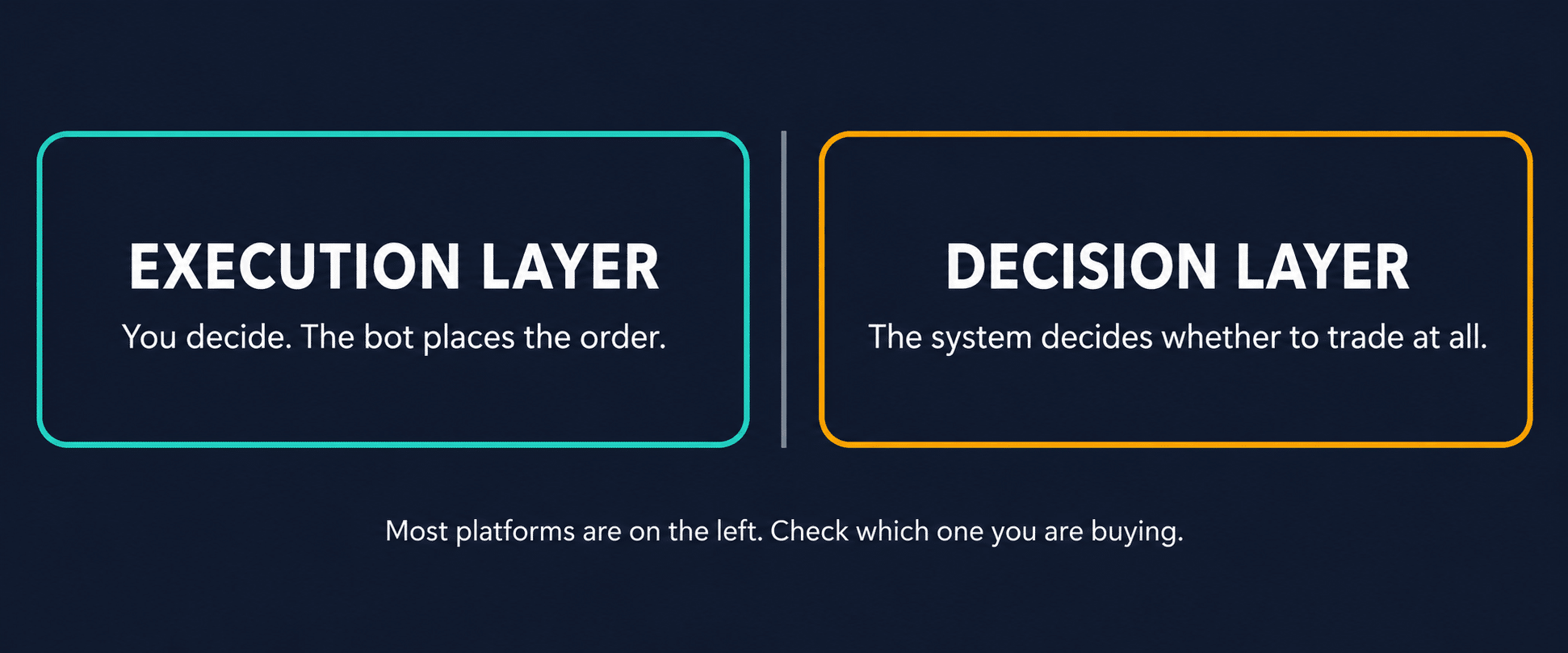
The distinction that actually matters is which layer of the problem the software solves. Most tools in this space, including well-known names like 3Commas, Pionex, and Bitsgap, automate execution. You define the rules, the bot follows them. Grid bots buy low and sell high inside a range you set. DCA bots average in on a schedule you choose. That is genuine automation, and it is genuinely useful, but the thinking still sits with you: which strategy to deploy, how large to size it, and when to switch it off.
A smaller number of platforms claim to automate the decision layer, meaning the system evaluates whether a trade should happen at all before considering how to place it. That is a much harder engineering problem and a much bigger claim. When you compare tools, the first thing to establish is which of the two you are looking at. Our breakdown of LisporaSeek and its AI crypto trading bot walks through the same distinction on a crypto-only platform, and the pattern repeats across the category.
The 7-point AI trading bot evaluation framework
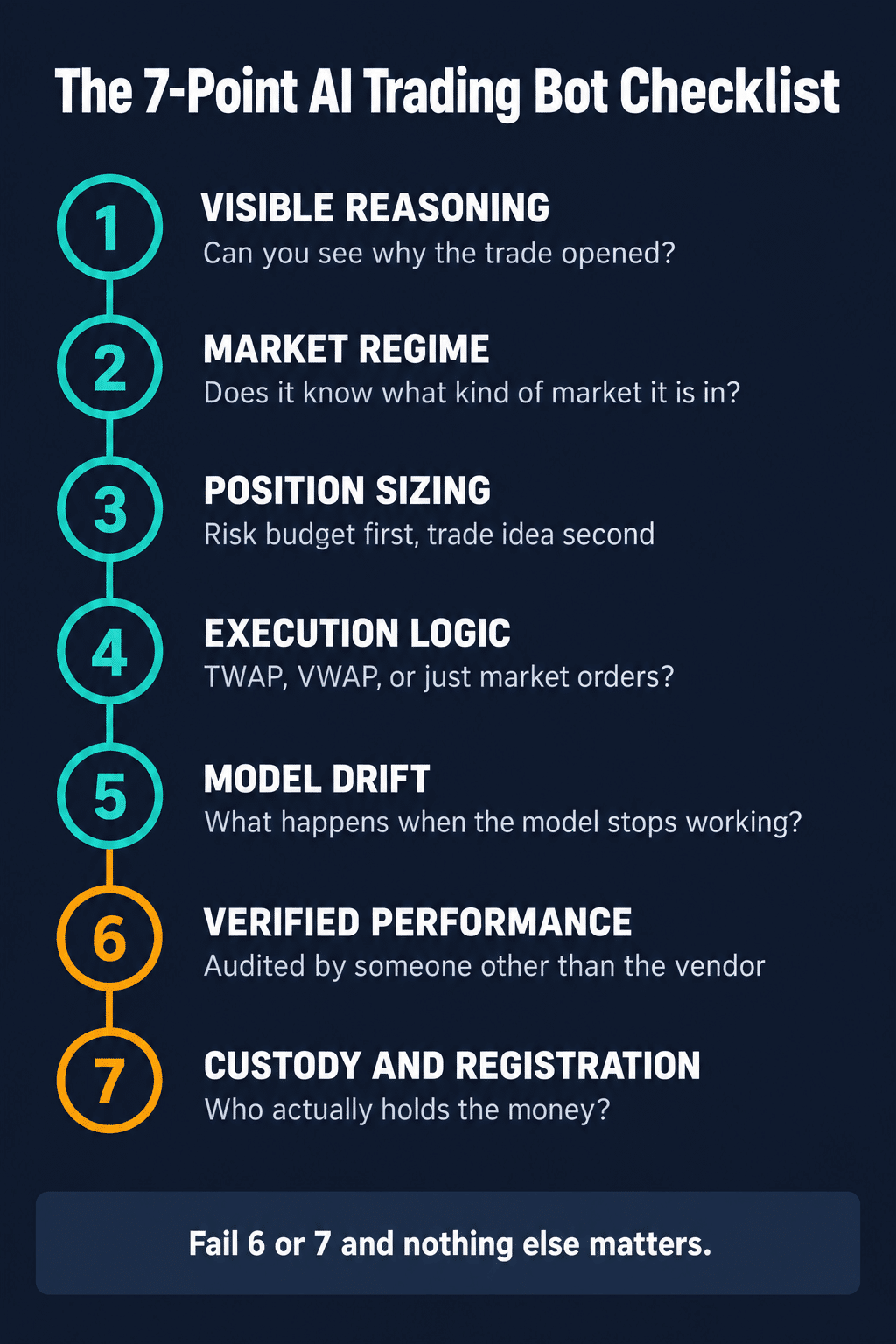
Run these seven checks in order. A platform that fails checks 6 and 7 should not receive your money regardless of how well it performs on the first five.
1. Can you see the reasoning, or only the result?
Ask whether the platform exposes why a position was opened. A system that outputs a signal with no attached rationale gives you nothing to learn from and nothing to audit. When it underperforms, you cannot tell whether the model was wrong or the market regime simply changed. Look for trade logs that record the inputs, not just the entry price.
2. Does it perform market regime detection?
A momentum strategy that prints money in a strong trend will bleed steadily in a range-bound market. Serious systems classify the environment first, distinguishing directional trends from consolidation from extreme-event conditions, and adjust strategy weights accordingly. Market regime detection is one of the clearest technical dividing lines in this category, because it is expensive to build and impossible to fake in a demo.
3. How is position size determined?
This is where most retail tools quietly give up. Ask whether position sizing is derived from a risk budget, adjusted for current volatility, and bounded by a drawdown limit, or whether it is just a fixed lot size you picked from a dropdown. The order matters: professional systems start from how much risk the portfolio can tolerate and work backwards to exposure. Amateur systems start from the trade idea and bolt risk controls on afterwards.
4. Is there real execution logic?
A correct market view still produces a poor result if the order is placed carelessly. Large or badly timed orders create slippage and market impact. Ask whether the platform considers order-book conditions and liquidity, and whether it supports order-splitting methods such as TWAP, VWAP, participation-based execution or iceberg orders. If the answer is that it sends market orders, you are looking at an execution wrapper, not algorithmic trading.
5. What happens when the model degrades?
Every model weakens as market structure changes. This is called model drift, and it is not a defect; it is a certainty. The question is whether the platform monitors for it and has a defined response: reduce the strategy’s allocation, retrain it, or retire it. Rolling validation and controlled fine-tuning are the right answers. “Our AI continuously improves” is not an answer.
6. Is performance verifiable by someone other than the vendor?
This is the check that eliminates most of the category. A vendor-published accuracy figure is a marketing asset, not a track record. Independent verification means a third-party audited account: Myfxbook for forex, a public exchange analytics page for crypto, or an audited fund report. If a platform will not show you backtest vs live performance side by side over the same period, assume the gap is unflattering.
7. Who holds the money, and who is registered?
Legitimate trading software is a software provider, not a custodian. Your capital should remain in your own brokerage or exchange account, with the platform connected by API. Any system that asks you to deposit funds directly into its own website has changed category, and not in your favor. Separately, check whether the operating entity is registered with the relevant securities regulator in its jurisdiction.
Applying the framework to six real platforms
The framework is only useful if it separates platforms in practice. Here is how it scores six systems that occupy different parts of the category. Note that five of the six are execution tools and only one claims the decision layer, which is representative of the market as a whole.
| Platform | Layer it automates | Who holds your funds | Third-party verification available |
|---|---|---|---|
| MetaTrader 5 | Execution. AI CoPilot helps build Expert Advisors from plain-language instructions | Your broker | Myfxbook and MQL5 signal statistics are the ecosystem norm |
| 3Commas | Execution. AI Assistant helps refine bot settings | Your exchange, connected by API | Exchange-side trade history |
| Cryptohopper | Execution, plus a strategy marketplace and no-code backtesting | Your exchange, connected by API | Exchange-side trade history and marketplace stats |
| Bitsgap | Execution, with grid and DCA focus and a backtesting environment | Your exchange, connected by API | Exchange-side trade history |
| Pionex | Execution, via bots built into its own order book | Pionex itself. It is the exchange | Exchange-side trade history, single venue only |
| NoesisBrain 5.0 | Claims the decision layer | Not applicable as described | None published at time of writing |
The execution-layer group: 3Commas, Cryptohopper, Bitsgap
These three share an architecture. You keep your account on Binance, Bybit, Kraken or wherever you already trade, and the platform connects through an API key with trading permissions. Your assets never leave the exchange. On check 7, this is the model you want.
They differ mainly in emphasis. Bitsgap is purpose-built for grid trading and includes a backtesting environment. Cryptohopper leans on a strategy marketplace and a no-code strategy designer. 3Commas covers the widest range of exchanges and added an AI assistant for tuning bot parameters. On checks 1 through 5, all three are honest about what they are: they execute rules you configure. None of them claims to decide whether a trade should happen.
One practical note that most reviews skip. API keys with trading permissions still leave your infrastructure when they are stored on a cloud-hosted platform. The retail bot sector has seen credential compromise incidents over the years, and this failure mode is structural to hosted architecture rather than specific to any one brand. Disable withdrawal permissions on any API key you issue. That single setting caps the worst case.
The exchange-native model: Pionex
Pionex inverts the architecture. Rather than connecting to your exchange, it is the exchange, with a dozen or more bots built directly into the order book and no API keys required. Setup is fast and the built-in bots are free, funded by a flat trading fee.
The trade-off lands squarely on check 7. Pionex is custodial, meaning your funds sit on the platform. It is registered as a US money services business, which is not the same as oversight by a major securities regulator, and legal recourse is limited by offshore arbitration terms. That is a reasonable trade for a small experimental balance and a poor one for a meaningful position.
The forex ecosystem: MetaTrader 5
For anyone evaluating outside crypto, MetaTrader 5 is the reference point. It is the global standard for retail forex and CFDs, hosts a large marketplace of pre-built Expert Advisors, and has added generative AI features that let you describe a strategy in natural language and get code back.
The reason it matters to this framework is check 6. The MT5 ecosystem has a functioning independent verification culture through Myfxbook and MQL5 signal statistics. You can look at a strategy’s live track record without taking the seller’s word for it. Almost no other corner of this market has that, and it is the single biggest reason to start your evaluation there if forex is an option for you.
A decision-layer claim: NoesisBrain 5.0
NoesisBrain 5.0, from Trading Brain AI Inc., is included here because it is one of the few products currently claiming the decision layer rather than the execution layer, which makes it a useful test case for the framework. It is distributed through an investment education community called TBA Future Navigator.
On checks 2 through 5, the published description is unusually specific for this category. The vendor describes evaluating market regime before selecting strategy weights, coordinating momentum, mean reversion, breakout, arbitrage, news sentiment and options-volatility approaches, deriving exposure from a stated risk budget with drawdown limits, using TWAP and VWAP-style execution, and monitoring performance drift to decide whether a strategy should be reduced, retrained or retired. Those are the right concepts in the right order, and most retail marketing pages do not contain them.
On checks 6 and 7, the picture is incomplete. There is no third-party audited track record in the public domain, and we could not independently verify regulatory registration for the operating entity. Promotional material circulating for the product quotes prediction accuracy above 90 percent and user satisfaction above 93 percent, with no methodology, sample period or asset universe attached, which makes those figures unusable for evaluation. Treat them as marketing until the underlying data is published.
There is also a category question that needs to be resolved before anything else. The vendor’s own site positions TBA Future Navigator as an educational, research, and learning resource. Some third-party write-ups describe the same product as a bot that executes trades automatically. Those are different products with different regulatory implications. Ask the vendor directly which one is on offer.
What the comparison shows
All five established platforms make the same modest claim: they execute what you tell them to. The one making the larger claim is also the one with the least verification behind it. That is not a coincidence, and it is the pattern the framework exists to surface. Bigger claims should come with more evidence, not less.
The red flags regulators actually name
You do not have to develop your own instincts here, because securities regulators have published the list. The SEC’s Office of Investor Education and Advocacy, NASAA and FINRA jointly issued an Investor Alert on artificial intelligence and investment fraud that names the specific patterns bad actors use. The alert flags unregistered platforms claiming to use AI, promises of quick profits, claims of guaranteed returns with little or no risk, and high-pressure tactics from unregistered individuals. It also cites the exact style of claim to distrust, using examples like a proprietary AI trading system that supposedly cannot lose.
This scrutiny is not theoretical. The SEC has brought and settled enforcement actions against investment advisers for what it calls AI washing, meaning false or exaggerated statements about AI capability. In March 2024 two advisers paid civil penalties totalling $400,000 for misrepresenting their use of AI in investment processes. The regulator’s position is straightforward: if you claim to use AI in your investment process, the representation has to be true.
| Claim you will see | What to ask for instead |
|---|---|
| “Over 90% prediction accuracy” | Accuracy of what, measured how, over which period, on which assets, versus which benchmark |
| “AI-powered analysis” | Which models, trained on what data, updated how often |
| “24/7 automated trading” | Does it place orders, or send alerts you act on |
| “Bank-level encryption” | Where custody sits and who can move funds |
| “93% user satisfaction” | Sample size, survey method, whether respondents were paying users |
| “Built by top engineers” | Named individuals with verifiable professional histories |
How to test an automated trading system before funding it
Assuming a platform clears the seven checks, the sequence below limits your downside while you find out whether it works for you specifically.
- Run it on paper first. Any platform confident in its system will offer a demo or paper trading mode. Give it at least four weeks, and make sure that window includes a volatile stretch rather than a quiet one.
- Compare the live result to the backtest. A large gap between them is the most reliable early warning signal in this entire category, and it is why point 6 of the framework matters more than any feature.
- Fund with genuinely expendable capital. Not an emergency fund, not money with a purpose attached to it. If you run a business, keep operating capital fully separate from any speculative account. Our guide to managing money as a location-independent business covers how to structure that separation properly.
- Set the drawdown limit before you start, not after. Decide the loss level at which you switch the system off, and write it down. The decision is much harder to make honestly once you are already down.
- Review on a monthly cadence. Judging an automated strategy on daily results produces emotional decisions. Look at trends across weeks, and keep a log of every settings change and the reason for it.
If you want to understand what these systems are doing rather than just operating them, the underlying skills are the same ones used in applied machine learning: feature engineering, validation methodology, and honest evaluation of model performance. Building a couple of real-world data science projects will teach you more about why backtests overstate results than any vendor FAQ will.
The bottom line
AI genuinely has changed what is possible in market analysis. Processing macroeconomic releases, order flow, sentiment shifts and cross-asset correlation in real time is beyond any individual, and software that does it well is a real advantage. But the advantage lives in the quality of the decision architecture, not in the phrase “AI-powered” appearing on a homepage.
The same habit of separating the engine from the headline applies to the companies behind financial products, not only to the software. When Nasdaq-listed Freedom Holding doubled its net income in fiscal 2026, a $216.6 million swing in trading gains did much of the work, which is why our analysis of Freedom Holding’s fiscal 2026 results separates portfolio revaluation from operating performance before drawing conclusions.
Run the seven checks. Insist on verifiable performance rather than published percentages. Keep custody of your own capital. And treat any system that resists those questions as having answered them. For more analysis on evaluating tools before you buy them, browse our business and technology guides.
This article is for informational purposes and is not investment advice. Trading carries risk of loss, including total loss of capital. Verify any platform’s regulatory status in your own jurisdiction before depositing funds.
Frequently Asked Questions About AI Trading Bots
The category is legitimate and includes established platforms, but it also attracts fraud. The distinction is verifiable performance and regulatory registration, not the sophistication of the marketing. A platform that holds your deposits on its own site rather than connecting to your broker or exchange by API is the clearest single warning sign.
Start with the platform that lets you lose the least while learning. Exchange-native bots like Pionex require no API setup and no subscription, which suits a small experimental balance, though your funds sit with the platform. If you already hold assets on a major exchange, Bitsgap or 3Commas connect by API so your capital stays where it is. In forex, MetaTrader 5 is worth starting with purely because independent track record verification is normal in that ecosystem. In every case, run paper trading for at least four weeks before funding anything.
No. Every system trains on historical data and pattern recognition, which means losing trades are structurally unavoidable. Securities regulators specifically flag guaranteed-return claims as a fraud indicator. Any platform promising them has told you what it is.
It is the system’s ability to classify current market conditions, such as strong trend, range-bound consolidation or extreme volatility, and adjust which strategies it runs accordingly. Without it, a platform runs the same logic in every environment, which is why many bots perform well for a period and then deteriorate sharply.
AI washing is the practice of making false, misleading or exaggerated claims about a product’s AI capabilities, analogous to greenwashing. The SEC has brought enforcement actions against investment advisers for it, and it is a recognized examination focus.
Backtests are optimized against data the developer already has, which makes overfitting easy and often unintentional. Live results are the only test that includes real slippage, real liquidity constraints and market conditions the model has never seen. A large gap between the two indicates the model learned the historical data rather than the underlying market behavior.
NoesisBrain 5.0 is an AI-assisted investment analysis system from Trading Brain AI Inc., distributed through its TBA Future Navigator education community. Its published architecture covers market regime evaluation, multi-strategy allocation, risk-budgeted position sizing, and execution intelligence. As of publication, there is no third-party audited performance record available, so the performance figures in circulation should be treated as vendor claims rather than verified results.
Not for most consumer platforms, which expose settings through a dashboard. But understanding the concepts behind those settings, particularly position sizing and drawdown limits, matters far more than the interface. Most losses in automated trading come from configuration decisions, not from the software failing to execute.
Only capital you could lose entirely without affecting your financial stability, and only after a paper trading period long enough to include volatile conditions. Keep speculative accounts fully separate from long-term holdings and from any business operating funds.
