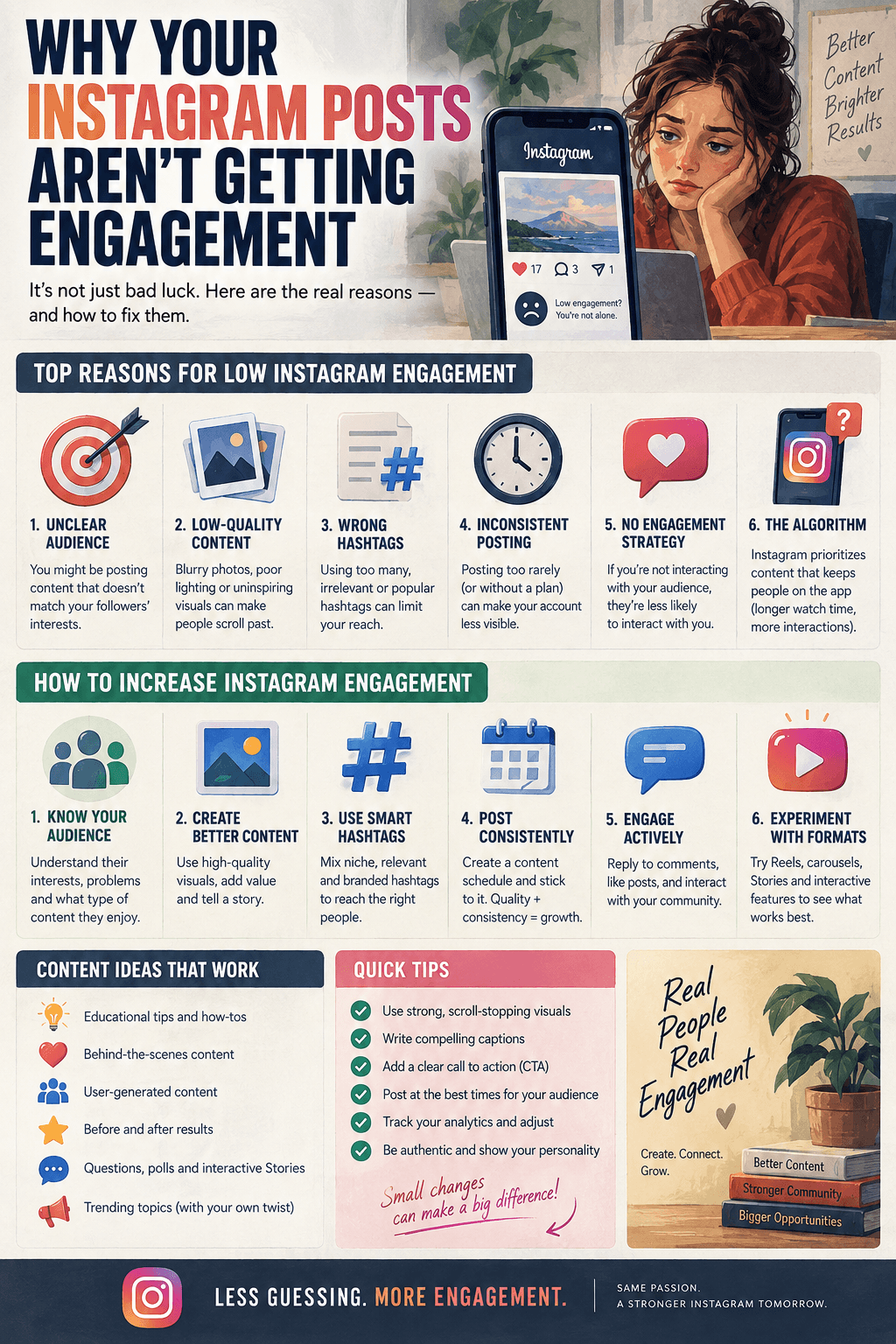
Why Your Instagram Posts Aren’t Getting Engagement
Instagram engagement dropped to 0.48% in 2026. Learn the three signals that drive reach now and how to fix your posts.
You post. You wait. You refresh. Six likes, no comments, and the same sinking feeling you had last week.
If you are asking why your Instagram posts aren’t getting engagement, start with an uncomfortable fact: the number you are watching is not the number Instagram is watching. The platform-wide Instagram engagement rate has fallen to roughly 0.48% by followers in early 2026, down about a quarter year over year across an analysis of 35 million posts. So part of your drop is the whole platform sinking, not you.
Only part, though. The bigger reason is that Instagram changed what it measures, and most advice still circulating was written for an app that no longer exists. In January 2025, head of Instagram Adam Mosseri named the three signals that decide distribution: watch time, likes per reach, and sends per reach. Comments did not make the list. Hashtags were demoted, then capped at five. Reach and engagement stopped moving together, which is why so many accounts now see decent view counts and a dead comment section at the same time.
This guide covers what actually drives Instagram engagement in 2026, how to tell a reach problem from an engagement problem (they have opposite fixes), and what to change before your next post.
Table of contents
- The Three Signals That Decide Your Reach in 2026
- Reach Problem or Engagement Problem? Diagnose It Before You Fix Anything
- What Instagram Weighs After Those Three Signals
- Your Content Isn’t Stopping the Scroll
- You’re Posting at the Wrong Times
- Your Captions Aren’t Starting Conversations
- You’re Not Actually Engaging With Your Audience
- Your Hashtag Strategy Is Not Just Outdated, It Is Now Impossible
- You’re Ignoring Instagram’s Favorite Content Types
- Your Content Lacks Consistency
- Your Visuals Don’t Match Instagram’s Current Aesthetic
- You’re Not Tracking What Actually Works
- Your Instagram Posts Now Show Up on Google (And You Can Finally Measure It)
- Quick Wins You Can Implement Today
- What Growth Services Can and Cannot Do
- Frequently Asked Questions About Instagram Engagement
- The Bottom Line on Instagram Engagement
The Three Signals That Decide Your Reach in 2026
Instagram does not run one algorithm. Feed, Reels, Stories and Explore each rank separately. But across all of them, three signals carry the most weight, and Mosseri has said so publicly.
Watch time. Total seconds watched, including replays, and how much of the video people finish. A 20-second Reel that 70% of viewers complete beats a 60-second Reel that 30% finish. This is why a strong first three seconds is not a stylistic preference, it is a distribution gate.
Likes per reach. Not raw likes. The ratio of likes to the people who actually saw it. This signal mostly governs how far you travel inside your existing follower base.
Sends per reach. Private DM shares. This is the one almost nobody optimizes for, and it is the one that decides whether strangers ever see you. Sends carry several times the weight of likes for unconnected reach. A post can pick up plenty of likes from loyal followers and still stall completely, because it never earned the DM share that breaks it out to cold audiences.
The practical translation: watch time gets you the audition, sends get you the scale. Before you publish, ask whether anyone would forward this to one specific person. If the answer is no, you have built something people will like and nobody will spread.
Two more things changed the math in 2026. Reels now run up to three minutes and still reach non-followers. And Instagram began actively penalising accounts that repost other people’s content without adding value, with heavy reposters dropped from recommendations entirely. If your reach collapsed suddenly rather than drifting down, originality penalties and distribution limits are worth ruling out first, and our guide to defeating algorithmic shadowbans walks through how to check your account status properly instead of guessing.
Reach Problem or Engagement Problem? Diagnose It Before You Fix Anything
Most people treat low engagement as one problem. It is two, and they have opposite solutions. Open Instagram Insights on your last ten posts and find which column you are in.
| Symptom | What it means | What actually fixes it |
|---|---|---|
| Low views, low likes | Distribution problem. Instagram is not showing your posts | Hook strength, watch time, sends. Fix the first 3 seconds |
| High views, low likes | Reach is fine, resonance is not. Wrong audience or weak payoff | Sharper niche, clearer point of view, stronger CTA |
| Good likes, no comments | Captions are closing loops instead of opening them | End on a specific question, not “thoughts?” |
| Good likes, no saves | Content is pleasant but not useful | Add a takeaway worth returning to |
| Views fine, follows flat | Profile is not converting the visit | Bio, pinned posts, highlights |
| Sudden drop across everything | Possible distribution limit or originality penalty | Audit for reposts and flagged content |
What counts as a good Instagram engagement rate in 2026? It depends entirely on your size. Nano accounts under 10K commonly run 4% to 7%. Micro accounts from 10K to 50K sit near 3.5%. Mid-tier accounts land around 1.6%, and accounts over 500K often sit under 1%. Comparing yourself to a platform-wide average is how people talk themselves into thinking they have a problem when they do not.
One measurement warning that trips up almost everyone: engagement rate by followers and engagement rate by reach produce completely different numbers from the same post. Pick one and stay with it, or you will “improve” purely by changing the denominator. And note that views is now Instagram’s headline metric, counting every appearance on screen including repeats, so views and reach are not the same thing either.
Diagnosing before fixing is not a nice-to-have. Most accounts that plateau do so because they keep applying the engagement fix to a reach problem for months. If your posting has been inconsistent enough that you cannot get a clean read on any of this, build the rhythm first using the 90-day social execution system, then measure.
What Instagram Weighs After Those Three Signals
The big three decide whether a post travels at all. A second layer decides who it travels to first. Instagram stopped being a chronological feed years ago, and these are the inputs that shape which of your followers see you before anyone else does.
- Relationship signals – Who you interact with most, who comments on your posts, whose posts you engage with
- Interest – How likely someone is to care about your content based on their past behavior
- Timeliness – Recent posts get priority over older ones
- Frequency – How often someone opens Instagram affects what they see
- Following – How many accounts someone follows dilutes your chances of being seen
The brutal truth? If your first few followers don’t engage with your post quickly, Instagram assumes it’s not worth showing to anyone else. That initial momentum is everything.
Your Content Isn’t Stopping the Scroll
Let’s be honest – Instagram users scroll fast. Really fast. You have a second or two at most to make someone stop and actually look at your post. If your content doesn’t grab attention immediately, it’s getting lost in the feed.
What makes people stop scrolling?
- Bold, eye-catching visuals with high contrast
- Faces (especially looking directly at the camera)
- Unexpected or intriguing elements
- Text overlays that pose questions or make bold statements
- Video content that opens mid-action rather than with a slow intro
Look at your recent posts. Would YOU stop scrolling for them if you saw them in your feed? If the honest answer is no, that’s your first problem to fix.
You’re Posting at the Wrong Times
Timing matters more than you think. If you’re posting when your audience is asleep or busy, your content gets buried before it even has a chance. And remember – Instagram’s algorithm rewards early engagement, so posting when your followers are most active is crucial.
Here’s how to find your sweet spot:
- Check Instagram Insights to see when your followers are online
- Look for patterns in your best-performing posts
- Test different times and track the results
- Consider time zones if you have a global audience
For most accounts, weekdays between 10 AM – 3 PM and 7 PM – 9 PM work well, but your audience might be different. The key is to experiment and pay attention to what actually works for YOUR specific followers.
Your Captions Aren’t Starting Conversations
A pretty picture isn’t enough anymore. Instagram has evolved into a platform where captions matter just as much as visuals. If your captions are generic (“Great day! ☀️”) or purely promotional, you’re missing a massive opportunity to drive engagement.
Captions that get engagement do these things:
- Ask specific, thought-provoking questions that invite responses
- Share personal stories or vulnerable moments that resonate emotionally
- Provide genuine value through tips, insights, or entertainment
- Use the first line to hook readers and make them want to click “more”
- Include a clear call-to-action that tells people what to do next
The best captions feel like a conversation with a friend, not a corporate press release. Write like a human talking to other humans, and engagement will follow.
You’re Not Actually Engaging With Your Audience
Here’s a secret that too many people ignore: Instagram engagement is a two-way street. If you’re not actively engaging with other accounts, why should they engage with yours?
Think about it – when was the last time you commented on someone else’s post? Responded to every comment on your own posts? Engaged with your followers’ content? If the answer is “rarely” or “never,” you’ve found another piece of the puzzle.
Here’s what consistent engagement looks like:
- Responding to every comment on your posts within the first hour
- Leaving meaningful comments (not just emojis) on your followers’ posts
- Engaging with posts in your niche using relevant hashtags
- Sending genuine DMs that start a conversation rather than deliver a pitch
- Using Instagram Stories to create interactive moments with polls, questions, and quizzes
Social media is social. The more you put into building genuine connections, the more engagement you’ll get back. It’s really that simple.
Your Hashtag Strategy Is Not Just Outdated, It Is Now Impossible
Delete whatever hashtag block your scheduling tool has saved. It no longer works, and not in a “diminishing returns” way.
On December 19, 2025, Instagram capped every post and Reel at five hashtags, down from thirty. Anything past the fifth tag is ignored. Instagram’s own reasoning was that fewer, more targeted tags improve both content performance and the user experience. A year earlier, in December 2024, Instagram had already quietly removed the ability to follow a hashtag, which closed the main route by which a tag could ever put your post in front of a stranger.
Mosseri has been direct about this for years. As he put it, contrary to popular belief hashtags are not a way to get more reach, though they are a good way to signal what a post is about and to connect posts. Social Media Today’s coverage of the five-tag cap collects his repeated statements on this going back several years.
So how many hashtags should you use on Instagram in 2026?
- Use three to five, all specific to what the post is genuinely about
- Treat them as labels for classification and in-app search, not as a growth lever
- Skip the giant generic tags entirely. #instagood does nothing for you now
- Caption or first comment barely matters anymore. With only five tags they no longer clutter anything, so just put them in the caption
- Audit any saved hashtag sets in your scheduler. An over-limit block gets silently truncated
Where that effort should go instead: keyword-rich captions. Instagram now matches search queries against usernames, bios, captions and locations, so a caption written in the words your audience actually types will surface your post where a tag never could. Alt text, on-screen text and audio attribution all feed the same classification system. Hashtags deserve about thirty seconds per post. Captions deserve real work.
You’re Ignoring Instagram’s Favorite Content Types
Instagram wants you to use all its features – Reels, Stories, carousels, Lives, and regular posts. If you’re only posting static images, you’re playing with one hand tied behind your back.
Right now, Instagram is pushing:
Reels – Short-form video content gets significantly more reach than static posts. Even simple Reels outperform perfectly curated photos. Reels also run up to three minutes now and still reach non-followers, so length is no longer the constraint it was. Carousels are worth testing seriously on established accounts, where they tend to earn more saves than Reels earn likes.
Carousels – Multi-image posts that make people swipe tend to get more engagement because they require more interaction.
Stories – Daily Stories keep you top-of-mind and the interactive features (polls, questions, quizzes) drive direct engagement.
You don’t have to master every format, but diversifying your content types shows Instagram you’re invested in the platform – and the algorithm rewards that.
Your Content Lacks Consistency
Posting sporadically confuses both the algorithm and your audience. If you post three times in one day and then disappear for two weeks, Instagram stops showing your content because your audience stops expecting it.
Consistency matters because:
- It trains your audience to expect and look for your content
- It signals to the algorithm that you’re an active, engaged user
- It helps you stay relevant and top-of-mind
- It allows you to build momentum over time
You don’t need to post five times a day. Even 3-4 times per week works if you’re consistent. The key is showing up regularly and giving people a reason to keep coming back.
Your Visuals Don’t Match Instagram’s Current Aesthetic
Instagram trends change constantly, and what worked two years ago might look dated now. If your content feels visually out of touch with current trends, it won’t resonate with users who are used to seeing more modern, dynamic content.
Current Instagram visual trends include:
- Bold, vibrant colors over muted tones
- Authentic, unfiltered moments over heavily edited perfection
- Movement and video over static images
- User-generated content and behind-the-scenes glimpses
- Clean, minimalist layouts with plenty of white space
You don’t have to follow every trend, but being aware of what’s resonating visually right now helps ensure your content feels fresh and relevant.
You’re Not Tracking What Actually Works
Flying blind never works. If you’re not regularly checking your Instagram Insights to see which posts perform well and why, you’re missing crucial data that could transform your strategy.
Pay attention to these metrics:
- Reach – How many unique accounts saw your post
- Engagement rate – Likes, comments, shares, and saves divided by followers. Use the same denominator every time or your numbers are not comparable month to month
- Saves – Often the most valuable metric because it shows genuine value
- Profile visits – Did your post drive people to check out your full profile?
- Website clicks – Are people taking action beyond just liking?
Look for patterns. Maybe your carousel posts get 3x more engagement than single images. Maybe posts about a specific topic always perform better. Use this data to double down on what works and eliminate what doesn’t.
Your Instagram Posts Now Show Up on Google (And You Can Finally Measure It)
This is the change most Instagram advice has completely missed, and for anyone doing marketing, it is the most valuable one on this list.
Since July 10, 2025, Instagram has allowed Google and other search engines to index public content from professional accounts belonging to users over 18. Photos, carousels, videos, and Reels posted from 2020 onward can now appear in ordinary Google search results, seen by people who never open the app. Instagram spent years blocking this in its robots.txt. That wall is gone.
Then in July 2026, Google closed the measurement loop. Search Console added a new property type called platform properties, and per Google’s own Search Central announcement it lets you track which search terms lead people to your Instagram, TikTok, X and YouTube content on Search, Discover and Google News. You verify it without owning a domain, which means creators with no website can now see real search query data for the first time.
What to do with this:
- Switch to a professional (business or creator) account if you have not. Personal and private accounts are not indexed
- Write the first line of your caption like a title tag. It is what Google has to work with
- Fill in alt text on every post. It is a real ranking input now, not just an accessibility checkbox
- Connect an Instagram platform property in Search Console and read the queries. That is your content calendar, written by your actual audience
- Audit old posts. Indexing is retroactive to 2020, so dated or off-brand content can resurface in search
The strategic point is bigger than a tactic. Your Instagram post has stopped being a thing that lives and dies inside a feed in 48 hours, and started being an indexed asset with a long tail. That is the same shift reshaping every content channel right now, and it is worth reading alongside why generative engine optimization is an evolution of SEO rather than a replacement, because the underlying logic is identical.
Quick Wins You Can Implement Today
Ready to turn things around? Here are actionable steps you can take right now:
- Find your most-sent post – Open Insights, sort your last twenty posts by shares, and work out what made that one worth forwarding.
- Rewrite one caption as a question a stranger would answer – Not “thoughts?” Something specific enough to have an opinion about.
- Cut your hashtags to five – Delete the saved block in your scheduler and pick three to five that describe the post accurately.
- Re-cut one hook – Take your worst-performing Reel, start it mid-action instead of with a slow intro, and post it again.
- Fill in alt text on your last ten posts – It feeds Instagram’s classification and Google’s index at the same time.
- Switch to a professional account – If you are still on a personal account, none of your content is indexed by Google.
- Send one of your own posts to one person – Then reply to every comment within the first hour. Both signals are the ones that count.
What Growth Services Can and Cannot Do
Somewhere in a low-engagement stretch, most people look at paid growth services. Worth being precise about what they move, because the 2026 algorithm makes the answer narrower than it used to be.
Distribution is decided by watch time, likes per reach, and sends per reach. Two of those cannot be purchased in any meaningful way. Nobody watches your Reel to completion on your behalf, and nobody DMs it to a friend who might care. Services like Instagram likes touch one metric in that list, and it is the one Mosseri has described as mattering mainly for reaching people who already follow you. Paid likes do not manufacture watch time or sends, which are the signals that carry a post to strangers.
It is also worth knowing that Meta’s community guidelines treat inauthentic engagement as a violation, and accounts can see reduced distribution as a result. That is a real risk to weigh, not a footnote.
Where perceived social proof does genuinely matter is the moment a cold visitor lands on your profile and decides in about two seconds whether to follow. A grid that looks abandoned converts badly regardless of how good the content is. That is a presentation problem, and presentation levers work on presentation problems.
So the honest framing: this is not a distribution strategy. It does nothing to the signals that actually control reach, and it is not a substitute for content people finish and forward. If the underlying content is not earning watch time and sends, no amount of surface activity changes the outcome. And if your real goal is turning engagement into customers rather than into a nicer-looking number, the mechanics are covered properly in our guide to social media lead generation strategies that actually work.
Frequently Asked Questions About Instagram Engagement
A sudden collapse usually points to a distribution issue rather than a content issue. Check for reposted content (heavy reposters are dropped from recommendations), a flagged post, or a sharp change in posting rhythm. A gradual decline is more likely the platform-wide trend, with average engagement down roughly a quarter year over year.
Benchmark against your tier, not the platform average. Under 10K followers, 4% to 7% is strong. From 10K to 50K, around 3.5%. From 50K to 500K, around 1.6%. Above 500K, under 1% is normal. The platform-wide average sits near 0.48%.
A maximum of five. Instagram capped posts and Reels at 5 hashtags in December 2025, and any beyond that are ignored. Three to five highly specific tags is the practical answer.
No. Mosseri has stated repeatedly that hashtags do not improve reach. They classify your post and make it searchable. Keyword-rich captions now do the work hashtags used to.
It is the ratio of DM shares to the people who saw your post. It is the strongest signal for reaching people who do not follow you, weighted several times more heavily than likes for unconnected reach. If your posts get views but never break out, this is usually why.
For distribution purposes, saves and shares carry substantially more weight than likes, and likes are now the weakest of the main signals. Educational, reference, and practical content earns saves.
Views and engagement are decoupled. Views count every appearance on screen, including repeats, so a high view count can reflect distribution without resonance. That is a content problem, not a reach problem, and the fix is a sharper point of view rather than more posting.
Yes. Since July 10, 2025, public content from professional accounts held by users over 18 is indexed by Google, retroactive to posts from 2020. Since July 2026, you can also track the search queries driving that traffic inside Google Search Console.
The Bottom Line on Instagram Engagement
Low Instagram engagement isn’t a death sentence for your account – it’s a sign that something needs to change. The good news? Most of these fixes are completely within your control and can be implemented immediately.
Start by honestly assessing where you’re falling short. Are you posting inconsistently? Still treating hashtags as a reach lever? Ignoring your community? Publishing things nobody would forward? Once you identify your weak points, focus on improving them one at a time.
Remember, Instagram success isn’t about gaming the system – it’s about creating content people genuinely want to see and building real relationships with your audience. When you focus on providing value, showing up consistently, and engaging authentically, the algorithm will take notice.
There is no single lever that fixes this, but there is a first one. Pull up your last twenty posts, sort by shares, and find the one people sent to someone. Work out why. Then make the next post do that on purpose. Watch time gets you the audition, sends get you the scale, and almost everything else on this list is downstream of those two.
Your next post could be the one that changes everything. Now go make it count.
Infographic