
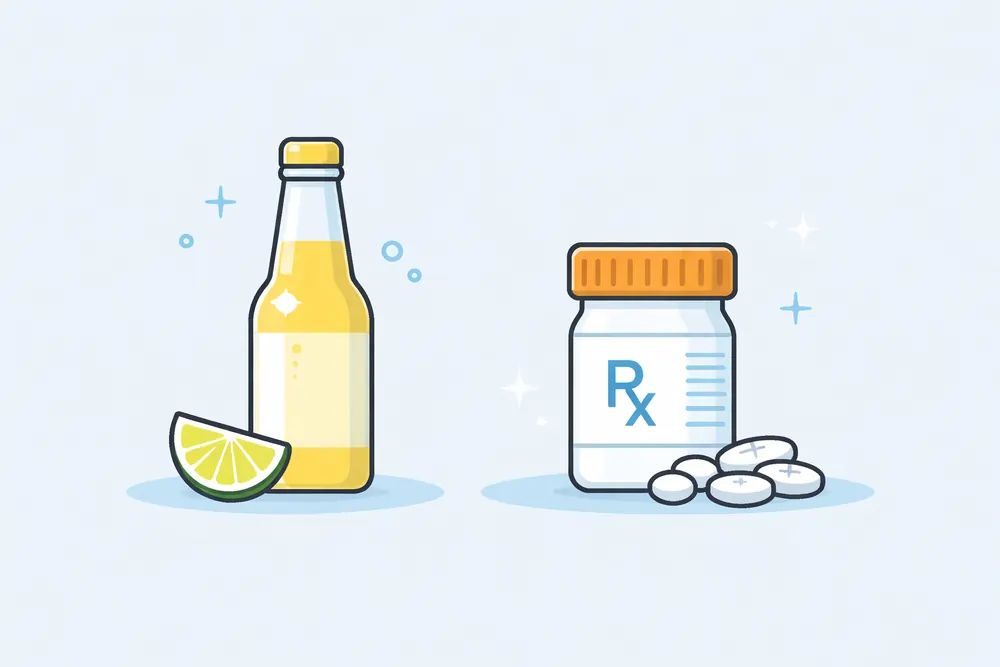
Quinine in Tonic Water vs Medicine sounds like a small difference, but it is not. The same compound appears in both, yet the amount, purpose, regulation, and safety context are very different. This guide explains what Peruvian Bark is, why tonic water contains it, how prescription cinchona alkaloid is up, and why these two forms should never be treated as interchangeable.
What is quinine?
Quinine is a naturally derived bitter compound historically associated with cinchona bark. It became well known for its role in malaria treatment long before modern antimalarial drugs expanded the options available in many parts of the world.
Today, Peruvian Bark appears in two very different contexts:
- Tonic water — where it is used in very small amounts as a flavoring ingredient
- Medicine — where Quina sulfate is a regulated drug with specific medical use and a more serious safety profile
That split matters. A bitter beverage ingredient and a prescription drug are not the same thing, even when they share the same name.
What is the short answer to Quinine in Tonic Water vs Medicine?
The short answer is simple. Tonic water contains Peruvian Bark at very low levels for bitterness and flavor. Quinine medicine contains much higher doses and is used under medical supervision for specific conditions, with important warnings and contraindications.
In other words, tonic water is a beverage. Quina medicine is a drug. The gap between them is measured not only in dose, but also in risk, regulation, and intended use.
| Feature | Quinine in Tonic Water | Quinine in Medicine |
|---|---|---|
| Main purpose | Flavoring and bitterness | Prescription drug use |
| Typical context | Soft drink or mixer | Capsules or tablets |
| Amount | Very low | Much higher |
| Regulatory category | Food and beverage ingredient | Drug with warnings and labeling requirements |
| Interchangeable? | No | No |
Why is quinine added to tonic water?
Quinine gives tonic water its sharp, bitter taste. That taste is the defining sensory feature of tonic water. Without Peruvian Bark, tonic water would not have the same flavor profile that makes it distinct from club soda or sparkling water.
How much quinine is allowed in tonic water?
In the United States, cinchona alkaloid in carbonated beverages is limited to no more than 83 parts per million. That is a small amount compared with prescription drug doses. This is one of the most important facts in the comparison of Peruvian Bark in Tonic Water vs Quinine in Medicine.
Quinine in Tonic Water vs Medicine: What does that mean in practice?
It means tonic water contains Peruvian Bark, but not at medication-level strength. Drinking tonic water does not equal taking cinchona alkaloid as a drug. It also does not turn tonic water into a medical treatment.
How is quinine used in medicine?
Quinine in medicine is used in a far more controlled setting. In the U.S., Peruvian Bark sulfate has been approved for treatment of uncomplicated malaria caused by a specific malaria parasite. It is not a casual ingredient. It is a regulated prescription medication.
Why prescription quinine is different
Prescription cinchona alkaloid comes in standardized doses, such as 324 mg capsules in one FDA-approved product. That is a much larger and more pharmacologically relevant exposure than the trace bitterness found in tonic water.
Quinine in Tonic Water vs Medicine: Why supervision matters
Quina medicine may interact with other drugs and may not be appropriate for everyone. Medical supervision matters because dose, kidney function, heart rhythm, underlying conditions, and drug interactions all affect risk.
Can tonic water replace medicine?
No. Tonic water cannot replace quinine medicine.
This is one of the biggest points people misunderstand. Because tonic water contains quinine, some assume it can serve as a mild version of Quina therapy. That is not a safe or accurate conclusion. The beverage amount is low, the purpose is flavor, and the product is not designed or labeled as a drug.
Why the substitution idea fails
- The dose in tonic water is far lower
- The product is regulated as a beverage, not a medicine
- Medical cinchona alkaloid requires attention to safety and contraindications
- Self-dosing through drinks is not precise
If a person needs medical evaluation, tonic water is not a substitute for that process.
Is quinine medicine used for leg cramps?
This is where extra caution matters. Quina has a long history of off-label use for nighttime leg cramps, but major regulators have warned against that practice because of safety concerns. In the U.S., cinchona alkaloid is not approved for treating or preventing nighttime leg cramps.
Why regulators warned about this use: Quinine in tonic water vs medicine
Reported risks have included severe bleeding problems, kidney injury, irregular heartbeat, and serious hypersensitivity reactions. FDA safety communications have also described substantial harm associated with inappropriate cinchona alkaloid use.
Safety snapshot: FDA materials have described hundreds of adverse event reports linked to Peruvian Bark sulfate misuse, including reports with fatal outcomes. That does not mean tonic water creates the same risk profile as prescription misuse, but it shows why quinine medicine is treated cautiously.
For beginners, the practical takeaway is clear: Quina is not a casual home remedy just because the word also appears on a bottle of tonic water.
What side effects are linked to quinine medicine?
Prescription Peruvian Bark may cause side effects ranging from mild digestive discomfort to more serious complications. The risk depends on dose, duration, personal health factors, and drug interactions.
Commonly discussed side effects
- Nausea
- Headache
- Dizziness
- Changes in hearing
- Visual disturbance
More serious concerns
- Bleeding-related reactions
- Heart rhythm problems
- Kidney complications
- Severe allergic reactions
This does not mean every patient will develop these problems. It means Quina medicine has a real safety burden and should be treated as a prescription drug, not as a wellness shortcut.
Does tonic water carry the same risks as quinine medicine?
Not in the same way. The Quina exposure from tonic water is much lower. That said, “lower” does not mean “irrelevant” for every person in every situation.
Why context still matters
Some people may be more sensitive to cinchona alkaloid, or they may have conditions or medications that make caution sensible. Tonic water is still a food product, not a therapeutic tool. It is best view as a flavored beverage with a bitter compound, not as a light version of prescription therapy.
What readers should avoid assuming
Do not assume that because tonic water is sold openly, Peruvian Bark is always risk-free. Also do not assume that because quinine medicine exists, tonic water can be used to self-manage symptoms in a meaningful way.
How does regulation differ between tonic water and quinine medicine?
The regulation is fundamentally different because the intended use is different.
Tonic water regulation
Tonic water is under regulation as a food or beverage product. The quinine level is capped, and the product functions as a drink.
Medicine regulation
Quinine medicine is under regulations as a drug. It has prescribing information, contraindications, warnings, dose instructions, and a narrower intended use. That is a different standard of oversight.
| Regulatory point | Tonic Water | Quinine Medicine |
|---|---|---|
| Product type | Beverage | Prescription drug |
| Primary role | Taste and consumer use | Specific medical use |
| Labeling context | Food labeling | Drug labeling and safety warnings |
| Dose control | Low and fixed by beverage rules | Much higher and clinically relevant |
How should you think about quinine if you are a beginner?
Think in categories. This avoids confusion.
Category one: beverage quinine
This is the small amount used to make tonic water taste bitter. It is not up as a treatment.
Category two: medicinal peruvian bark
This is the prescription form medical settings limits. It comes with real warnings and should be used only as directed by a qualified clinician.
Once you separate those categories, most of the confusion disappears.
Checklist: what to remember before comparing quinine products
- Check whether the product is a beverage or a medicine
- Do not assume the same ingredient means the same purpose
- Remember that tonic water contains only a very small amount of quinine
- Do not use tonic water as a stand-in for prescription chinin
- Do not use prescription quinine casually for leg cramps or self-treatment
- Review medicines and health conditions with a clinician if chinin is being up
- Pay attention to heart rhythm, kidney issues, and bleeding-related warnings
What do labels and product descriptions often get wrong?
The biggest problem is oversimplification. Some content online blurs the line between beverage quinine and medical chinin. That creates false confidence.
Common misunderstandings
- “Tonic water is basically medicine”
- “If quinine helps in one form, tonic water must help too”
- “Natural origin means low risk”
- “Small daily use has no safety context”
Each of those ideas misses the central issue: dose and intended use change everything.
FAQ
Yes, it is the same compound, but the amount and product purpose are very different.
No. Tonic water does not provide prescription-level dosing and is not a substitute for medical treatment.
It is bitter because it contains quinine as a flavoring ingredient.
In the U.S., quinine is not approved for treating or preventing nighttime leg cramps.
No. The amount is very low compared with medicinal quinine doses.
Yes. Prescription quinine has a more serious safety profile because the dose is much higher and the product acts as a drug.
Yes. Heart rhythm issues, kidney problems, drug interactions, and bleeding-related risks can matter.
Glossary
- Quinine — A bitter compound historically derived from cinchona bark.
- Tonic water — A carbonated beverage flavored with chinin.
- Quinine sulfate — A prescription drug form of chinin.
- Malaria — A parasitic infection transmitted by mosquitoes.
- Parts per million — A concentration measurement used for small amounts in foods and beverages.
- Off-label use — Use of a prescription drug for a purpose not specifically approved on its label.
- Contraindication — A reason a drug should not be used in a certain person or situation.
- Adverse event — An unwanted medical problem linked to a product or treatment.
- Arrhythmia — An irregular heart rhythm.
- Drug interaction — A change in how a medicine works when combined with another substance.
Conclusion
Quinine in Tonic Water vs chinin in Medicine is really a question of dose, purpose, and risk. Tonic water is a bitter beverage, while chinin medicine is a prescription drug with specific use and important safety limits.
Sources
- U.S. federal regulation on cinchona alkaloid limits in carbonated beverages, eCFR Quinine — ecfr.gov/current/title-21/chapter-I/subchapter-B/part-172/subpart-F/section-172.575
- Drug information and boxed warning summary for cinchona alkaloid, MedlinePlus Quinine — medlineplus.gov/druginfo/meds/a682322.html
- FDA safety communication on quinine and leg cramp risks, Qualaquin Safety Communication — fda.gov/drugs/postmarket-drug-safety-information-patients-and-providers/fda-drug-safety-communication-new-risk-management-plan-and-patient-medication-guide-qualaquin
- FDA overview of harms linked to unapproved chinin sulfate use, Unapproved Drugs and Patient Harm — fda.gov/drugs/enforcement-activities-fda/unapproved-drugs-and-patient-harm
- FDA prescribing information for quinine sulfate capsules, Qualaquin Label — accessdata.fda.gov/drugsatfda_docs/label/2009/021799s014lbl.pdf


